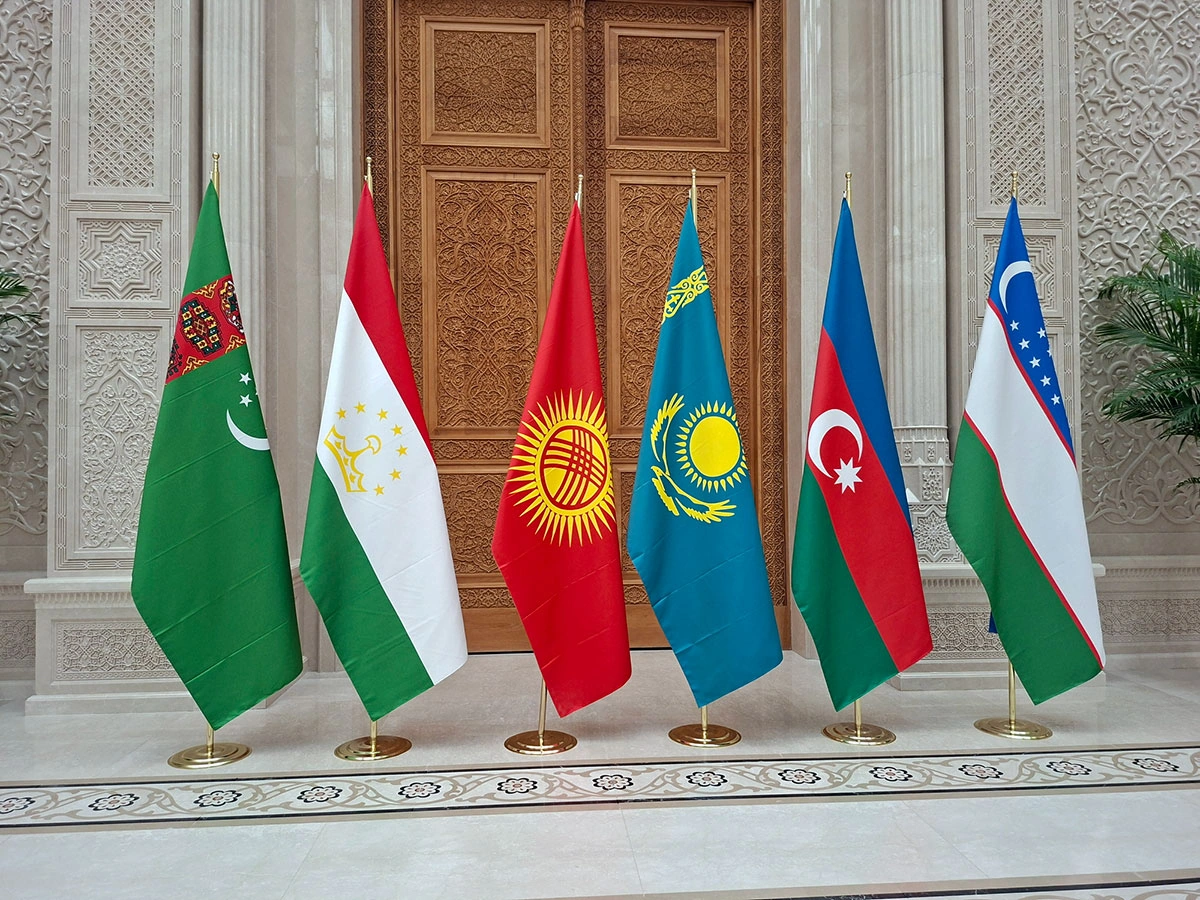
BAKU, Azerbaijan,
October 8. The National Tourism Zone of Avaza in
Turkmenistan will host the next Consultative Meeting of the Heads
of State of Central Asia and Azerbaijan on October 8. For Baku, the
meeting comes at a time of noticeably deepening ties between the
South Caucasus and Central Asia.
The decision taken in Tashkent in 2025 to grant Azerbaijan full
membership in the Consultative Meeting of the Heads of State of
Central Asia was a natural reflection of processes that have
gradually been reshaping the architecture of regional cooperation
in recent years. Azerbaijan's historical, cultural and economic
ties with Central Asian countries have gained a stronger
institutional foundation, evolving from bilateral and situational
cooperation into a broader regional partnership.
This is particularly important amid a changing geopolitical and
economic environment. Central Asia and the South Caucasus are
increasingly viewed not as separate spaces, but as interconnected
regions capable of jointly creating new trade routes, energy links
and logistics chains between East and West.
From historical ties to strategic
connectivity
Azerbaijan and the Central Asian states have traditionally
maintained close historical and cultural relations. However, the
current stage is characterized by the increasingly concrete
economic and infrastructure content of these ties.
Cooperation covers energy, oil and gas, renewable energy,
transport, trade and investment. Central Asian countries are also
actively involved in the reconstruction of Karabakh, while regular
mutual visits and the signing of new documents are gradually
elevating bilateral relations to a higher level.
Notably, bilateral trade between Azerbaijan and the Central
Asian countries reached $1.8 billion in 2025. Although imports from
the region still account for the bulk of trade, Azerbaijani non-oil
and gas products are also gradually strengthening their positions
in Central Asian markets. In particular, exports of such products
to Kazakhstan and Uzbekistan increased by more than 5%
year-on-year. Positive dynamics continued in 2026, with trade
turnover between Azerbaijan and Central Asian countries reaching
about $425 million in the first six months.
Thus, the relationship is no longer simply about expanding
trade. A deeper economic interdependence is taking shape, with
transport infrastructure becoming one of the main tools for further
convergence.
Azerbaijan and Central Asia as a single transport
space
Transport and connectivity can now become the main link between
Central Asia and the South Caucasus.
Thanks to its geographical position, Azerbaijan effectively
serves as one of the key links connecting Central Asian markets
with Türkiye and European destinations. For Central Asian
countries, this means broader access to global markets, while for
Azerbaijan it means greater transit potential and a stronger role
in the emerging Eurasian logistics architecture.
It is no coincidence that Azerbaijani President Ilham Aliyev
said on October 2 at the 8th congress of the New Azerbaijan Party
that the volume of transit cargo through the country is expected to
reach 16 million tons in 2026. The president set a medium-term
target of increasing this figure to 30 million tons.
These figures reflect a much broader process. The Middle
Corridor is gradually moving beyond its perception as simply an
alternative cargo route and becoming the foundation of a new system
of trade and economic links between Asia and Europe.
The World Bank emphasizes that the next stage in the development
of the Trans-Caspian International Transport Route requires not
only infrastructure construction, but also deep integration of
railways, ports, customs authorities, logistics operators and
border services. This also involves digitalization, harmonization
of procedures and greater predictability of transportation.
This is where the interests of Azerbaijan and Central Asia
largely coincide.
The countries of the region are interested in expanding
alternative routes for their trade, while Azerbaijan is interested
in increasing transit flows through its territory and further
developing its port, railway and logistics infrastructure.
At the same time, the prospects of the Middle Corridor cannot be
assessed solely in terms of cargo volumes. Its full development
could create new production and trade chains along the entire
route.
As World Bank representatives note, turning the Trans-Caspian
route into a competitive trade and economic corridor will require
the integration of operational processes, customs and border
procedures, documentation and digital systems. The private sector
will play a key role through investments in logistics, warehouses,
distribution centers and modern services.
The potential of this direction is also reflected in World Bank
projections. According to its assessment, if the necessary
infrastructure and institutional improvements are implemented,
delivery times between Asia and Europe via the Middle Corridor
could fall to 18-19 days by 2040, compared with about 47-50 days
currently.
Energy as a key element of regional
connectivity
Energy cooperation is meanwhile becoming one of the clearest
examples of how Azerbaijan's relations with Central Asia are moving
from political dialogue toward practical projects. This involves
traditional energy and oil and gas projects, as well as the
development of entirely new infrastructure for transmitting
renewable energy.
Turkmenistan is perhaps the most notable example in this regard.
Baku and Ashgabat already have experience of joint work on energy
resources in the Caspian Sea. Following the signing of a memorandum
of understanding in 2021, the sides began steadily developing
cooperation on the exploration and development of the Dostlug
field.
The previously disputed Kapaz/Serdar field was renamed Dostlug,
meaning “Friendship,” and the sides moved toward joint cooperation
in the energy sector. In 2023, Baku and Ashgabat also discussed the
possibility of SOCAR participating in projects at other Turkmen
fields.
Meanwhile, 2026 has already demonstrated that the energy agenda
between Baku and Ashgabat is reaching a new institutional level.
During Turkmen President Serdar Berdimuhamedov's state visit to
Azerbaijan on June 22-23, the sides signed an agreement on energy
cooperation, along with documents covering transport, industry,
investment and other areas.
As part of the June visit, Azerbaijan handed over the Dostlug
oil tanker to Turkmenistan. The move has significance beyond
symbolism: the development of maritime transportation creates
additional opportunities to integrate the energy potential of the
two countries with broader transport routes across the Caspian.
Energy relations between Azerbaijan and Uzbekistan have also
acquired a concrete investment dimension. In August 2026, Tashkent
and SOCAR discussed energy projects in Uzbekistan with an estimated
value of about $2 billion. Another important project involves SOCAR
and Uzbekneftegaz in the Ustyurt region. In May 2026, bp joined the
SOCAR-Uzbekneftegaz consortium for a project in Northern Ustyurt.
The production sharing agreement covers six blocks.
At the same time, energy relations between Baku and Tashkent are
developing beyond traditional energy. In September 2026, Azerbaijan
and Uzbekistan signed a Roadmap for Energy Cooperation for
2026-2028. The document covers development of the Central
Asian-Azerbaijani Green Energy Corridor, the oil and gas sector,
renewable energy, energy efficiency and investment. Integration of
the two countries' energy systems remains another area of
focus.
Azerbaijan, Kazakhstan and Uzbekistan have created a trilateral
framework for developing a new energy route between Central Asia
and Europe. In November 2024, during COP29 in Baku, the presidents
of the three countries signed an agreement on strategic partnership
in the development and transmission of green energy. Subsequently,
the power system operators of Azerbaijan, Kazakhstan and Uzbekistan
established a joint venture to implement the project.
It is precisely the combination of these two directions that
makes energy cooperation one of the most important elements of the
emerging Azerbaijan-Central Asia space.
From individual projects to a single regional
space
Baku's full-fledged participation has institutionalized an
already established practice of close interaction and created
additional opportunities for its further expansion. At the same
time, the logic of relations is gradually changing. While the focus
was previously placed primarily on bilateral ties, regional
connectivity is becoming increasingly important today.
Azerbaijan and Central Asia are effectively forming one of the
new hubs of the Eurasian space - from China across the Caspian Sea,
Azerbaijan and the South Caucasus toward Türkiye and Europe. In
this sense, the development of the Middle Corridor is not a
standalone transport project, but the physical foundation of
broader economic integration.
That is why the current meeting in Avaza comes at an important
moment, when relations between the two regions are moving from
historical and political affinity toward the formation of a
sustainable system of economic, energy and transport
interdependence.
Against the backdrop of geopolitical changes around the world,
such connectivity is acquiring strategic importance. The closer
Central Asia and the South Caucasus become, the more opportunities
both sides will have to shape new trade routes independently,
attract investment and strengthen the resilience of their
economies.
Ultimately, this is about creating a space in which Azerbaijan
and the Central Asian states do not simply complement each other,
but jointly shape a new geoeconomic reality at the heart of
Eurasia.