BAKU, Azerbaijan, September 29. The Asian
Infrastructure Investment Bank (AIIB) and Uzbekistan have updated
their Multi-Year Rolling Pipeline (MYRP), setting out potential
infrastructure investments of up to $5 billion for 2026–2029,
during a meeting in Doha today.
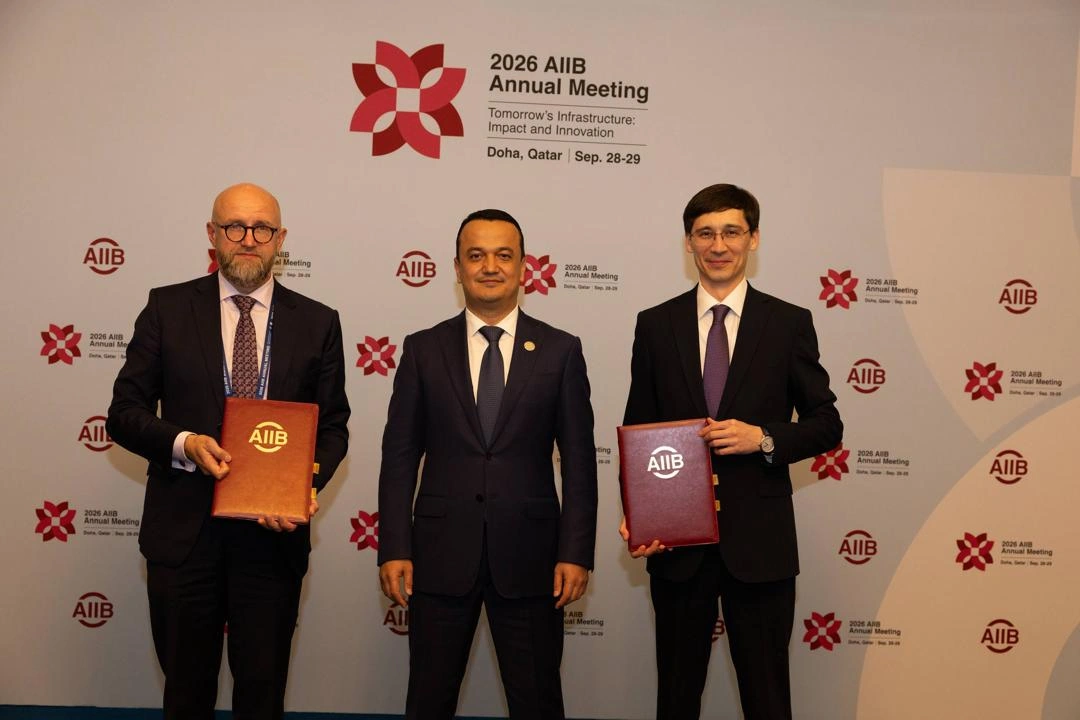
The agreement was signed on the sidelines of AIIB’s 11th Annual
Meeting in Doha, Qatar, according to AIIB.
The updated MYRP provides a framework for AIIB and Uzbekistan to
advance cooperation across priority infrastructure sectors over the
coming years.
The document was signed by AIIB Chief Investment Officer, Public
Sector (Region 2) and Project and Corporate Finance Clients
(Global), Konstantin Limitovskiy, and Uzbekistan’s Deputy Minister
of Investment, Industry and Trade, Shohrukh Gulamov. The signing
was witnessed by Laziz Kudratov, Uzbekistan’s Minister of
Investment, Industry and Trade and AIIB Governor for
Uzbekistan.
“Uzbekistan is an important founding member of AIIB and a valued
partner, with a strong pipeline of infrastructure investments in
line with the country’s development priorities,” Limitovskiy
said.
He added that the updated MYRP provides a framework for
cooperation through 2029, while project preparation support would
allow the sides to develop infrastructure projects from their early
stages.
Kudratov said Uzbekistan is becoming a key hub for trade, energy
and transport in Central Asia.
“It is no coincidence that we are AIIB's largest partner in
Central Asia. With the updated program, we want to take this
partnership even further, bring in more private investors and turn
our shared plans into real projects faster,” he said.
Under a separate Project Preparation Special Fund (PPSF)
agreement signed at the meeting, AIIB will provide a $1.5 million
grant to support preparation of the proposed Uzbekistan Resilient
Electricity Transmission Project.
The grant will finance technical studies and other preparatory
work for a potential investment aimed at strengthening the
capacity, reliability and climate resilience of Uzbekistan’s
electricity transmission network.
The project preparation work will focus on priority areas of the
transmission network, including the southern corridor between
Surkhandarya and Samarkand and the Ferghana Valley. It will assess
investment needs and climate risks, refine technical designs,
support renewable energy integration and identify solutions to
transmission bottlenecks.
Uzbekistan aims to increase the share of renewable energy in its
power mix from around 30% to 54% by 2030, requiring modernization
and expansion of its electricity transmission infrastructure.