BAKU, Azerbaijan, September 29. The decision by
Italiana Petroli (IP) to cap fuel prices across Italy is a
practical outcome of the strategic partnership between Azerbaijan
and Italy, which has been consistently developed under the policy
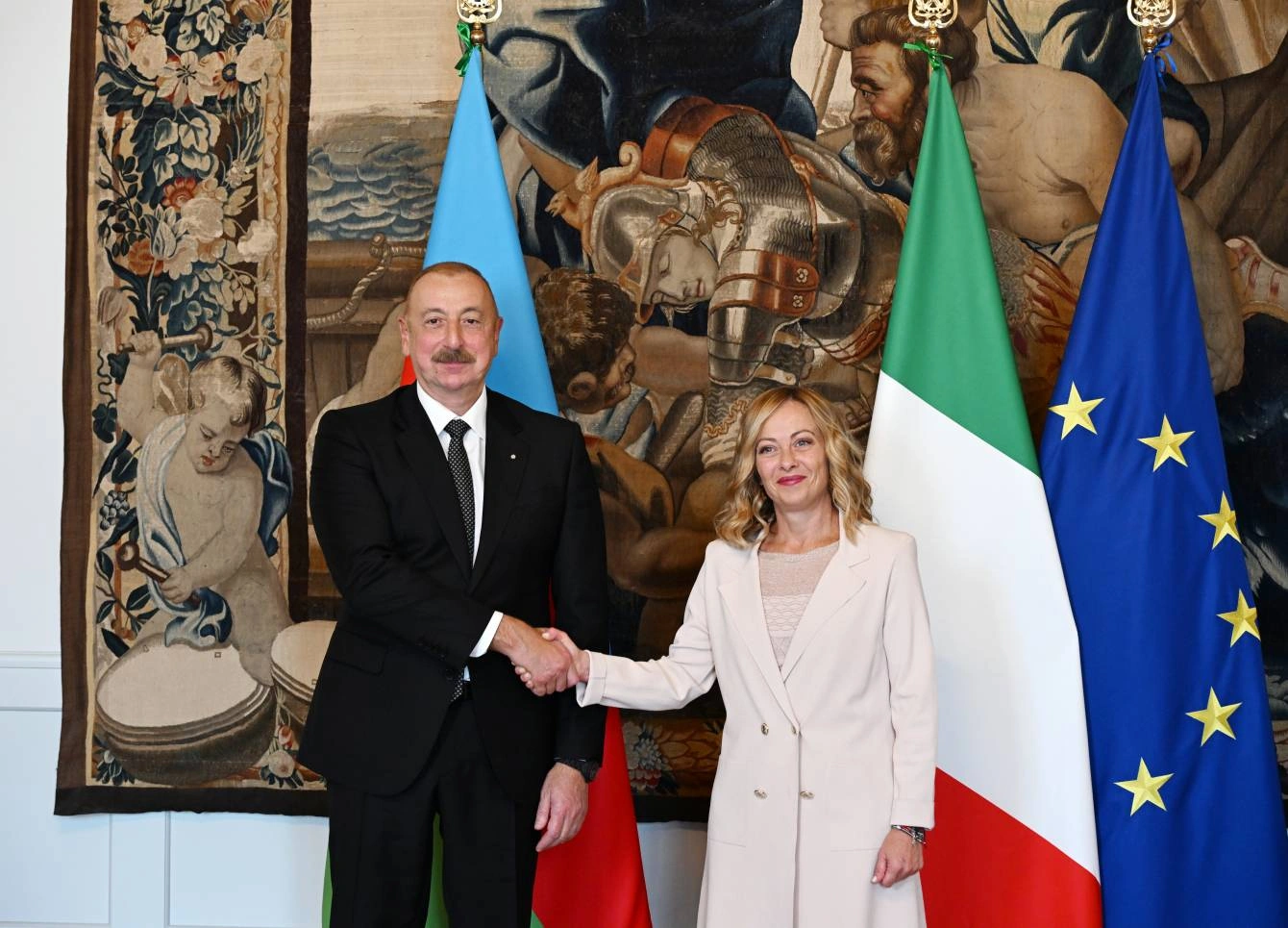
of Azerbaijani President Ilham Aliyev. Italian Prime Minister
Giorgia Meloni has welcomed the decision.
“Following Eni, IP has also chosen to cap fuel prices across the
entire national territory. This is an important signal of attention
to Italian families, confirming that it is possible to make a
concrete contribution to containing the rising cost of fuel. I wish
to thank the President of Azerbaijan, Ilham Aliyev, for this
gesture of attention that strengthens our cooperation, and the
president of Socar, Rovshan Najaf,” Meloni wrote on her official X
account on September 28.
For Italy, the decision is significant amid the government’s
focus on energy costs and household purchasing power. Capping fuel
prices directly reduces household expenses, but the economic impact
extends further: petrol and diesel prices affect carriers,
logistics, industry and services. Measures by major players in the
fuel market can help contain part of these transportation
costs.
The relevance of such measures is linked to rising fuel prices
in Italy amid geopolitical instability in the Middle East and
related disruptions to global supply chains. Meloni’s government
had repeatedly extended temporary cuts in fuel excise duties,
allocating around 2.8 billion euros to such measures, including
support for transport operators. These measures only partially
contained the increase, while average prices at filling stations
remained high. Against this backdrop, the authorities called on
major market operators to contribute to price stabilization. After
Eni introduced a price cap, IP’s similar move provided a practical
response to that call.
This is where IP’s role in the broader economic cooperation
between the two countries becomes particularly significant. SOCAR
acquired the Italian company from API Holding, making the deal one
of the notable steps taken by the Azerbaijani state oil company in
the European downstream market. According to Fitch Ratings, IP
operates two refineries in Ancona and Novara with a combined
capacity of around 10 million tons per year, approximately 4,500
filling stations, as well as significant storage and logistics
infrastructure. This gives SOCAR a direct presence in the Italian
economy.
The acquisition of IP has enabled SOCAR to operate within a
major national fuel network while establishing a long-term
partnership between the two sides. This presence is already
extending into other areas. SOCAR said its partnership with Italian
football for 2027–2030, with an option to extend it through 2032,
reflects the company’s commitment to its long-term operations in
Italy.
This development fits into a broader model of
Azerbaijani-Italian relations that is gradually moving beyond
traditional energy cooperation. Speaking during a joint press
statement with Meloni in Baku on May 4, President Ilham Aliyev,
referring to relations between the two countries, said: “One of the
primary directions of our relations is partnership in the energy
sector. Here, too, we have supported each other as reliable
partners for many years.”
Energy ties have provided the foundation for further expansion
of economic cooperation. According to President Ilham Aliyev,
Azerbaijan exported 25 billion cubic meters of natural gas in 2025,
of which 9.5 billion cubic meters went to the Italian market.
Azerbaijan ranks second among Italy’s oil and gas suppliers.
However, the importance of the Italian market for Baku extends
beyond energy supplies.
“The Italian market is of great interest to us. Under the
leadership of Madam Prime Minister, the Italian economy is
developing successfully. Over the past few years, the State Oil
Fund of Azerbaijan has invested approximately $3 billion into the
Italian economy. Issues regarding the attraction of these
investments into new projects were also discussed,” President Ilham
Aliyev said.
Energy cooperation is therefore gradually becoming the
foundation for a broader investment relationship. On September 25,
Maurizio Tamagnini, founder and CEO of Fondo Strategico Italiano,
said at the 2nd Azerbaijan International Investment Forum in Baku
that plans were being developed to establish manufacturing
facilities of Italian companies in Azerbaijan’s free economic
zones. FSI, together with AZPROMO and the State Oil Fund of
Azerbaijan, is working to expand cooperation between Italy,
Azerbaijan and Central Asia.
In this context, energy is becoming not a standalone area of
cooperation, but one element of broader industrial cooperation.
Italian companies including Eni, Leonardo and Tecnimont already
have a presence in Azerbaijan. The next stage could involve
localizing production, developing supply chains and turning
Azerbaijan into a manufacturing and logistics hub serving the wider
region.
“If we can really connect two regions, such as continental
Europe, Italy, with Azerbaijan and Central Asia, and Italian
technology companies come here following the major companies that
are already operating here, this will be a modern way of building a
partnership,” he said.
This approach is consistent with the position outlined by Meloni
during her May 4 visit to Baku: “We must work not only on supply
volumes but particularly on the quality of industrial partnership
across all sectors.” She highlighted Azerbaijan’s role as a hub
between Europe and Asia and Italy’s readiness to serve as a
“privileged gateway to the European market.”
Against this backdrop, SOCAR’s acquisition of IP takes on
additional significance. Azerbaijan gains a direct presence within
one of Europe’s largest economies, while Italy gains an opportunity
to deepen cooperation with an energy company that is both a major
energy supplier and an investor.
Cooperation is also expanding beyond bilateral projects. On
September 26, SOCAR and Eni completed a deal under which the
Azerbaijani company acquired a 10-percent stake in the development
of the Baleine field in Côte d’Ivoire. This broadens the geographic
scope of the two companies’ shared interests and gives SOCAR access
to Africa’s upstream sector.
Taken together, these developments point to a changing structure
of Azerbaijani-Italian relations: from energy trade and investment
toward direct corporate presence, industrial cooperation,
infrastructure and long-term commercial ties.
President Ilham Aliyev’s consistent policy has played a key role
in shaping this model. Over many years, Azerbaijan and Italy have
built a strategic partnership in which energy cooperation serves as
the foundation for broader economic engagement. This approach has
created the conditions for a transition from oil and gas supplies
to investment, industrial cooperation and the direct presence of
Azerbaijani capital in the Italian economy. IP’s decision on fuel
prices has become one of the most visible practical manifestations
of this long-term approach.
For the Italian economy, the development of this model means
opportunities to attract additional investment, expand industrial
cooperation and strengthen energy resilience. For Azerbaijan, it
means a broader presence in the European market and new
opportunities for companies and capital to enter international
markets.
In this sense, IP’s fuel pricing decision is not an isolated
commercial move, but part of an established network of business
ties. As cooperation deepens, the energy partnership between
Azerbaijan and Italy can provide a foundation for new manufacturing
projects, investment and technology exchange, creating additional
economic opportunities for both countries.