KALBAJAR, Azerbaijan, September 12. Kalbajar
and Karabakh represent a historical and cultural heritage of great
value to the entire Turkic world, President of the International
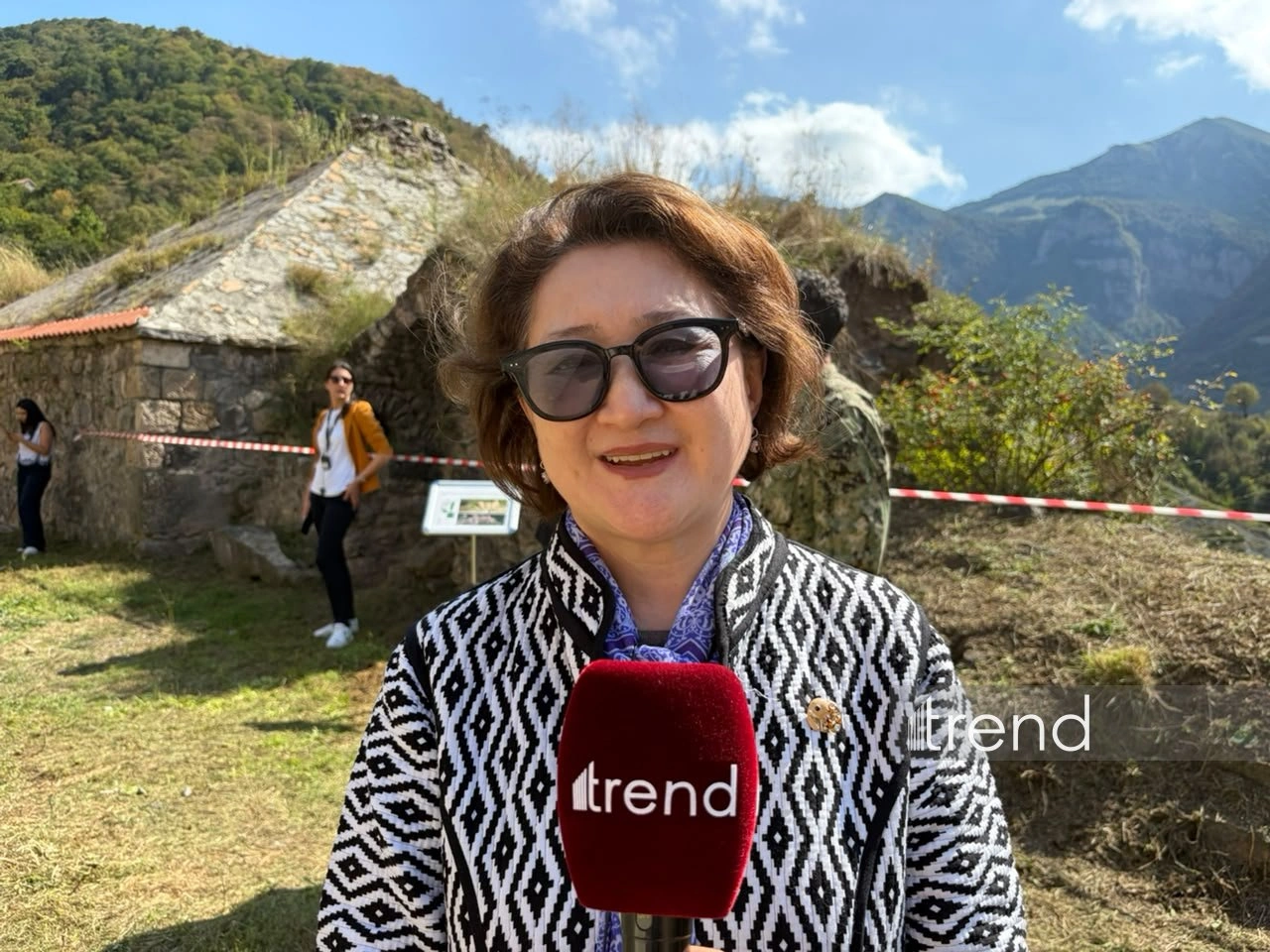
Turkic Culture and Heritage Foundation, Aktoty Raimkulova, told
Trend during the
second day of a visit to Karabakh and East Zangezur by
representatives of the diplomatic corps accredited in
Azerbaijan.
She noted that visits to Karabakh by representatives of the
diplomatic corps and international organizations are of great
importance for witnessing firsthand the large-scale restoration and
reconstruction work underway in the region.
"Every time we visit these lands, we see the changes taking
place. Magnificent new structures are being built, and significant
efforts are being made to improve living conditions for the people.
At the same time, we are witnessing serious efforts to preserve and
restore the cultural heritage that was damaged during the years of
occupation," said Raimkulova.
The official pointed out that this was approximately her seventh
visit to Karabakh and her second to Kalbajar.
She emphasized that the International Turkic Culture and
Heritage Foundation is also contributing to the restoration of
cultural heritage in Karabakh.
"We are restoring the 18th-century Haji Alakbar Mosque in
Fuzuli. This is a major project that has been underway for three
years in collaboration with the Azerbarpa Scientific-Research
Design Institute LLC. The work is nearing completion," she
explained.
Raimkulova highly appreciated the restoration efforts regarding
historical monuments in Kalbajar. According to her, significant
progress has been observed in the restoration of these monuments
compared to the previous year.
"It's evident just how much substantial work has been
accomplished over the past year. Restorers are treating both the
preserved sections and the parts that were previously distorted—or
subjected to so-called 'restoration'—with great sensitivity. The
monuments are now being returned to their original appearance.
History tolerates no falsification; it must be presented exactly as
it is," she stated.
The foundation's president noted that the ongoing research and
restoration work also makes it possible to reveal the various
stages of development these historical monuments underwent over
time.
Raimkulova stressed that the historical and cultural monuments
located within the territory of Azerbaijan are the wealth of the
Azerbaijani people.
"Every monument on Azerbaijani land is, first of all, the wealth
and cultural heritage of the Azerbaijani people. At the same time,
this heritage is part of the shared cultural wealth of the entire
Turkic world and all Turkic peoples. Monuments located in
Kazakhstan, Uzbekistan, Kyrgyzstan, Türkiye, and other Turkic
states also constitute our shared tangible and intangible cultural
heritage. We must cherish and protect them as the apple of our
eye," she clarified.
She added that the International Turkic Culture and Heritage
Foundation is carrying out systematic work in this area. As part of
the events marking the 100th anniversary of the First Turkology
Congress held in Baku, the foundation prepared a 'Catalogue of
Shared Turkic Cultural Heritage.' The catalogue includes a total of
70 examples of tangible and intangible cultural heritage from seven
countries.
"Kalbajar and Karabakh are of great value to the Turkic world;
they represent a heritage—our cultural and historical heritage.
This is a land we must preserve for both present and future
generations. I take pride in the work Azerbaijan is doing to
protect the heritage in these lands," Raimkulova emphasized.
Representatives of the diplomatic corps accredited in Azerbaijan
are visiting Karabakh and East Zangezur accompanied by Hikmet
Hajiyev, Assistant to the President of the Republic of Azerbaijan
and Head of the Foreign Policy Affairs Department of the
Presidential Administration.
The visit involves a 150-member delegation representing 58
countries and nine international organizations.
On September 11, the diplomatic representatives visited
Khankendi and Shusha. In Khankendi, the delegation first toured the
Khankendi Railway and Bus Terminal Complex, where construction work
is underway. They then visited the Cultural Center in Khankendi.
The diplomats also visited Victory Park and took a group photo in
front of the Victory Arch. The visit also included a tour of
Karabakh University.
In Shusha, the delegation inspected ongoing restoration and
reconstruction work and visited the First Residential Quarter, the
construction site of the New Shusha Mosque, the Molla Panah Vagif
Museum-Mausoleum Complex, Jidir Duzu, Karabakh Street, Sadigjan’s
House, the Ashaghi Govhar Agha Mosque, Shusha Central Square, the
Shusha Creative Center and the Uzeyir Hajibeyli House Museum.
The diplomats also took a group photo in front of the Shusha
Fortress walls and attended an official reception held to mark the
Independence Day of the United Mexican States.