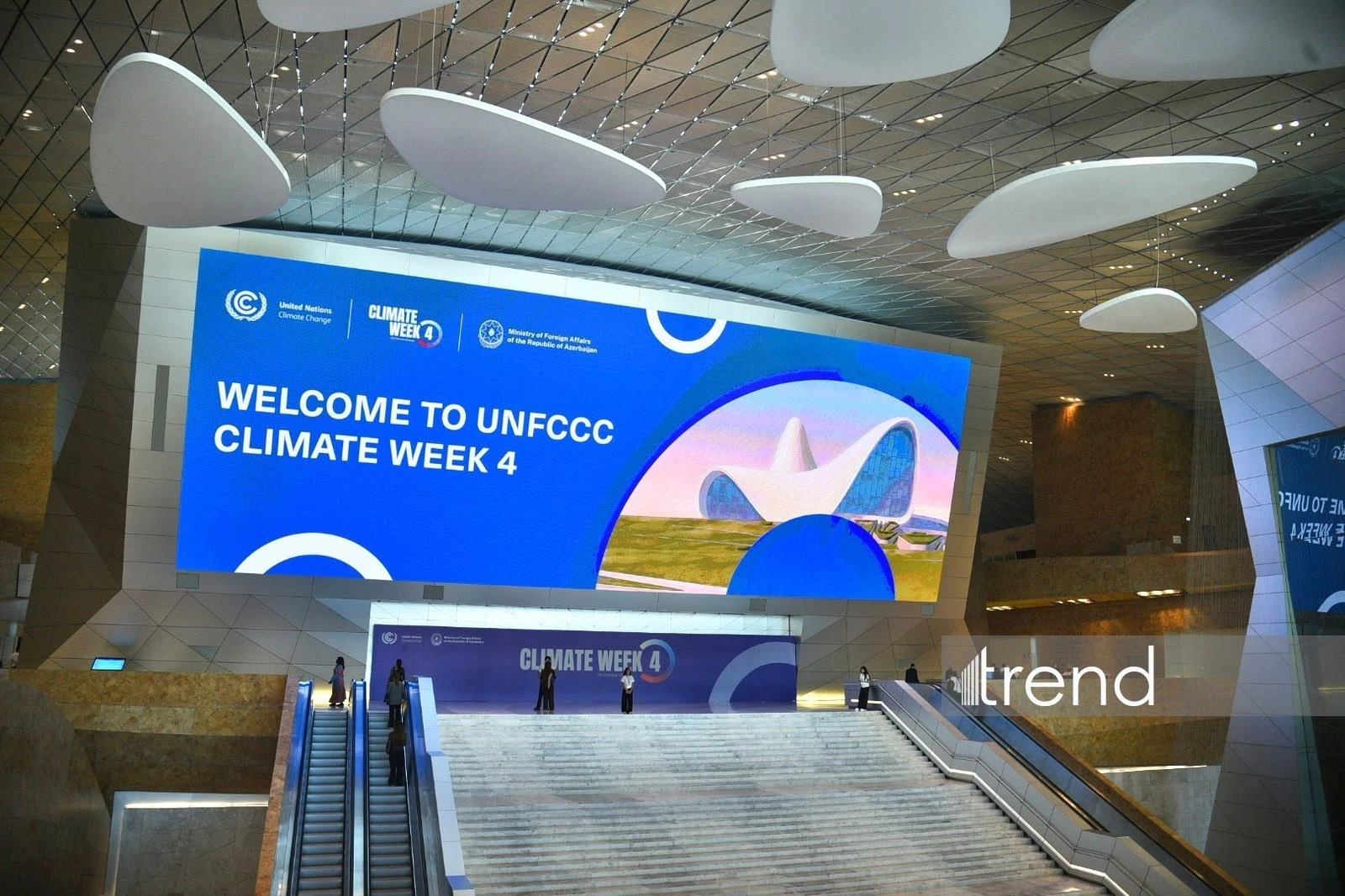
BAKU, Azerbaijan, September 12. The legacy of
COP29, held in Baku, is becoming increasingly evident; one
indication of this is the Fourth UN Climate Week, hosted in the
Azerbaijani capital ahead of COP31 in Türkiye.
The very fact that a regional UN Climate Week was held in
Baku—in the run-up to the conference in Antalya—carries both
symbolic and practical significance. Azerbaijan did not simply hand
off the climate agenda to the next presidency upon the conclusion
of COP29. On the contrary, the country has continued to engage in
processes linking the decisions made in Baku to the subsequent
stages of global climate policy.
Representatives from various countries and international
organizations—not just from Azerbaijan—highlighted this during
Climate Week. Their assessments reveal a broader picture: for
Azerbaijan, COP29 is not merely a one-off event, but a pivotal
moment marking the country's continued role in shaping the global
climate agenda.
One of the most significant outcomes of COP29 was the agreement
reached on the New Collective Quantified Goal (NCQG) for climate
finance. Speaking at the opening of Baku Climate Week, Simon
Stiell, Executive Secretary of the UN Framework Convention on
Climate Change (UNFCCC), directly linked the current phase of
climate action to the decisions adopted in Azerbaijan.
He noted that it was during COP29 that nations made progress on
climate finance: a new global goal of $300 billion annually by 2035
was established, a call was made to raise the total volume of
climate finance to at least $1.3 trillion annually by 2035, and
work began on the "Baku-to-Belém" roadmap.
The principle of continuity is particularly important here.
In this context, Baku serves not as the endpoint of the
negotiation process, but as its starting point. While the primary
focus at COP29 was on reaching agreements, the subsequent phase
involves giving those agreements practical substance.
This is precisely why the remarks by the Turkish
representative—stating that COP31 will prioritize the
implementation of existing decisions over the adoption of new
ones—carry particular significance. Thus, the "Antalya agenda"
largely builds upon the logic established in Baku.
Head of the Support Services Department at Türkiye’s Ministry of
Environment, Urbanization and Climate Change, Ahmet Sami
Kulaklıoğlu, explicitly told Trend that Türkiye is continuously drawing on
Azerbaijan’s experience and expertise as it prepares for COP31.
He noted that since the decision was made to host COP31 in
Türkiye, the two sides have maintained constant communication, with
Türkiye aiming to address conference preparations jointly with
Azerbaijan and guided by its experience.
This demonstrates that Baku’s organizational and negotiating
experience is viewed as a practical asset for the incoming
presidency.
This assessment was confirmed by the Chairman of the Environment
Committee of the Grand National Assembly of Türkiye, Mehmet Galip
Ensarioğlu.
He noted that Türkiye participated in COP29 and witnessed the
successful organization of the conference in Azerbaijan. He
specifically highlighted the decision on climate finance reached in
Baku and stated that Türkiye intends to use Azerbaijan’s successful
organizational experience as a model for hosting COP31.
Thus, the legacy of COP29 encompasses at least two
dimensions.
The first is the negotiating dimension: the decisions,
agreements, and processes initiated in Baku.
The second is the institutional and organizational dimension:
the experience of hosting one of the largest international climate
conferences, fostering dialogue among states, the business
community, the financial sector, and civil society, and sustaining
the negotiation process after the conference concluded.
It's precisely the combination of these two components that
makes Azerbaijan’s experience potentially applicable beyond the
scope of a single conference. Perhaps the most telling assessment
came from a member of the UK House of Lords and former
Secretary-General of the Commonwealth, Patricia Scotland.
She noted that Azerbaijan’s efforts during COP29 were pivotal,
and that the country’s subsequent activities paved the way for
achieving the set goals and established the necessary
framework.
Scotland also specifically highlighted that Azerbaijan didn't
stop after COP29; instead, it continued its work as a partner in
the Belém Process and maintains its cooperation in the lead-up to
COP31 in Antalya.
This assessment is significant precisely because it demonstrates
that the international perception of Azerbaijan’s role extends
beyond the mere fact of hosting COP29.
Once a conference concludes, the presidency inevitably faces the
question: what remains after the final plenary session?
In Azerbaijan’s case, the answer lies in ongoing climate
diplomacy, participation in follow-up processes, engagement with
the COP30 and COP31 presidencies, and now the hosting of Climate
Week in Baku.
Azerbaijan's Deputy Foreign Minister, COP29 lead negotiator
Yalchin Rafiyev described the hosting of UN Climate Week in Baku as
a logical continuation of the country's active climate
diplomacy.
According to him, 62 events were held as part of Baku Climate
Action Week, with some directly linked to the practical
implementation of decisions from previous COP summits.
COP29 took place in Baku, and COP31 will be held in Antalya.
COP30 is scheduled to take place in Belém in the interim. During
this period, Baku is once again serving as a venue for discussions
on the implementation of adopted decisions, climate finance, the
energy transition, adaptation, and international cooperation.
This creates a distinct chain: Baku – Belém – Antalya.
However, within this chain, Baku remains more than just the site
of a past COP; it continues to serve as a platform for dialogue and
the sharing of expertise.
This is particularly important for developing and vulnerable
nations, for whom the climate agenda is increasingly becoming a
matter not only of the environment but also of access to finance,
energy security, infrastructure resilience, and economic
development.
Another element of the COP29 legacy is evident in Azerbaijan's
energy policy.
Speaking at the opening of Climate Week, Energy Minister Parviz
Shahbazov announced that Azerbaijan plans to begin operating two
green energy corridors starting in 2032.
These include the first phase of the Caspian–Black Sea–Europe
project, with a total capacity of 3,900 MW, and the Central
Asia–Azerbaijan green energy corridor.
At the same time, Azerbaijan is exploring the development of new
energy links toward Türkiye and Europe via Georgia, the Zangezur
Corridor, and Nakhchivan.
This highlights another aspect of Azerbaijan's approach: climate
policy is increasingly viewed through the lens of regional
connectivity.
In this context, the energy transition is about more than just
reducing emissions. It also involves creating infrastructure that
connects markets, enhances the resilience of energy systems, and
opens up new opportunities for cross-border electricity trade.
Here, a link to the upcoming COP31 emerges once again.
Shahbazov himself noted that the energy transition and
electrification would be key priorities of the Turkish presidency,
emphasizing that Azerbaijan would continue to build upon the "rich
legacy of COP29" by translating the energy transition agenda into
concrete projects and regional interconnectivity.
However, the climate legacy of COP29 cannot be reduced solely to
finance and energy.
Discussions in Baku also addressed how countries can adapt to
climate changes that are already underway.
Azerbaijan’s Deputy Minister of Ecology and Natural Resources,
Umayra Taghiyeva, announced plans to implement a project—in
partnership with UNEP and the Green Climate Fund—aimed at
strengthening climate data and multi-hazard early warning
systems.
Particular attention is being paid to the integration of
artificial intelligence into climate risk forecasting.
Azerbaijan has already automated 82 percent of its national
meteorological observation systems, and the next phase involves
establishing more advanced early warning mechanisms.
A connection to COP29 decisions is evident here as well:
Taghiyeva herself noted that the new climate finance goal agreed
upon in Baku creates opportunities for vulnerable nations regarding
adaptation and early warning systems.
This serves as a significant example of how a global climate
agreement can translate into action at the national level.
There is also a less visible but fundamentally important element
of the COP29 legacy: transparency.
Head of the Climate Diplomacy Department at Azerbaijan’s
Ministry of Foreign Affairs, Elchin Allahverdiyev, noted that the
country had submitted its transparency reports ahead of schedule.
According to him, this helped ensure that more than a hundred
countries submitted their reports by the end of the relevant
period, while the process itself fostered trust among the parties.
This is of fundamental importance for international climate
policy.
Ultimately, the main outcome of Baku Climate Week lies not in
the number of events held or even the number of participants. Its
significance lies in demonstrating that the climate agenda
continues to evolve beyond COP29 and that Azerbaijan remains an
active participant in this process.
From Baku to Belém, and from Belém to Antalya. Yet, part of the
road to COP31 still runs through Baku.