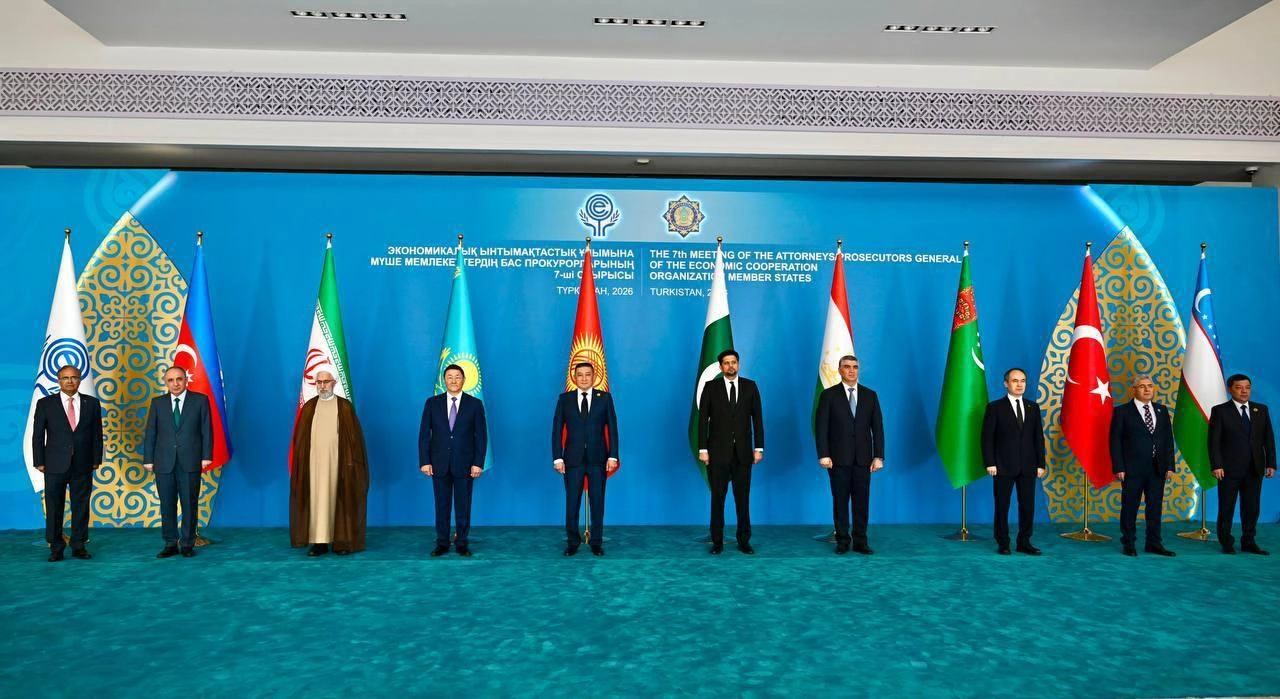
BAKU, Azerbaijan, September 11. Kazakhstan has
proposed creating a network of contact points among the central
authorities of
Economic Cooperation Organization (ECO)
member states to speed up the response to online fraud and
financial crime, the Kazakh Prosecutor General’s Office said.
The proposal was made during the seventh meeting of prosecutors
general of ECO member states, held in Turkestan under the
chairmanship of Kazakhstan’s Prosecutor General Berik Assylov.
“Kazakhstan proposed moving from predominantly formalized
procedures for international legal assistance to more operational
cooperation,” the Prosecutor General’s Office said.
The proposed network would operate under the ECO Secretariat and
facilitate the rapid exchange of information on criminals, response
to suspicious transactions and, where necessary, the formation of
joint investigative and operational groups.
The meeting focused on practical measures to combat online
fraud, digital and financial crime by combining resources,
information and modern technologies. Prosecutors and
representatives from Kazakhstan, Azerbaijan, Uzbekistan,
Tajikistan, Kyrgyzstan, Turkmenistan, Iran, Türkiye and Pakistan
participated in the meeting, along with the ECO Secretary General
and a representative of the Coordinating Council of Prosecutors
General of CIS member states.
Kazakhstan also presented its multi-level system for protecting
citizens against online fraud, including biometric identification
for online loans, a cooling-off period, voluntary refusal to obtain
loans, anti-fraud systems operated by telecom providers and the
National Anti-Fraud Center.
These measures helped prevent the issuance of more than 700
fraudulent loans worth over $850,000, while more than 600 money
mules were held accountable. Kazakh courts also upheld claims to
recover unjust enrichment worth more than $12 million, according to
the Prosecutor General’s Office.
A Unified Analytical Platform for Monitoring Online Fraud
operates at the Crime Threat Forecasting Center. It combines data
from legal statistics, the banking sector, telecom operators, law
enforcement and government agencies.
The use of artificial intelligence enables authorities to
identify common digital and financial infrastructure used by
criminals and predict new fraud schemes, the office said.
The proposed mechanisms received support from the participants.
The sides agreed to continue exchanging experience in combating
online fraud and financial crime, digital forensics, and the use of
artificial intelligence and analytical technologies.