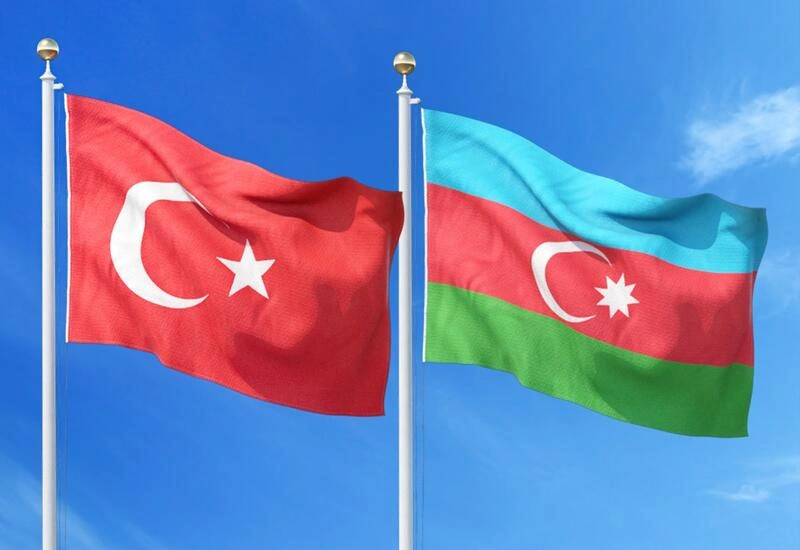
BAKU, Azerbaijan, September 11. The energy
partnership between Azerbaijan and Türkiye is entering a new phase:
while oil and natural gas formed its foundation in recent decades,
the joint agenda is now increasingly focused on electricity,
renewable energy sources, interconnections, and the export of green
energy to Europe.
Namely, this transition was a key topic at the 5th
Azerbaijan-Türkiye Energy Forum, held today in Baku.
Meanwhile, it's not a matter of replacing traditional energy
with a "green" agenda. Rather, Azerbaijan and Türkiye are building
the next stage of the energy architecture they have already
established: existing oil and gas routes are serving as the
foundation for developing new energy links, and the model of
cooperation itself is gradually shifting from hydrocarbon trade to
electricity trade.
From BTC and TANAP to new energy map
For decades, energy cooperation between the two countries has
centered on major infrastructure projects—such as the
Baku-Tbilisi-Ceyhan oil pipeline, the Baku-Tbilisi-Erzurum gas
pipeline, and the Southern Gas Corridor—along with their associated
production and processing assets.
This infrastructure has transformed not only the energy
relationship between Baku and Ankara but also the standing of both
nations on the regional energy map. Azerbaijan gained the ability
to bring its resources to international markets, while Türkiye
strengthened its role as an energy transit hub connecting the
Caspian region with Europe.
According to data presented at the forum, a total of 561 million
tons of oil and 196 billion cubic meters of gas have already been
supplied from Azerbaijan to Türkiye—and via Türkiye to
international markets—using existing oil and gas infrastructure.
Türkiye has received 130 billion cubic meters of Azerbaijani gas,
40 billion cubic meters of which were transported via the
Trans-Anatolian Natural Gas Pipeline (TANAP), the longest section
of the Southern Gas Corridor. In the first eight months of 2026
alone, Azerbaijan supplied 6.2 billion cubic meters of gas to
Türkiye, while another 7.5 billion cubic meters were routed through
Turkish territory to European countries, and 1 billion cubic meters
went to Syria.
Thus, the gas infrastructure continues to fulfill its function.
Moreover, the geographic reach of Azerbaijani gas supplies is
expanding, and Türkiye itself remains a key transit link between
Azerbaijan and external markets. It is against this backdrop that
the next step becomes clearer.
Electricity becomes new strategic resource
As Türkiye’s Minister of Energy and Natural Resources, Alparslan
Bayraktar, said in an exclusive interview with Trend on the
sidelines of the event, the global energy sector is undergoing a
profound transformation: industry, transport, buildings, and daily
life are becoming increasingly electrified.
This means that competition will gradually shift beyond the mere
possession of energy resources to focus on the capacity to generate
electricity, transmit it over long distances, and ensure the
reliability of the associated grids.
"The issue now goes beyond mere energy production. It is crucial
to deliver the generated energy to demand centers in the safest,
most sustainable, rapid, and efficient manner," Bayraktar noted.
That's precisely why interconnectors are becoming the modern
equivalent of the pipelines that defined the previous energy era
for Baku and Ankara.
The minister emphasized that cooperation between Azerbaijan and
Türkiye already extends far beyond oil and gas, encompassing
everything from mining and renewable energy sources to energy
efficiency, electricity markets, and transmission and distribution.
According to him, the work of the six working groups within the
framework of the energy forum not only advances existing
cooperation but also "shapes the energy future of both countries
and the region."
This represents a significant shift in the partnership's very
architecture. In the oil and gas model, the primary assets were the
resource itself and the pipeline. The new model adds generation
capacity, electrical grids, storage systems, digital technologies,
and the capability to balance energy systems to the mix.
Most notably, Türkiye doesn't view the future electric power
infrastructure as an exclusively bilateral project. Bayraktar
explicitly stated that the model Azerbaijan established for
exporting traditional energy resources is also intended to be
applied to the green energy sector.
"Azerbaijan is a strategic partner for Europe in natural gas
supplies. The country supplies gas to 16 different nations and
plays a vital role in ensuring Europe's energy security. We plan to
apply a similar model to the electricity sector—specifically
regarding green energy," the minister said.
This statement effectively outlines the new strategic logic
behind Azerbaijan-Türkiye energy cooperation. Azerbaijan possesses
significant solar and wind energy potential in the Caspian region
and other parts of the country, while Kazakhstan and Uzbekistan
also hold substantial energy potential of their own. Türkiye, for
its part, boasts a large domestic market, a developed industrial
sector, and existing infrastructure for accessing the European
market. This creates a value chain in which Azerbaijan can act not
only as an electricity producer but also as a hub for consolidating
and exporting power, while Türkiye serves as an energy and transit
hub connecting to Europe.
Bayraktar noted that three major projects being implemented with
Türkiye's active participation are set to provide Europe with
access to the carbon-neutral electricity it requires.
"Electric TANAP" as new version of energy
corridor
The most telling description of this new model came from
Bayraktar regarding the four-party project involving Azerbaijan,
Georgia, Türkiye, and Bulgaria. The minister dubbed it a potential
"electric TANAP." The significance of the comparison is clear:
TANAP became a key artery of the Southern Gas Corridor, enabling
Azerbaijani gas to transit through Türkiye and reach the European
market. Now, the aim is to establish a similar function for
electricity.
The initial phase of the project focuses on maximizing the
efficiency of existing infrastructure. A 700 MW electrical
interconnection already operates between Türkiye and Georgia, and
connections exist between Türkiye and Bulgaria; Azerbaijan is
linked to Georgia, while a Nakhchivan–Türkiye connection is being
developed in parallel.
Subsequent stages will involve a gradual increase in
transmission capacity.
This approach is fundamentally important: new energy
infrastructure doesn't necessarily have to be built from scratch
all at once. Utilizing existing interconnections allows for the
gradual formation of a unified system, with capacity expanded in
step with rising production and demand. In the long term, this
could transform the electricity grid of the South Caucasus and
Türkiye into a new transit route connecting the Caspian region with
Europe.
The project to integrate Nakhchivan’s power grid with Türkiye’s,
along with the associated exchange of electricity between the
parties, holds particular significance.
The importance of this project extends beyond Nakhchivan itself.
As Bayraktar noted, the line could eventually be linked to the
Azerbaijani mainland via the Zangezur Corridor. Thus, the
development of power grid connections could take on an additional
dimension should new regional transport and communication routes be
established.
An even more ambitious undertaking is the third project
highlighted by Bayraktar: an undersea electricity link across the
Black Sea.
The project entails the construction of an interconnector
originating in Azerbaijan and Georgia that would run along the
Black Sea seabed toward Romania and Hungary. Türkiye has also
expressed its intention to participate in this initiative.
Taken together, these three avenues—Nakhchivan–Türkiye,
Azerbaijan–Georgia–Türkiye–Bulgaria, and the Black Sea cable—create
several potential routes for transporting electricity from the
Caspian region and Central Asia to Europe. It is in this context
that bilateral cooperation takes on a truly Eurasian dimension.
Bayraktar noted that Azerbaijan's agreements with Kazakhstan and
Uzbekistan create additional opportunities to pool the energy
potential of the Turkic world. "If we combine this with the
agreement we signed with Kazakhstan and Uzbekistan, I believe it
will connect the entire Turkic world," the minister said.
Central Asia can become next source of
resources
At the same time, the new electric power architecture does not
diminish the importance of hydrocarbons. On the contrary, in
Ankara’s energy vision, traditional and new resources are beginning
to complement one another. The potential of Turkic states is not
limited to oil and gas; Kazakhstan possesses significant oil
resources and is a major uranium supplier, Turkmenistan holds vast
natural gas reserves, and the region as a whole possesses critical
minerals.
For Türkiye, this presents an opportunity to act simultaneously
as a consumer of these resources and as a transit hub for their
export to international markets. In this context, the
Baku-Tbilisi-Ceyhan oil pipeline remains significant. According to
Turkish data, approximately 500,000–600,000 barrels of oil are
supplied to global markets daily via Ceyhan, and the potential to
channel oil from Central Asia and other Turkic states into this
infrastructure is particularly noteworthy.
In other words, the new energy model is not being built by
abandoning the old one; rather, existing infrastructure must be
utilized more intensively while simultaneously being supplemented
by new routes.
Why this matters for Europe
For the European energy market, the significance of this
transformation lies primarily in diversification. In the gas
sector, Azerbaijan has already demonstrated its ability to act as
an independent supplier and expand its export reach. A similar
model can now be applied to electricity. Here, the advantage of the
Azerbaijan-Türkiye model lies not only in the availability of
renewable resources but also in the existence of multiple
infrastructure layers—ranging from power generation to transmission
via regional grids.
This is precisely why the development of interconnectors has
become a strategic priority. The more interconnected the systems,
the greater the capacity to redistribute electricity across
markets, integrate variable generation sources, and enhance the
resilience of energy supplies.
For Azerbaijan, this implies a potential shift from being solely
an oil and gas exporter to playing a broader role as an energy
supplier—including electricity from renewable sources. For Türkiye,
it means consolidating its status as an energy hub connecting the
Caspian region and Central Asia with European markets.
Another key takeaway from the forum is that the energy
transition is reshaping the very structure of investment.
As Azerbaijan’s Energy Minister Parviz Shahbazov emphasized,
digitalization, artificial intelligence, data centers, and
expanding electrification are creating new demands on energy
systems. Consequently, new generation capacity alone will not
suffice.
Robust grids, energy storage systems, new cross-border
interconnections, and digital management of energy flows are
essential. This is precisely why cooperation between Azerbaijan and
Türkiye is gradually shifting from generation to system
infrastructure.
Thus, the 5th Azerbaijan-Türkiye Energy Forum demonstrated that
energy cooperation between the two nations is moving beyond the
traditional "supplier–transit country" framework.
In the 1990s and 2000s, the partnership was anchored in oil and
gas. Subsequently, a vast pipeline network was established, linking
the Caspian region to Türkiye and Europe. Today, this model is
taking on a new dimension. The primary focus of cooperation is no
longer a single resource, but an integrated energy system
encompassing generation, grids, trade, transit, digital
technologies, and the European market. Crucially, Azerbaijan and
Türkiye are not starting this process from scratch; they are
leveraging the infrastructure, political, and institutional
foundations established over decades.
In this sense, the term "electric TANAP" is more than just a
fitting metaphor. It captures the fundamental logic of the next
phase: just as TANAP became a physical artery for transporting
Azerbaijani gas to Türkiye and Europe, new electricity
interconnectors could serve as a similar system for electricity
from Azerbaijan—and, looking ahead, from Central Asia.
This will add a second dimension to the East-West energy
corridor: alongside oil and gas flows, electricity—including green
energy—will begin to move along the route.
This marks the key shift in the Azerbaijan-Türkiye energy
partnership: it is gradually evolving from the joint development
and transport of resources to the collaborative shaping of a new
energy map for Eurasia.