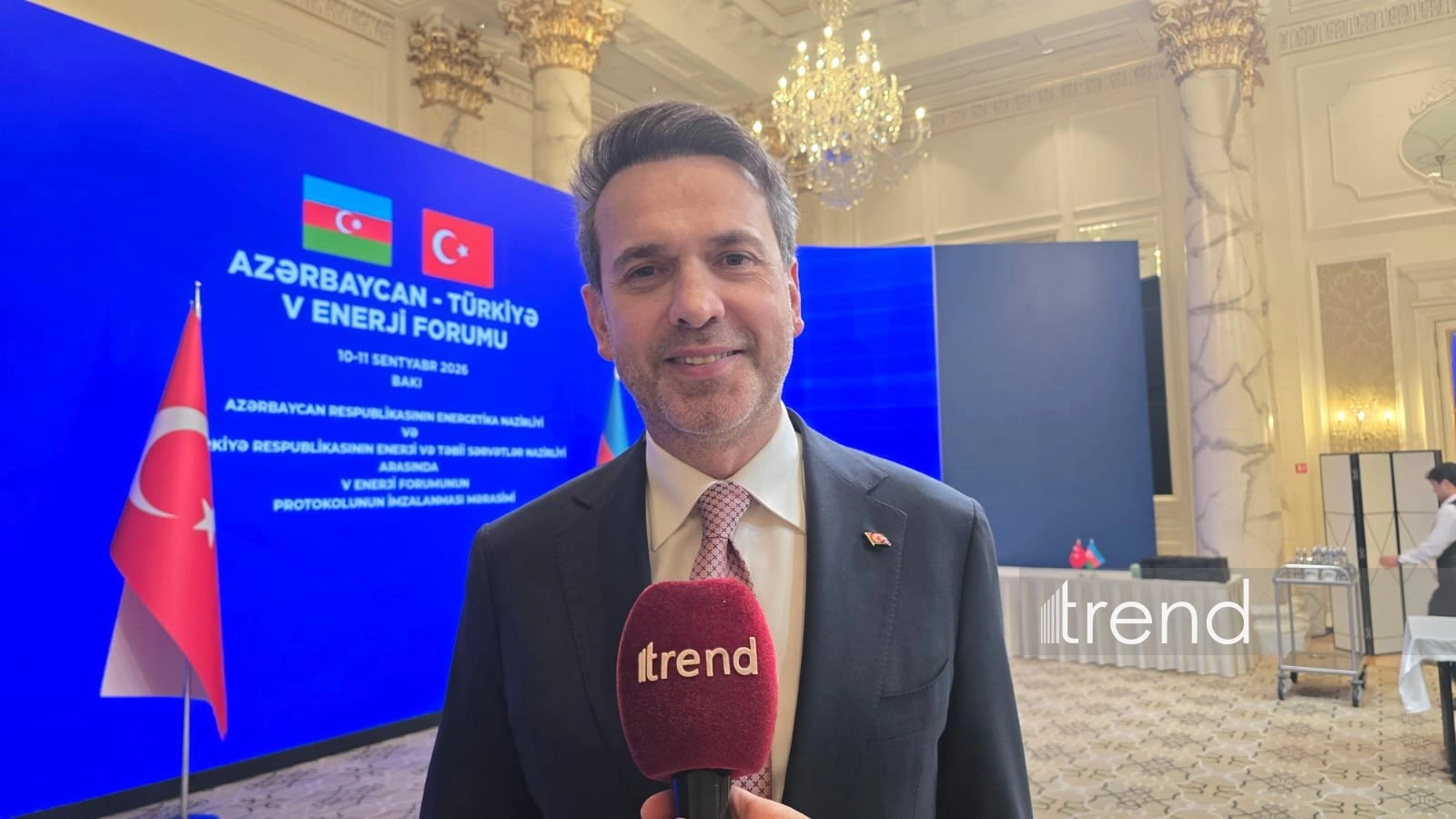
BAKU, Azerbaijan, September 11. Three key
projects for exporting Azerbaijan's green energy to Europe are
successfully progressing, Turkish Minister of Energy and Natural
Resources, Alparslan Bayraktar, told Trend in an interview on the sidelines of the
5th Azerbaijan-Türkiye Energy Forum.
He said that energy cooperation between Azerbaijan and Türkiye
is entering a new phase, and the parties are implementing a number
of major regional projects in the fields of electricity and, in
particular, renewable energy.
According to the minister, Azerbaijan is currently a strategic
partner for Europe in natural gas supplies, and there are plans to
apply the model the country has established in energy exports to
the green energy sector as well.
"Azerbaijan is a strategic partner for Europe in natural gas
supplies. The country supplies natural gas to 16 different states
and plays a vital role in Europe's energy security. We plan to
implement a similar model in the electricity sector, particularly
regarding green energy," Bayraktar noted.
He pointed out that Azerbaijan's significant renewable energy
potential, combined with agreements reached with Turkic states such
as Uzbekistan and Kazakhstan, creates new opportunities to
transport the region's energy resources to European markets via
Azerbaijan and Türkiye.
"Three distinct projects are being developed to implement this
strategy. These projects, which are set to be realized with
Türkiye's active participation, will ensure access to the
carbon-neutral green energy that Europe requires," the minister
emphasized.
Bayraktar also said that Azerbaijan-Türkiye energy cooperation
is not limited to bilateral relations alone but is also of
significant importance for regional and European energy
security.
According to him, the Azerbaijan-Türkiye Energy Forum is one of
the key institutional platforms for the exemplary energy
cooperation between the two countries. The forum is held
alternately, one year in Türkiye and the next in Azerbaijan.
"Currently, working groups are active in six different areas,
including electricity, oil and natural gas, mining, energy
efficiency, and other sectors. In addition to inter-institutional
cooperation, representatives from the private sector are also
involved in this process. This further strengthens the integration
between the energy sectors of the two countries," he added.
Cooperation in oil and gas sector
The minister said that the energy partnership between Azerbaijan
and Türkiye, which began in the 1990s, has expanded to cover
everything from the production to the transportation of oil and
natural gas.
He noted that the TANAP and TAP projects play a crucial role in
delivering Azerbaijani natural gas to Türkiye and, via Türkiye, to
Europe.
"The total volume of Azerbaijani gas transported via TANAP has
already surpassed the 100-billion-cubic-meter mark," said
Bayraktar.
The minister also noted that the Baku-Tbilisi-Ceyhan (BTC)
pipeline plays a crucial role in the energy supply security of the
region and Europe.
According to him, approximately 500,000–600,000 barrels of crude
oil are transported daily via the BTC pipeline from the Ceyhan
terminal to global markets. Noting that the pipeline's capacity is
higher than current throughput, Bayraktar emphasized the importance
of incorporating oil resources from Central Asia and other Turkic
states into this infrastructure.
"Our goal is to channel oil from Central Asia and the Turkic
world into this line and utilize the existing infrastructure to its
full capacity," he explained.
Three major green energy projects
Bayraktar noted that energy cooperation between Azerbaijan and
Türkiye has entered a new phase, extending into the fields of
electricity and renewable energy.
According to him, three key projects in this area are currently
in focus.
"The first project envisages the integration of Nakhchivan's
electricity grid with Türkiye and energy exchange between the two
parties. In the future, it is also possible to connect this line to
the main territory of Azerbaijan via the Zangezur Corridor," the
minister said.
He noted that the second initiative is a quadrilateral
electricity corridor connecting Azerbaijan, Georgia, Türkiye, and
Bulgaria.
"This is a significant green energy project involving four
countries. It will enable the export of electricity generated in
Azerbaijan to European markets via Georgia, Türkiye, and
subsequently Bulgaria," Bayraktar emphasized.
According to the minister, the third major project is an
underwater electricity cable planned to be laid across the bed of
the Black Sea.
"This project is a major interconnector initiative extending
from Azerbaijan and Georgia, across the Black Sea bed, to Romania
and Hungary. At the invitation of the Azerbaijani side, Türkiye has
also expressed its intention to participate in and support this
project," he stated.
Energy potential of Turkic states
Bayraktar noted the significant potential for expanding
cooperation among Turkic states in the energy and mining
sectors.
He said that the countries of the region possess complementary
energy and raw material resources.
"Turkmenistan is one of the countries with the world's largest
natural gas reserves. Kazakhstan is not only a major global oil
producer but also one of the world's key uranium suppliers. The
region's potential is not limited to hydrocarbons; it also holds
various mineral and mining resources of great importance to
industry," the minister said.
According to him, Türkiye plays a dual role in this chain: as a
large consumer market and as a vital transit hub.
"Türkiye's rapidly growing economy and robust industrial
infrastructure generate a constant demand for raw materials,
mineral resources, and electricity. Meanwhile, the abundant
resources of the Central Asian Turkic states can be transported to
diverse global markets via the existing transport and energy
infrastructure of Azerbaijan and Türkiye," Bayraktar stated.
Global energy crisis and supply security
The minister stated that supply security remains a key issue in
global energy markets.
According to him, unlike the demand-driven crisis observed in
energy markets during the pandemic, pressures related to supply and
availability are now coming to the fore. This situation is also
impacting the prices of oil, gasoline, diesel, and natural gas.
Bayraktar noted that natural gas prices in Europe are rising,
with one of the primary reasons being that countries across the
continent are purchasing larger volumes of gas from the market to
fill their storage facilities.
Highlighting that Türkiye has diversified its sources and
routes, the Minister noted that the country is not facing
significant difficulties regarding energy supply.
"Türkiye's sources and routes have been diversified. Our natural
gas storage facilities reached 100% capacity as of July. At the
same time, hydroelectric reserves in our reservoirs are also at
high levels," said Bayraktar.
He emphasized that the regional energy projects jointly
implemented by Azerbaijan and Türkiye constitute an exemplary model
of cooperation for ensuring supply security amidst global
crises.
According to Bayraktar, the diversification of energy routes and
resources, as well as the strengthening of close cooperation
between the countries, are of decisive importance for ensuring
global energy security.
"Azerbaijan's rich energy resources complement Türkiye's large
domestic market, strategic geographic location, and extensive
transport and energy links with Europe. These projects not only
strengthen Azerbaijan-Türkiye relations but also enable the
delivery of energy resources from Central Asia and Turkic states to
European markets via a unified infrastructure," the minister
added.