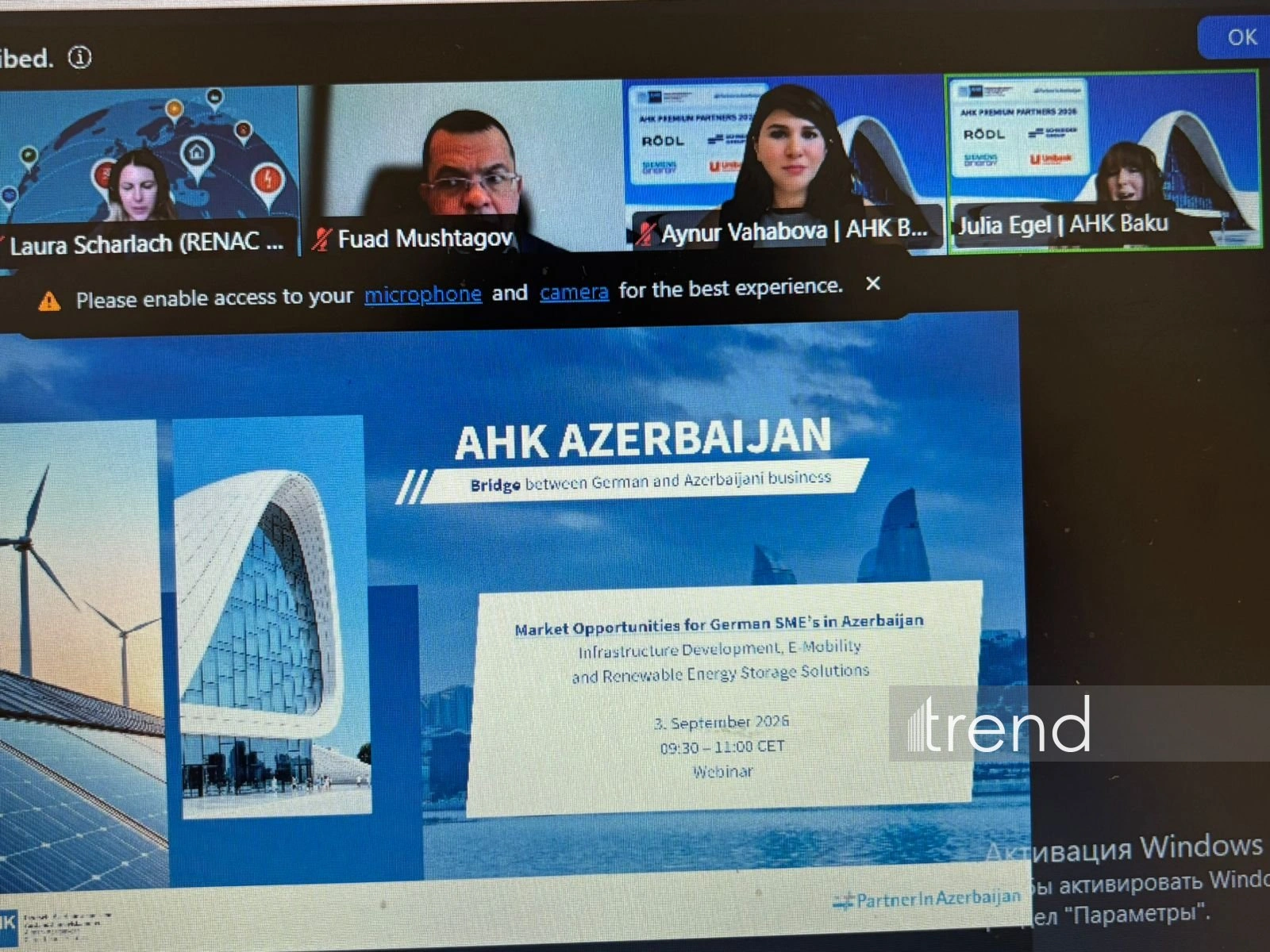
BAKU, Azerbaijan, September 3. German companies
may participate in projects to modernize and integrate Azerbaijan’s
power grids, as well as in the development of energy storage
systems and charging infrastructure for electric vehicles, Julia
Egel, Head of Stakeholder Engagement and Partnerships at the
German-Azerbaijani Chamber of Commerce (AHK Azerbaijan), said,
Trend's correspondent
reports from the event.
She made the remark during an online webinar titled “Azerbaijan:
Infrastructure Development, E-Mobility and Renewable Energy Storage
Solutions.”
According to her, Azerbaijan is implementing and planning a
large number of renewable energy projects, including large-scale
solar and wind projects. “Solar and wind energy have significant
potential in Azerbaijan. When we talk about large-scale solar and
wind projects, there is strong demand as well as many
opportunities. Given Azerbaijan’s geographical location and its
role in the Middle Corridor, renewable power generation could also
become of interest for exports to Europe in the future.
A necessary regulatory framework has been established in
Azerbaijan’s energy sector. The government has previously
identified various priorities, including energy sector reform, the
development of green energy, improving energy efficiency and
building a low-carbon economy,” she said.
Egel emphasized that measures being implemented to diversify and
ensure the sustainability of the country’s energy balance are
creating opportunities for the application of relevant technologies
and solutions.
She also noted that projects involving various investors and
developers, including those from the Middle East and China, are
being implemented in Azerbaijan. “There are opportunities for
cooperation in areas such as energy storage systems, solar and wind
power. One potential area of cooperation for German companies could
be contributing to the goal of increasing the share of renewable
energy sources to 30% by 2030. Opportunities for German companies
are particularly concentrated in power grid modernization, energy
system integration, battery energy storage systems and, for
example, charging solutions for electric mobility,” Egel said.
Egel also said that a German pavilion was organized at Baku
Energy Week as part of international events held this year.
According to her, German companies may consider participating with
their own stands at Baku Energy Week in June next year.
She also highlighted Azerbaijani President Ilham Aliyev’s recent
visit to Berlin, where he met with German Chancellor Friedrich Merz
and a joint declaration was signed. In addition, according to Egel,
a declaration on the establishment of the Azerbaijani-German
Business Council was signed during the visit with the participation
of AHK Azerbaijan.
She also announced a planned conference on connectivity, which
will focus, among other areas, on energy along the Middle Corridor,
as well as an upcoming trade mission of German energy companies to
Azerbaijan.
Egel said the trade mission’s program includes meetings with
representatives of Azerbaijan’s Ministry of Energy, an
executive-level business roundtable, briefings and B2B meetings.
“B2B meetings are particularly important for you, as you want to
establish direct contacts and explore your opportunities. AHK
Azerbaijan will coordinate B2B meetings based on the interests of
the participating German companies and help identify suitable
partners,” she said.