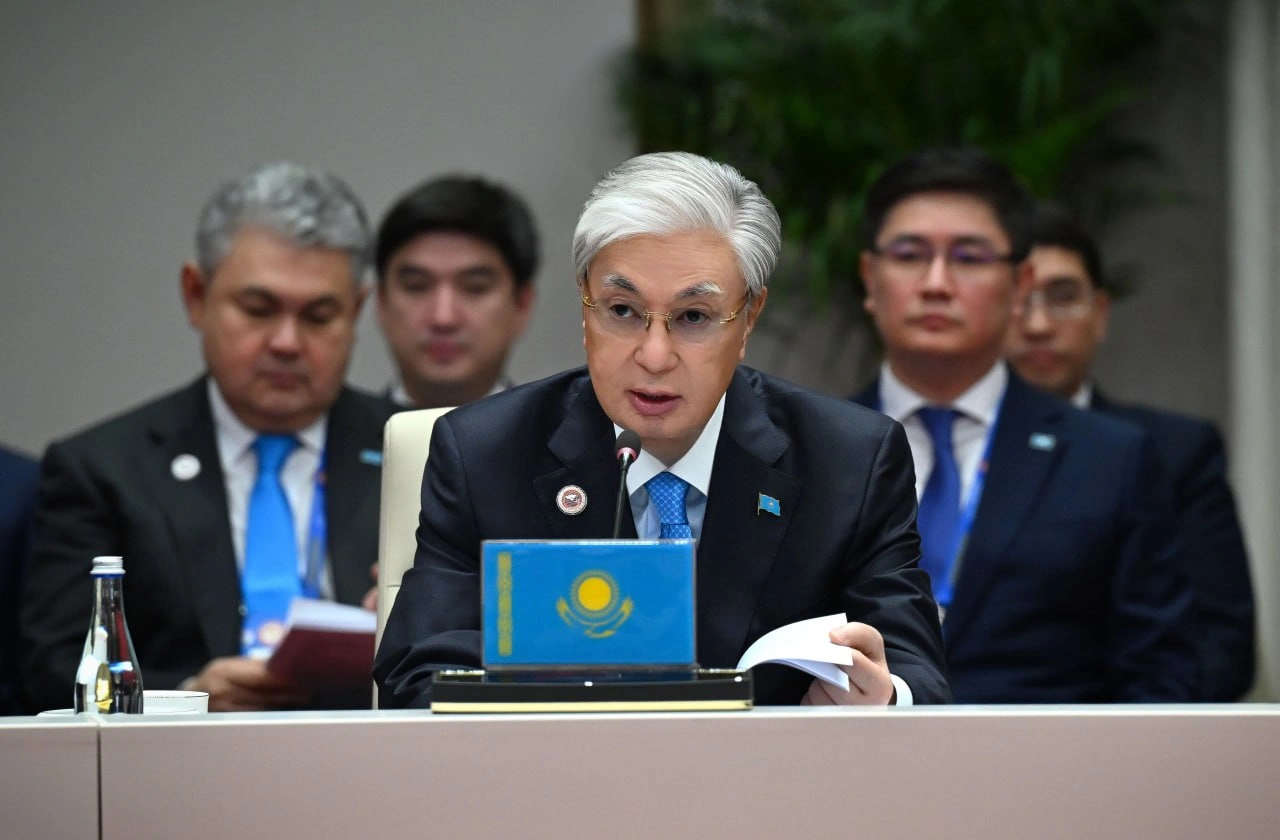
BAKU, Azerbaijan, September 3. The speech by
Kazakh President Kassym-Jomart Tokayev at the Shanghai Cooperation
Organization (SCO) summit in Bishkek draws particular attention to
the wide range of proposals put forward by Kazakhstan - from
security and transport issues to AI, water scarcity and the role of
the UN.
These areas are united by Astana's overall approach to
multilateral cooperation. Tokayev speaks of the SCO as an
organization that should remain open to interaction between
countries with different interests.
"The SCO represents a unique palette of countries that are
different in essence but united in spirit, embodying in practice
the principles of non-interference, respect for sovereignty, mutual
trust, openness and cooperation," the President of Kazakhstan
said.
For Kazakhstan, this also has quite practical significance. In
2025, the country's trade turnover with SCO member states amounted
to $72.6 billion, demonstrating the scale of economic interaction
within the organization. However, the SCO agenda for Astana is not
limited to trade - Kazakhstan also proposes using this platform to
strengthen trust and reduce security risks.
This position is reflected in Kazakhstan's proposal to hold a
special ministerial conference on strategic stability and
confidence-building measures.
"We consider it relevant to hold an SCO Ministerial Conference
on strategic stability and confidence-building measures on the
Eurasian continent. The agenda of this event could include issues
related to reducing military risks, containing a new arms race and
preventing dangerous incidents," Tokayev said.
Thus, Kazakhstan proposes using the SCO's capabilities not only
for economic interaction, but also for reducing risks and
strengthening trust between states. Amid growing tensions between
major powers, maintaining channels for dialogue is becoming a
separate task.
In this context, Tokayev's assessment of the role of middle
powers is also understandable. According to him, they can
facilitate dialogue between different centers of power and
participate in developing collective solutions.
"Their positions and initiatives should be properly reflected in
global governance mechanisms. Kazakhstan is ready to actively
contribute to this process," Tokayev said, speaking at the SCO Plus
summit.
From security and dialogue issues, Tokayev moves to areas where
multilateral cooperation can produce a more concrete economic
result. One of them is the development of transport connectivity.
The President of Kazakhstan proposed developing an SCO Transport
Connectivity Strategy until 2035 and creating a Unified Digital
Transit Platform.
For Kazakhstan, the transport issue is directly linked to its
geographical position. About 85% of continental freight traffic
between China and Europe passes through Kazakhstan, making
increased transit efficiency an important economic task.
However, geography alone is not enough: cargo moves along routes
where borders are crossed faster, there is less bureaucracy, and
costs are lower. Therefore, transit digitalization, mutual
recognition of electronic documents and "green corridors" have
direct economic significance for Kazakhstan.
Another area Kazakhstan proposes developing through the SCO is
artificial intelligence. Tokayev proposes pooling the efforts of
universities, research institutions and technology companies from
member states.
"Therefore, we consider it appropriate to propose creating,
under the auspices of the SCO, a Network of Artificial Intelligence
Centers involving leading universities, research institutions and
technology companies of the member states," the Head of State
continued.
At the same time, the issue is not only about knowledge
exchange. As Tokayev noted, it is necessary to "...move from
sharing experience to jointly creating technologies."
For Kazakhstan, this area is of practical importance as the
country seeks to develop its own AI capabilities, participate in
technology creation, and contribute to discussions on the rules
governing their use. In Kazakhstan, 2026 was declared the Year of
Digitalization and Artificial Intelligence.
Another important issue for the region is water. For Central
Asia, water is directly linked to agriculture, energy, the economy,
and relations between neighboring states. According to World Bank
data for 2024, more than 37 million people, or 49% of the
population of Central Asia, live in areas facing severe water
shortages.
Against this backdrop, Tokayev proposed establishing an
International Water Organization under the auspices of the UN and,
at the SCO level, a Center for Analysis of Water Problems.
"I count on the support of the SCO member states in establishing
both an International Water Organization at the UN platform and a
Center for Analysis of Water Problems of the Shanghai Cooperation
Organization," the President of Kazakhstan said.
This is where another feature of Kazakhstan's approach becomes
apparent: Astana proposes addressing some issues through regional
SCO mechanisms, while bringing others to a broader international
level.
Viewed as a whole, Tokayev's proposals in the areas of security,
transport, technology and water are linked by a common objective -
creating conditions for practical cooperation while at the same
time preserving opportunities for political dialogue.
Within this system, the SCO serves as one of the platforms
through which Kazakhstan can interact with several major centers of
power simultaneously. For a country located between the largest
economies of Eurasia, it is important to maintain the ability to
cooperate with different partners and use multilateral formats to
address specific issues.
This is where the practical value of Kazakhstan's approach lies:
economic cooperation, transport connectivity, and technological
development are advancing in parallel with the intention to
preserve space for dialogue on security and international
relations.