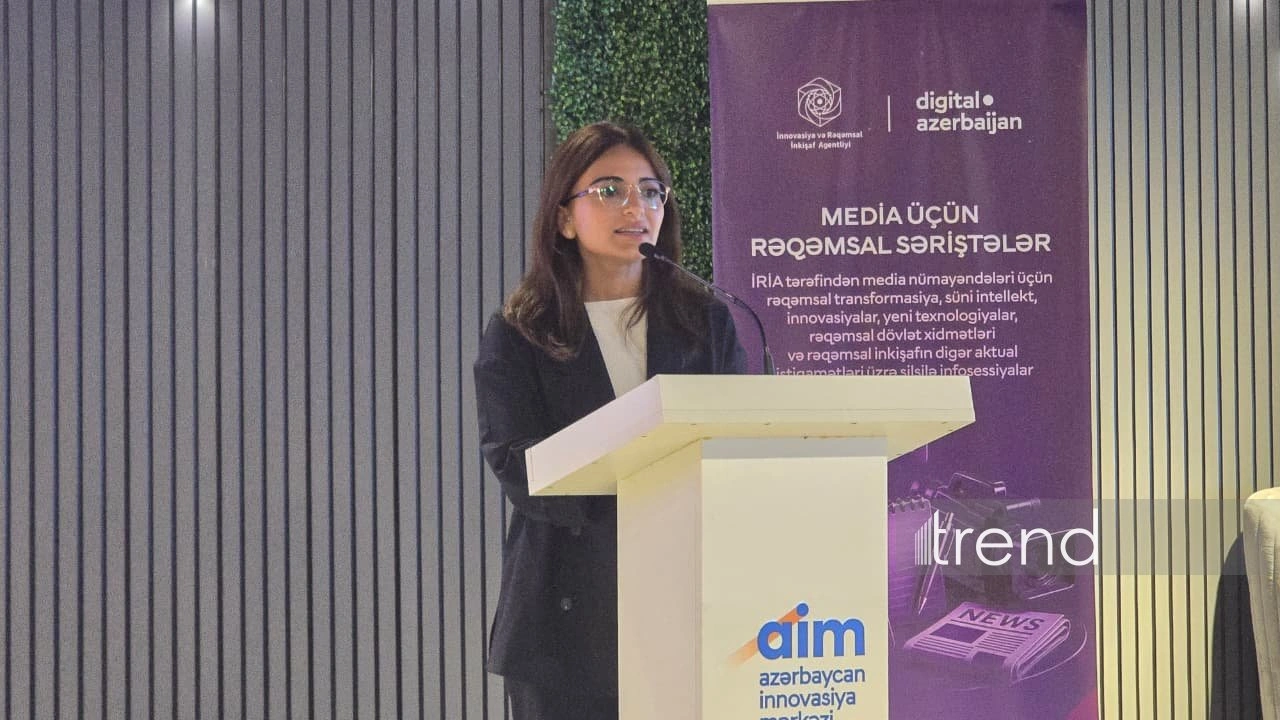
BAKU, Azerbaijan, September 1. New tax and
customs benefits are planned for startup and technology park
residents in Azerbaijan, Head of the Legal Department of the
Innovation and Digital Development Agency (IDDA), Sabina
Humbatzade, said during her speech on the topic "Development of the
digital and innovation ecosystem in Azerbaijan: new legislative
opportunities" organized within the framework of the educational
session "Digital skills for the media", Trend's correspondent
reports from the event.
According to her, individuals and legal entities operating in
certain areas, including individual entrepreneurs, will be exempted
from income and profit taxes, as well as dividends.
"The main condition for the application of these exemptions is
that when products are exported and sold abroad, payments must be
made through bank and payment accounts in Azerbaijan," Humbatzade
noted.
She pointed out that tax breaks are also provided for property
and land used by entities operating in the relevant areas.
The department chief also said that changes are also being made
to the legislation regarding the duration of tax audits.
"In practice, one of the main difficulties we observe when
talking to residents and startups is related to the duration of
mobile tax audits. In most cases, residents of the technology park
and startups are micro, small, and medium-sized businesses. The
fact that mobile tax audits last for months has a negative impact
on their activities," she emphasized.
According to Humbatzade, with the new changes, the duration of
mobile tax inspections of technology park residents and startups
cannot exceed 90 business days.
She added that concessions are also envisaged regarding the
freezing of funds in the bank accounts of startups and technology
park residents with tax debts.
"If their tax debt is up to 50,000 manat ($29,410), then the
freezing of bank accounts will not be applied. The goal is to
enable these entities to continue and develop their businesses by
using the funds in their accounts effectively," the official
explained.
Humbatzade also spoke about changes related to scientific
research and technological projects.
"When startups, technology park residents, and scientific
institutions are ordered to form an innovative product, the
expenses incurred in this direction are multiplied by a factor of
1.5 and included in the object of taxation," he noted.
According to him, the fact that a research and development
(R&D) project results in technological failure won't prevent
the costs incurred from being considered justified.
"Even if an R&D project fails technologically, it is
considered a justified cost from a tax perspective," Humbatzade
stressed.
She further noted that concessions are also envisaged in the
field of technology transfer.
"Fifty percent of the income from the sale or use of proprietary
intangible assets, including software and know-how, is exempt from
tax," the head of the department said.
Humbatzade also announced concessions related to cloud
services.
"One of the main infrastructures used by startups and residents
of the technology park is cloud services. Payments for cloud
computing services purchased from abroad will not be subject to tax
at source. In addition, these services will also be exempt from
VAT," she pointed out.
Touching upon import concessions, the head of the department
said that products, supporting components and devices imported by
entities in connection with their activities will be exempted from
customs duties and VAT for a period of 10 years.
She noted that certain concessions are also envisaged to support
personnel training.
"Certain funds may be allocated from the wage fund for the
improvement of professional qualifications and professional
development of employees of individual entrepreneurs and companies.
These funds will be taken into account as an expense deducted from
income, provided that they do not exceed 3 percent of the wage
fund," Humbatzade said.
The official added that in order to ensure legal certainty, the
legislation also establishes the concepts of 'digital traveler' and
'freelancer'.
"Digital traveler refers to foreign citizens who work remotely
through information and communication technologies and operate in
the fields of digitalization, innovation, cybersecurity, and
artificial intelligence," she clarified.
According to her, according to the amendments to the Migration
Code, digital travelers will be able to obtain a business visa for
a period of three years.
"The main condition is that they must have a stable income from
a foreign country for six months. The amount of this income must
not be less than 13 times the minimum wage in Azerbaijan,"
Humbatzade noted.
She added that income tax won't be applied to digital travelers
and no limits will be imposed on transfers to their bank accounts.
In addition, it's planned to apply discounts related to social
insurance payments.