BAKU, Azerbaijan, September 1. Uzbekistan is
seeking to leverage its position within the Shanghai Cooperation
Organization (SCO) to strengthen trade and investment ties, enhance
transport connectivity, and expand cooperation in emerging areas
such as digital technologies and artificial intelligence. With SCO
member states already accounting for a substantial share of
Uzbekistan’s investment and international freight flows, the
organization has assumed increasing importance in the country’s
efforts to deepen regional economic integration and diversify
access to foreign markets.
President Shavkat Mirziyoyev arrived in Bishkek to participate
in the SCO Council of Heads of State meeting and the SCO Plus
format on August 31–September 1. The summit is expected to adopt
the Bishkek Declaration marking the SCO’s 25th anniversary,
alongside documents addressing economic cooperation, transport,
artificial intelligence, environmental protection, and other
areas.
For Tashkent, the timing is particularly relevant as several of
its priorities within the organization are moving toward more
concrete forms of cooperation. Uzbekistan has advanced initiatives
related to transport corridors, investment mechanisms, industrial
cooperation, critical minerals, energy, and digitalization,
reflecting its efforts to utilize the SCO as a platform for
addressing practical constraints on economic expansion. The key
question for Uzbekistan, therefore, is how effectively the
organization can facilitate connectivity, capital flows, and
technological cooperation that directly support the country’s
development objectives.
Uzbekistan is becoming increasingly integrated with SCO
economies
The scale of Uzbekistan's economic ties with SCO members
provides a strong economic rationale for deeper cooperation within
the organization. According to Uzbekistan's Ministry of Foreign
Affairs, investment from SCO countries reached $17.5
billion in 2025, with China accounting for about $13 billion,
Russia $2.6 billion, Kazakhstan $870 million, Iran $265 million,
India $247 million, Kyrgyzstan $197 million and Tajikistan $196
million. China therefore represented roughly 74% of investment from
SCO members, while Russia accounted for almost 15%, highlighting
both the depth of Uzbekistan's economic links with the two largest
SCO economies and the concentration of capital flows within the
group. This concentration creates an incentive for Tashkent to
broaden the investment base by making it easier for companies and
financial institutions from other SCO countries to participate in
Uzbek projects.
Uzbekistan has increasingly promoted mechanisms aimed at
achieving this, including an SCO investment forum, an electronic
business portal and networks of venture companies and funds. The
SCO Investment and Business Forum held in Bishkek on June 24-25
brought these priorities together, with discussions covering
investment, trade, industrial and technological cooperation,
artificial intelligence, e-commerce and industrialization. The
emerging approach is therefore centered on creating channels
through which existing economic ties can generate a wider range of
investment and business connections, rather than relying
predominantly on bilateral capital flows from the largest SCO
economies.
Transport remains the most important economic
priority
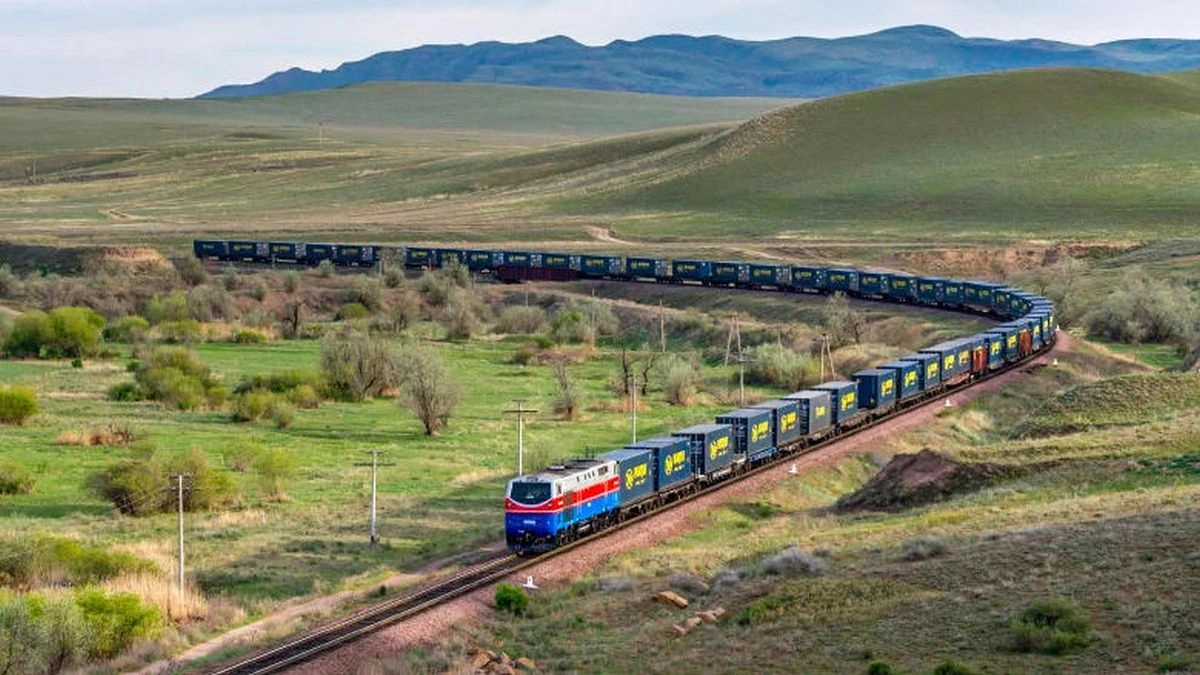
For Uzbekistan, transport connectivity has a particularly
strategic importance because the country is landlocked and depends
on transit through neighboring states to access major external
markets. The importance of SCO countries to Uzbekistan's logistics
network is already substantial. According to Uzbekistan's Center
for Transport and Logistics Development Studies, international
freight transportation between Uzbekistan and SCO member states
increased by 40%, or 9 million tons, over five years, reaching 33.5
million tons in 2025.
SCO countries account for around 80% of Uzbekistan's
international freight transportation, with the largest volumes
involving Russia, Kazakhstan, China and Kyrgyzstan. Uzbekistan's
Ministry of Transport estimates that freight transportation with
SCO members could reach 47 million tons by 2030. This implies an
additional increase of about 13.5 million tons, or 40%, from the
2025 level by the end of the decade.
The figures demonstrate why transport cooperation has become one
of the central elements of Uzbekistan's SCO agenda. One of the most
important projects is the China-Kyrgyzstan-Uzbekistan railway,
which could strengthen Uzbekistan's connection with China and
create an additional east-west route through Central Asia. At the
same time, Tashkent has promoted transport links southward through
Afghanistan toward Pakistan and the ports of the Indian Ocean. The
development of these east-west and north-south corridors could
expand Uzbekistan's access to external markets, reduce transport
costs and strengthen the country's position as a regional logistics
hub.
For Tashkent, however, the benefits of greater connectivity
extend beyond transit revenues. More efficient transport links can
improve the competitiveness of Uzbek exports and make the country
more attractive to manufacturers seeking access to multiple
markets. The SCO could support this process by improving
coordination between national transport systems, including through
harmonized customs procedures, digital documentation,
border-crossing processes and transportation standards. Such
coordination could help reduce bottlenecks along cross-border
routes and increase the economic value of infrastructure projects
already being developed across the region.
Tashkent wants to move from trade toward industrial
cooperation
Uzbekistan's economic objectives within the SCO increasingly
extend beyond increasing the volume of trade. Tashkent has been
advocating the development of reliable production and logistics
chains, mutual investment and deeper industrial cooperation. At the
2025 SCO summit in Tianjin, Mirziyoyev proposed several mechanisms,
including a Regional SCO Center for Critical Materials, an SCO
Energy Consortium, a network of venture companies and funds, and an
electronic portal for business contacts and investment
promotion.
The critical-materials initiative is particularly relevant to
Uzbekistan's industrial strategy. The proposed center would
facilitate cooperation in modern technologies for the extraction
and deep processing of mineral resources. For Uzbekistan, greater
participation in regional processing chains could help shift the
country's role from a supplier of raw materials toward a producer
of higher-value products. This distinction is important for the
country's long-term growth. Investment in mining alone can increase
export revenues, but investment in processing, metallurgy,
chemicals, and related manufacturing can generate wider industrial
effects, including technology transfer, skilled employment, and the
development of domestic suppliers.
Cooperation with SCO members could therefore support
Uzbekistan's efforts to integrate its mineral resources into
broader regional value chains. The same principle applies to
industrial localization. Uzbekistan can use its expanding domestic
market, relatively large labor force and improving industrial base
to attract production projects aimed at serving not only the Uzbek
market but also neighboring Central Asian and other SCO
markets.
Finance could provide another layer of
support
The proposed SCO Development Bank is another initiative with
potential relevance for Uzbekistan. SCO Deputy Secretary-General
Sohail Khan said in May that consultations on establishing the bank
had begun, describing it as a potential institution for financing
joint projects and strengthening the organization's financial
architecture. The issue was also discussed at the July meeting of
SCO foreign ministers in Cholpon-Ata, where member states noted
progress in consultations on the proposed institution, particularly
in connection with investment, infrastructure and
transport-logistics projects.
For Uzbekistan, an SCO financial institution could provide an
additional source of long-term financing for infrastructure and
industrial projects involving several member states. The potential
value is particularly significant given the scale of infrastructure
investment required to expand transport networks, electricity
generation, industrial capacity and digital infrastructure. At the
same time, the Development Bank would complement rather than
replace existing financial institutions.
Uzbekistan already works with the World Bank, Asian Development
Bank, Asian Infrastructure Investment Bank, European Bank for
Reconstruction and Development, Islamic Development Bank and other
international institutions. The country's 2025 presidential address
specifically highlighted continued cooperation with these
institutions on infrastructure modernization, sustainable energy
and transport. The proposed SCO mechanism could therefore be most
useful for projects with a clear regional component, particularly
those requiring coordination and financing across multiple SCO
countries.
The same applies to discussions on increasing the use of
national currencies in mutual settlements. Wider use of local
currencies could eventually reduce transaction costs and dependence
on third-country currencies, although the effectiveness of such
arrangements will depend on the development of financial markets,
currency convertibility and settlement infrastructure.
Energy cooperation could support Uzbekistan's growing
electricity needs
Energy represents another area where SCO cooperation could have
a direct economic relevance for Uzbekistan. The country is facing
rising electricity demand while simultaneously expanding generation
capacity, renewable energy and transmission infrastructure. Against
this backdrop, discussions within the SCO on energy security,
efficiency, infrastructure protection, renewables and the proposed
SCO Energy Consortium are aligned with Uzbekistan's own investment
priorities. A regional mechanism could facilitate cross-border
investment, technology transfers and greater coordination in
electricity generation and transmission, particularly as Central
Asian countries seek to develop complementary energy resources.
The economic implications extend beyond energy security. For
Uzbekistan, a more coordinated regional energy system could support
industrial expansion by improving the availability and reliability
of electricity for manufacturing, data centers and other
energy-intensive activities. This could become increasingly
important as the country seeks to attract investment into
higher-value industries and digital infrastructure. In this
context, energy cooperation within the SCO could serve not only as
a mechanism for coordinating energy projects, but also as part of
the infrastructure base supporting Uzbekistan's broader industrial
and technological development.
Digital cooperation is becoming a new dimension of
Uzbekistan-SCO ties
The recent engagement between Uzbekistan and the SCO Business
Council indicates that technology is becoming a more substantive
component of Tashkent's economic agenda within the organization. At
an August 11 meeting, IT Park Uzbekistan and the
SCO Business Council discussed investment in Uzbek IT startups,
digital infrastructure, data centers and R&D, including
projects involving electronic mapping, government platforms, and
transport and healthcare information systems. The sides also
considered integrated projects combining computing capacity, energy
supply and operational infrastructure. For Uzbekistan, such
cooperation could help address one of the key requirements of its
digitalization strategy: moving from the expansion of basic digital
services toward the development and export of technology-intensive
products.
Access to SCO markets and investors could give Uzbek technology
companies additional opportunities to scale beyond the domestic
market, while investment in data centers and R&D could
strengthen the infrastructure needed to support AI and other
advanced technologies. This direction is consistent with
Mirziyoyev's earlier proposal to establish a New SCO Economic
Dialogue focused on digitalization, artificial intelligence,
robotics, biotechnology and other emerging sectors. The growing
focus on these areas suggests that Uzbekistan is seeking to use the
SCO not only to facilitate traditional trade and infrastructure
cooperation, but also to connect its technology sector with a
broader pool of capital, markets and expertise.
Uzbekistan's SCO strategy complements its multi-vector
economic policy
Uzbekistan's expanding role within the SCO is taking place
alongside an active effort to diversify its external economic
partnerships. Tashkent continues to deepen relations with China and
Russia while expanding economic ties with India, the European
Union, Türkiye, the Gulf states, South Korea, Japan and other
markets. The latest example is India, with the two countries
agreeing on August 31 to raise bilateral trade to $5 billion by 2030 and expand cooperation in energy,
critical minerals, pharmaceuticals, electronics, machinery and
agriculture. Bilateral trade reached $598.1 million in the first
half of 2026, while Indian investment and loans for fixed-capital
projects in Uzbekistan amounted to $225.9 million. The agreements
also cover areas such as healthcare, education, tourism and
environmental protection, demonstrating that Tashkent's
diversification strategy extends well beyond traditional goods
trade.
This approach gives the SCO a specific place within Uzbekistan's
broader economic architecture. The organization brings together
several of the country's major economic partners, including China,
Russia, India and Iran, while providing access to additional
markets in Central and South Asia. At the same time, Uzbekistan is
developing economic and transport links outside the SCO, including
connections through the Caspian Sea and the Middle Corridor, as
well as routes toward Afghanistan, Pakistan and the Persian Gulf.
The SCO can therefore complement Uzbekistan's multi-vector strategy
by providing a multilateral framework for coordinating selected
cross-border projects, while Tashkent retains the flexibility to
pursue bilateral partnerships and alternative trade routes with
countries outside the organization.
What Uzbekistan brings to the SCO
The relationship is also important from the perspective of what
Uzbekistan contributes to the organization. With its large domestic
market, expanding industrial base, growing technology sector and
central position within Central Asia, Uzbekistan represents a
significant potential market for SCO companies and investors.
Its geographic position also gives it a role in several
potential transport corridors connecting China with Central Asia
and, further south and west, with the Caspian Sea, South Asia and
the Middle East.
Uzbekistan's economic development therefore gives it an interest
in strengthening regional connectivity, while its market and
industrial potential give other SCO members an incentive to support
such initiatives.
This creates a degree of mutual interest around infrastructure
and trade that can exist even where member states have different
geopolitical priorities.
Bishkek could advance Uzbekistan's economic agenda
within the SCO
The Bishkek summit comes at a point when several of the
initiatives promoted by Uzbekistan are moving through different
stages of discussion. The summit agenda is expected to include
documents on the economy, transport, artificial intelligence,
environmental protection and other areas.
For Uzbekistan, several developments will be particularly
relevant.
The first is the future of the SCO Development Bank and broader
financial mechanisms for regional projects.
The second is the development of transport cooperation,
including measures to improve customs procedures, digital logistics
and the interoperability of transport systems.
The third is the proposed Energy Consortium and cooperation on
renewable energy and regional energy infrastructure.
The fourth is industrial cooperation, particularly critical
minerals, processing and localization.
The fifth is digitalization, including artificial intelligence,
data infrastructure, R&D and technology investment.
The outcome of these initiatives will determine the practical
scope of Uzbekistan's economic engagement with the organization in
the coming years.
Outlook: Uzbekistan is seeking practical value from the
SCO
Uzbekistan's approach to the SCO increasingly reflects the
country's broader economic priorities. The objective is to improve
connectivity, attract investment, integrate domestic companies into
regional and global value chains, expand exports, and gain access
to new technologies.
The organization can support these goals through several
complementary mechanisms: transport coordination can reduce
logistical barriers; financial institutions can provide additional
capital; industrial cooperation can facilitate localization and
deeper processing; energy cooperation can strengthen
infrastructure; and digital initiatives can help Uzbek technology
companies reach larger markets.
The scale of existing economic interaction suggests that the
potential is significant. SCO member states already provided $17.5
billion in investment to Uzbekistan in 2025, while freight
transportation with SCO countries reached 33.5 million tons and
accounted for roughly 80% of Uzbekistan's international freight
traffic. At the same time, the most important opportunities for
Uzbekistan are likely to come from greater coordination of existing
economic activity rather than the creation of entirely new economic
relationships.
The country already has strong bilateral ties with China, Russia
and other SCO members. The added value of the organization can
therefore come from connecting these relationships through common
transport standards, investment mechanisms, production networks and
digital infrastructure. In this context, Uzbekistan is positioning
the SCO as an additional layer of its economic strategy — one that
can help connect its bilateral partnerships and regional
initiatives into a broader framework. For Tashkent, the long-term
value of the SCO will ultimately be measured by its contribution to
lower transport costs, greater investment, stronger industrial
capacity, expanded exports, and access to technology. The current
trajectory suggests that Uzbekistan will continue pushing the
organization toward precisely these practical economic
objectives.