BAKU, Azerbaijan, August 26. The Middle
Corridor is gradually moving beyond the traditional concept of a
transport route between Asia and Europe. Growing cargo volumes,
shorter delivery times, the development of port and railway
infrastructure, the introduction of digital solutions and new
logistics services are turning the Trans-Caspian International
Transport Route into a comprehensive economic ecosystem.
This process is particularly important for Azerbaijan. The
country is located at the center of the Caspian-Caucasus segment of
the route, connecting Central Asia with Georgia, Türkiye and
European markets. Therefore, the development of the Middle Corridor
creates opportunities for Azerbaijan not only to increase transit
traffic, but also to attract investment, develop logistics and
expand trade and economic ties.
From a route between regions to an economic
platform
Today, the Middle Corridor connects China, the countries of
Central Asia, the Caspian region, the South Caucasus, Türkiye and
Europe. Its importance is growing as companies and governments seek
a more diversified and resilient system of international supply
chains.
At the same time, the nature of the route itself is gradually
changing. While the initial focus was primarily on moving cargo,
the Middle Corridor is now developing a broader range of services,
including multimodal transportation, port handling, container
logistics, railway services, warehousing solutions and digital
support.
This is why the Middle Corridor is increasingly being described
as an economic corridor rather than simply a transport route. In an
article, Alexi Alexishvili, president of consulting company PMCG,
notes that economic corridors can not only move goods, but also
stimulate investment, industrial development, integration into
global supply chains and job creation.
This approach is particularly relevant for the countries of the
South Caucasus and Central Asia, which can use their geographical
position to expand economic cooperation with China and European
markets.
Growing cargo volumes show the changing
scale
The dynamics of recent years demonstrate that interest in the
route is becoming increasingly practical. According to data cited
in an exclusive interview with Trend by Kazakhstan’s Vice Minister of Trade and
Integration Asset Nusupov, cargo transportation along the Middle
Corridor increased more than fivefold from 2022 to 2025. In 2025,
total cargo transportation reached 4.5–4.7 million tons, while
container traffic amounted to 76,900 TEUs, up 36% year-on-year.
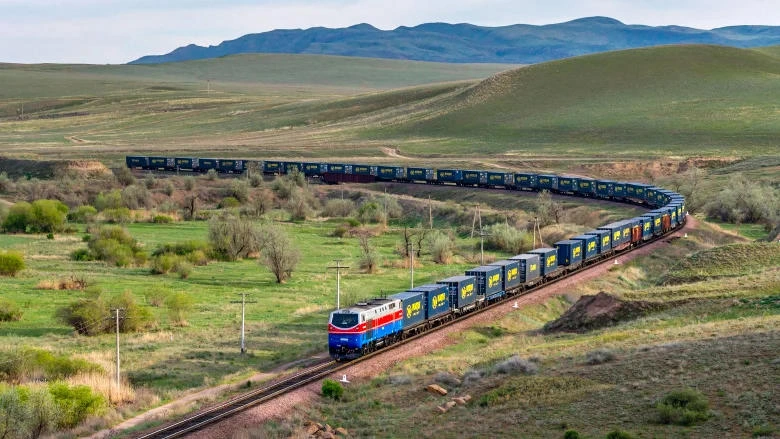
Positive dynamics have continued in 2026. In the first quarter,
125 container trains traveled along the route, up 34.4% compared
with the same period last year. The Xi’an–Alat Port route has shown
particularly strong growth: 85 trains traveled along it in the
first three months of the year, twice as many as a year earlier. At
the same time, delivery times have fallen significantly. Whereas
transportation along this route previously took 28–32 days, the
timeframe has now been reduced to around 11–13 days. This is one of
the most important indicators of the Middle Corridor’s development:
the route is becoming not only more in demand, but also faster.
Azerbaijan strengthens its role as key
logistics hub
Against this backdrop, Azerbaijan’s role as a central link
between the Caspian Sea and the South Caucasus is becoming
increasingly important. The Alat Port, railway infrastructure,
international highways and the Baku–Tbilisi–Kars railway provide a
comprehensive foundation for further growth in cargo flows.
In an exclusive interview with Trend, PMCG representatives previously highlighted
Azerbaijan’s strategic importance for the Middle Corridor.
According to the company, the country plays an important role not
only because of its geographical location, but also due to the
development of railway connectivity, port infrastructure and
regional coordination.
The connection between the Port of Baku at Alat on the Caspian
Sea and the Georgian ports of Poti and Batumi is particularly
important. Through this system, cargo flows gain access to the
Black Sea and subsequently to European markets. Azerbaijan is
therefore becoming not merely a transit territory, but a
fully-fledged logistics hub where different modes of transport
converge.
The Caspian segment is becoming part of an integrated
logistics system
The development of the Middle Corridor is increasingly based on
multimodality. Railway transportation is complemented by maritime
and road services, allowing different delivery options to be
developed depending on the destination and type of cargo.
A notable example is the first multimodal shipment of mineral
fertilizers from Ekibastuz to the UK via the Middle Corridor. The
cargo traveled through Kazakhstan, the Caspian Sea, Azerbaijan and
Georgia, after which it was shipped from the ports of Poti and
Batumi to the British port of Felixstowe. This example demonstrates
how the Middle Corridor is gradually becoming a practical
instrument for Central Asian producers seeking access to European
markets. For Azerbaijan, this means greater importance for Caspian
infrastructure and the development of additional services around
transit flows.
Europe is getting closer
Another important trend is the expansion of the Middle
Corridor’s European geography. Liliana Krutonog, CEO of Czech
international transport and logistics company MALBI-trans, told
Trend in an exclusive
interview about plans to develop transportation via the Romanian
port of Constanta.
The company considers Constanta one of its priority destinations
and, together with Carpatica Feroviar, is working on new logistics
projects. These include plans to organize trains from Prague, Brno,
Ostrava and other major Czech logistics centers to Constanta,
followed by delivery of cargo to Poti or Batumi, then across the
Caspian Sea to Aktau and Kazakhstan.
Thus, a new geography of the Middle Corridor is emerging. It is
no longer simply connecting China and Europe in general terms, but
specific production and logistics centers stretching from Central
Asia to the Czech Republic, Romania and the UK. This significantly
increases the economic importance of the route.
Digitalization becomes the next stage of
development
Alongside physical infrastructure, the digital component of the
corridor is also developing. Kazakhstan and Georgia have agreed to
launch an electronic permit exchange system for international road
freight transportation.
Testing of the e-Permit platform began on July 22, 2026. The
system will allow carriers to submit and verify permits
electronically, creating a more convenient environment for
international road transportation.
Following the full launch, Kazakhstan and Georgia plan to move
to an unlimited permit regime for bilateral road freight
transportation. The establishment of a technical monitoring group
will allow the two countries to coordinate data exchange between
transport and customs authorities.
This process is part of the broader digital transformation of
the Middle Corridor. The goal is to create a unified digital
environment that will allow carriers, ports, railways, customs
authorities and other participants to access information on cargo
movements and coordinate operations more quickly. For an
international route crossing several countries and using different
modes of transport, such digital integration is of strategic
importance.
Kazakhstanand Azerbaijan are building a new transport
link
The development of the Middle Corridor is also strengthening
bilateral ties between Azerbaijan and Kazakhstan. Azerbaijan’s
Minister of Digital Development and Transport Rashad Nabiyev,
during a meeting with Kazakhstan’s Deputy Head of the Presidential
Administration Assel Zhanassova, discussed further cooperation in
transport, logistics and digital infrastructure.
Particular attention was paid to enhancing the competitiveness
of the Middle Corridor, developing port and transport
infrastructure, expanding digital platforms, simplifying road
freight transportation and implementing a new ferry service
project. In other words, cooperation between the two countries is
gradually moving beyond individual transportation operations and
taking on a comprehensive character. Kazakhstan is developing the
eastern part of the Caspian segment, while Azerbaijan is developing
the western part. Together, they form a key link between Central
Asia and the South Caucasus.
The Middle Corridor opens up new investment
opportunities
Growing cargo volumes inevitably increase demand for new
terminals, warehouses, logistics centers and services. This is
where a transport route begins to evolve into an economic
platform.
In an exclusive comment to Trend, PMCG representatives noted that the Middle
Corridor creates significant opportunities for foreign investment
in port infrastructure, railway logistics hubs and value-added
services within supply chains.
According to the company, international interest in diversifying
supply chains and developing critical mineral resources further
enhances the investment attractiveness of the region. For
Azerbaijan, this means an opportunity to develop new business areas
around its transport infrastructure.
A logistics center can combine not only transportation and
storage, but also sorting, packaging, document processing,
insurance, trade finance and other services. As a result, each
additional cargo shipment can generate a significantly greater
economic impact than a simple transit operation.
From transit to industrial cooperation
The next stage in the development of the Middle Corridor could
involve expanding production and trade ties among the countries
along the route. Central Asia has significant raw material reserves
and growing production capacity. China is one of the world’s
largest production and export centers. Europe represents a major
market with strong demand for various categories of goods.
An increasingly dense network of connections is emerging between
these economies, while the Middle Corridor provides the
infrastructure necessary for expanding them. This is why the
importance of the Middle Corridor may be measured not only by the
number of tons and containers transported. Its longer-term value
lies in its ability to stimulate trade, investment and cooperation
among companies in different countries.
International organizations also see the region’s
potential
International organizations are also providing positive
assessments of the Middle Corridor’s prospects. In an exclusive
comment to Trend, the OECD noted that the development of the Middle
Corridor offers broad opportunities to strengthen trade links
between Europe and
Asia.
The organization emphasized that improving infrastructure,
developing border procedures and deepening regional cooperation
could contribute to the creation of more efficient and resilient
trade routes. At the same time, the OECD views Kazakhstan as an
important platform for developing Eurasian transport connectivity
and cooperation with Central Asian countries. In the longer term,
the Middle Corridor could become part of a broader economic
transformation of the region, bringing together transport, energy,
trade, digitalization and investment.
Why it matters now
Global trade is gradually becoming more flexible and
multilayered. Companies are increasingly considering multiple
logistics routes simultaneously, while governments seek to develop
infrastructure connecting them with the world’s largest markets.
Against this backdrop, the Middle Corridor has a historic
opportunity to establish itself as part of the new architecture of
Eurasian trade.
This opportunity is particularly significant for Azerbaijan. The
country has port infrastructure on the Caspian Sea, railway
connections with Georgia and Türkiye, a developed transport network
and a geographical position that enables it to connect Central Asia
with Europe.
With further growth in cargo flows, this creates the basis for
establishing a major regional logistics and trade hub around
Azerbaijan. The Middle Corridor is gradually transforming from a
route connecting two points on a map into a large-scale economic
system around which new trade links, investment projects and
logistics services are emerging.
For Azerbaijan, this creates an opportunity to strengthen its
role as one of Eurasia’s major transport and logistics centers. For
the Middle Corridor itself, the next step is no longer simply to
increase the volume of cargo transported, but to become a space
where these cargo flows generate new investment, trade and economic
activity. This is where its greatest potential for the coming years
lies.