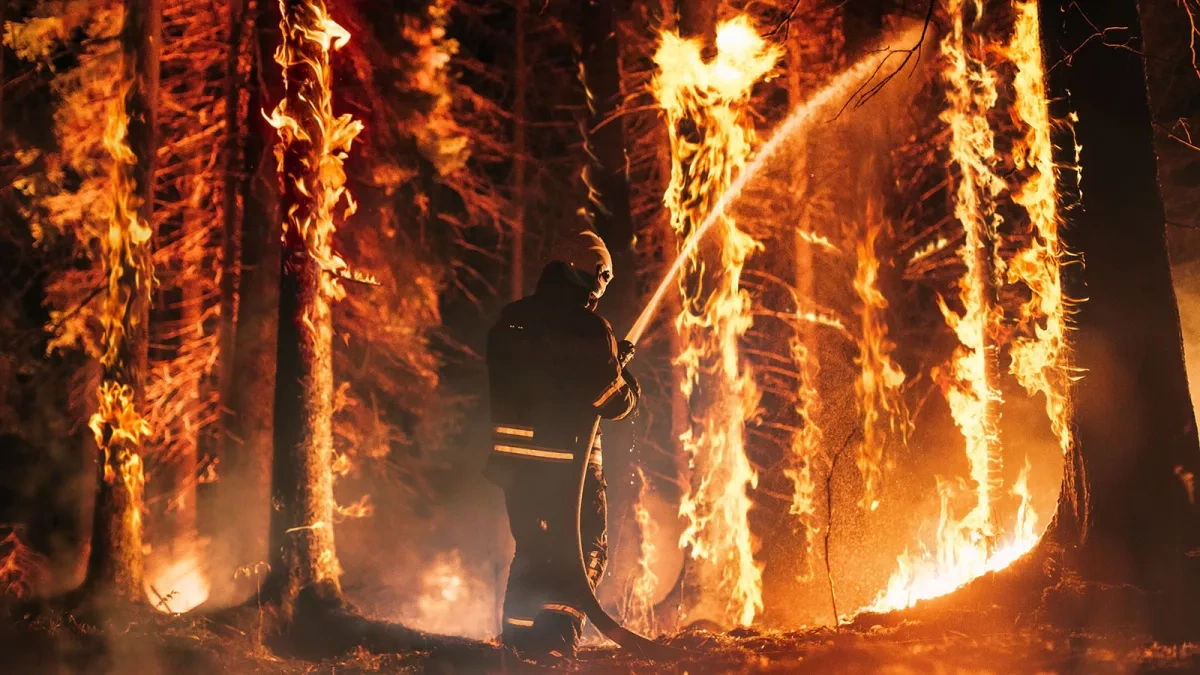
The wildfires burning across Europe this summer have exposed a potentially deadly threat beneath the blackened landscape: unexploded bombs and mines left behind from the First and Second World Wars.
Some of the ageing weapons have detonated in the intense heat, as highlighted by the AP, with explosions reported in France, Belgium, Germany and the Netherlands.
Steady temperatures and predictable rainfall once helped keep most buried munitions dormant. But this year’s wildfire season was intensified by heavy rainfall in January, which encouraged vegetation growth that later became fuel for fires during the summer heat.
High temperatures, drought, low humidity and strong winds created ideal conditions for the fires, according to a study published last month by the World Weather Attribution group. The blazes have forced mass evacuations across several European countries.
In Belgium’s eastern province of Liège, Governor Hervé Jamar said "a few sporadic detonations" had recently been heard and that emergency services were adapting their response to account for potentially explosive munitions buried beneath the affected area.
Jamar said firefighters were not in immediate danger, although local media published photographs of a firefighter handling a rusted bomb.
During the Second World War, booby traps, bombs and mines were scattered throughout the dense peat-bog forests of the High Fens, which straddle the Belgian-German border and were the scene of major fighting, including the Battle of the Bulge.
In the Netherlands, a bomb-disposal team was sent to inspect a forest threatened by flames near a site of heavy fighting in Limburg province in 1944.
Bernard Collard, a local historian authorised to search former battlefields with a metal detector, said the sheer number of unexploded items makes the area particularly unpredictable.
"In an environment like this, you are not sure where the explosives are," he said.
Collard said he had discovered mortar shells, machine guns, helmets and cigarette cases during his searches, as well as a human skeleton.
In France, a major wildfire outside the southwestern city of Bordeaux uncovered what is believed to be a cache of Second World War-era ammunition.
Around 400 shells and other pieces of ammunition were recovered in the village of Le Porge earlier in August. The weapons, which are believed to include both German and French munitions, consisted mainly of mortar shells along with several high-explosive anti-tank rounds.
Fire commander Thomas Mimiague said explosions heard during the blaze may have been caused by ammunition detonating in the heat.
Mayor Martial Zaninetti told French news outlet France Info that the explosions sounded like "the sound of war."
"There were ammunition depots buried in land within our municipality, but we didn't know it, and they exploded," Zaninetti told France Info, adding that one of the munitions "went through a house."
Europe’s buried wartime legacy
The discovery of unexploded ordnance is not unusual in Europe, where millions of bombs, shells and mines were deployed during the two World Wars.
In December, a 1,000-pound aerial bomb used by Allied forces during the Second World War was removed from a construction site in Belgrade, Serbia.
In September 2025, researchers discovered unexploded Nazi bombs lying on the seabed of a German bay, where they had become a habitat for marine life.
In some cases, the discovery of unexploded weapons has triggered mass evacuations similar to those caused by wildfires.
Thousands of residents were forced to leave their homes in Dresden, Germany, in August 2025 after an unexploded bomb was discovered in the southern part of the city.
In March 2025, operations at France’s busy Gare du Nord railway station were halted after an unexploded bomb was found near the tracks.
By Nazrin Sadigova