BAKU, Azerbaijan, August 20. The Hill has
published an opinion article highlighting the strategic importance
of the Trump Route for International Peace and Prosperity (TRIPP)
and its role in strengthening US and Western engagement in the
South Caucasus and Central Asia.
The article was authored by Brenda Shaffer, a faculty member at
the U.S. Naval Postgraduate School and a senior fellow at the
Atlantic Council’s Global Energy Center, and Svante Cornell,
co-founder and director of the Institute for Security and
Development Policy and a Senior Fellow for Eurasia at the American
Foreign Policy Council.
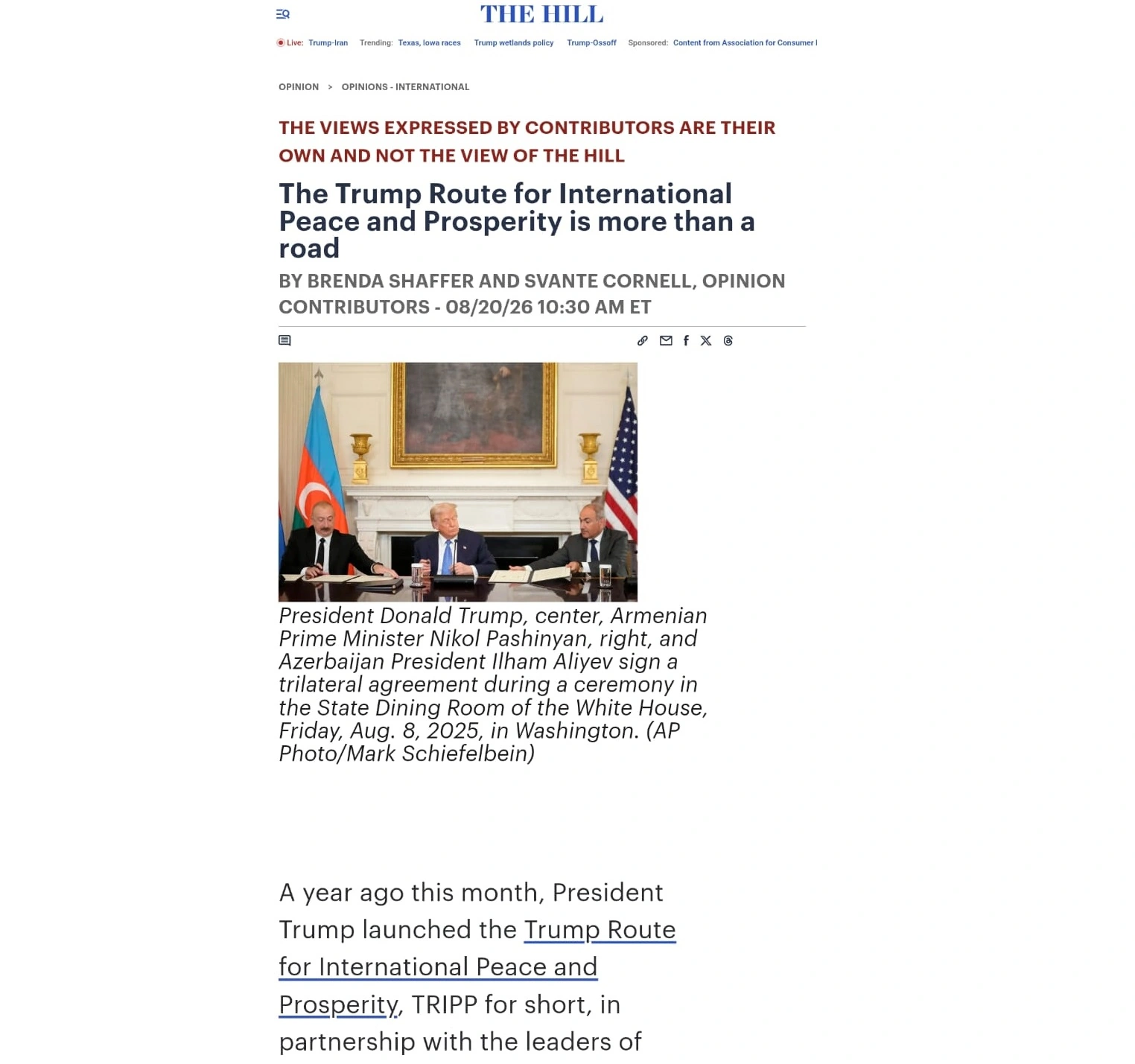
"A year ago this month, President Trump launched the Trump Route
for International Peace and Prosperity, TRIPP for short, in
partnership with the leaders of Armenia and Azerbaijan," the
authors write.
According to the article, TRIPP represents more than a transport
route, reflecting US efforts to safeguard access to the heart of
Eurasia and support the independence of countries in the
region.
"This route is much more than a simple road; it represents an
active American intent to safeguard access to the heart of Eurasia,
helping partner countries maintain their independence and
preventing Russia, China and Iran from dominating the strategically
vital Caspian region," the article states.
The authors note that the route has gained additional strategic
significance amid heightened geopolitical tensions, including the
war in Ukraine and military confrontation involving Iran.
"As the U.S. and Israel exchanged missile and rocket fire with
Iran and Russia’s war on Ukraine intensified over the past year,
TRIPP provided a narrow safe route above the Caucasus for global
aviation between Europe and Asia," they write.
The article says the Trump administration is working to
strengthen the security of the corridor and increase the American
presence along it, with American companies expected to operate
TRIPP for 99 years under a public-private partnership.
The authors describe TRIPP as a physical manifestation of the
peace process between Azerbaijan and Armenia and note that it forms
part of the broader Middle Corridor connecting Europe and Asia.
"The TRIPP corridor links Azerbaijan, Armenia and Türkiye in a
physical manifestation of the peace agreements signed last August
at the White House, ending a 30-year conflict between Armenia and
Azerbaijan," the article reads.
The Hill article also highlights the growing importance of the
Middle Corridor for global trade, particularly as it offers an
alternative to major maritime routes affected by geopolitical
risks.
According to the authors, TRIPP and the wider Middle Corridor
can help reduce dependence on maritime chokepoints, while also
providing access to energy and critical mineral resources in the
Caspian region and Central Asia.
The article notes that Central Asia accounts for nearly half of
global uranium production and has significant deposits of rare
earth elements, while the Caspian region is home to oil and gas
resources that could contribute to the diversification of global
energy supplies.
"Western access to these resources depends on the Middle
Corridor," the authors emphasize.
At the same time, the authors argue that the primary value of
TRIPP is strategic rather than purely economic. They note that
major energy and digital infrastructure may be developed farther
north of the route, while remaining connected to Azerbaijan,
Armenia and Türkiye.
"Instead, TRIPP should be conceived as a signpost of America’s
return to actively engaging with a region where it has been largely
absent in recent years," the article states.
The authors also call on Western partners, including the
European Union, the United Kingdom, Japan and South Korea, to
participate in strengthening the route and the wider Middle
Corridor.
"The route and the wider Middle Corridor directly serve their
security interests by ensuring that Russia, China and Iran do not
assert control over the heart of the Eurasian continent," they
write.
The article concludes that the development of alternative
transport and energy routes can help reduce geopolitical
vulnerabilities and strengthen economic and security ties between
the West and the South Caucasus and Central Asia.