Russian President Vladimir Putin has made his first visit to the Kuril Islands, territories claimed by Japan, in a move that signals Moscow’s growing willingness to challenge Tokyo while reinforcing Russia’s territorial claims in the Pacific, The Telegraph reports.
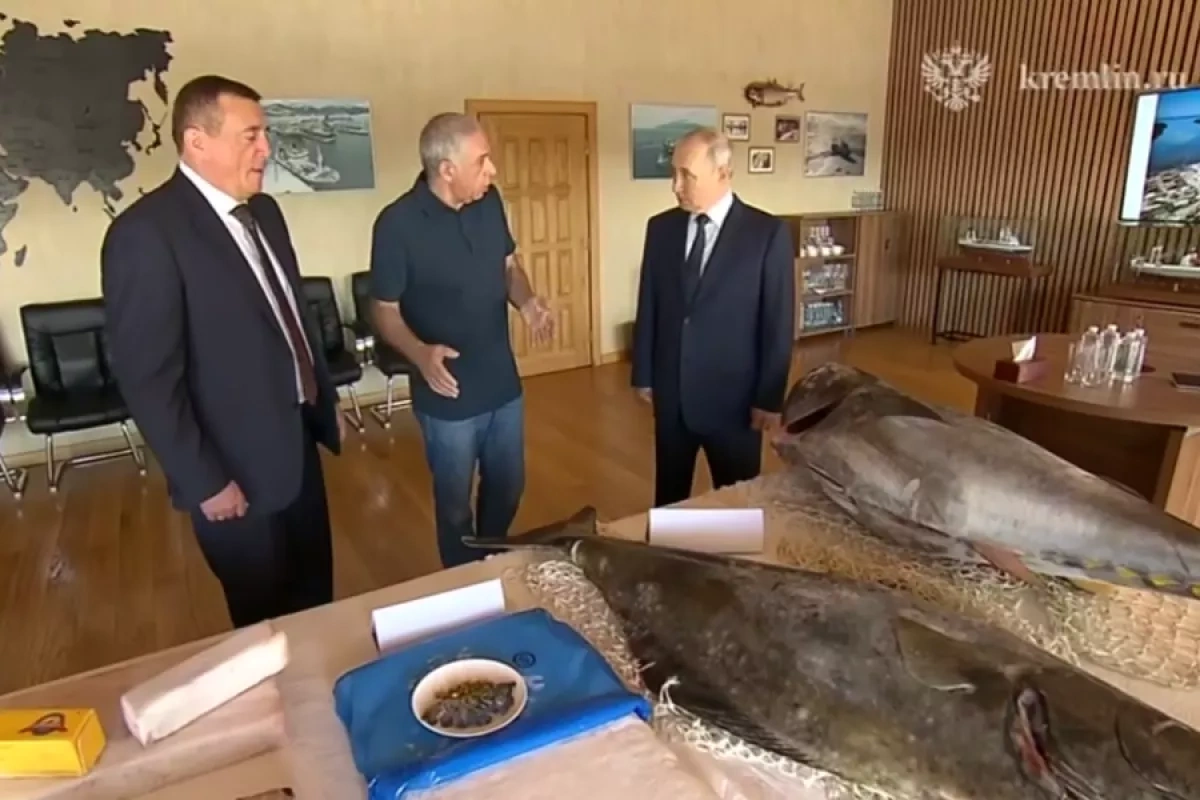
The report said Putin travelled to Iturup, known as Etorofu in Japan, on August 13, visiting a fishery where he spoke with workers, interacted with children and sampled caviar. The island has been administered by Moscow since Soviet forces seized the Kurils in 1945.
The visit marks a departure from Putin’s previous approach to the disputed islands. Despite being aware of Japan’s sensitivities over the territory, he had avoided visiting the archipelago until now.
Japanese Prime Minister Sanae Takaichi condemned the trip as “absolutely unacceptable”, saying it “hurts the feelings of the Japanese people”.
She noted that this visit can only be said to have further hardened anti-Russia sentiment within Japan and made the medium to long-term recovery of relations more difficult.
The Kremlin’s move was more than a symbolic provocation, however. It also reflects a broader shift in relations between Moscow and Tokyo and the changing balance of power in the region.
Japan had sought to separate its territorial dispute with Russia from broader bilateral relations, particularly before Russia’s full-scale invasion of Ukraine in 2022. Tokyo had hoped that maintaining ties with Moscow could help limit China’s growing influence in the western Pacific.
Japan’s dispute with Russia over the Kurils dates back to the final days of the Second World War. The Soviet Union declared war on Japan two days after the atomic bombing of Hiroshima and invaded the Kuril Islands shortly before Japan surrendered.
Soviet forces subsequently expelled the Japanese population. Japanese buildings were destroyed or demolished, while towns and streets were renamed. Today, around 21,000 people live across the archipelago, most of them Russian citizens.
The four southernmost islands remain at the centre of Japan’s territorial claims. Takaichi has described them as “inherently part of Japanese territory, both historically and under international law”.
For years, Putin had attempted to ease tensions over the dispute. In 2022, he even considered a proposal that could have seen Russia return two of the smaller islands, although questions remained over Moscow’s intentions given its history of territorial expansion.
Tokyo and Moscow nevertheless saw strategic benefits in maintaining pragmatic relations. Former Japanese Prime Minister Shinzo Abe, who served from 2012 to 2020, believed that isolating Russia would push it closer to China. He therefore sought stronger economic and political ties with Moscow and promoted investment in Russia’s underdeveloped Far East.
Abe also developed a close relationship with Putin, who at the time shared some of Japan’s concerns about China’s rapidly expanding influence.
Russia’s invasion of Ukraine fundamentally changed that strategy. Japan aligned itself firmly with Western countries, providing assistance to Kyiv and imposing sanctions on Moscow that had previously been more limited.
Putin’s visit now signals not only a renewed assertion of Russian control over the disputed islands but also the collapse of the remaining political warmth between Moscow and Tokyo. Russia no longer appears interested in accommodating Japan, which Moscow increasingly views as part of the opposing camp.
The visit comes as tensions across the region continue to rise. Russia has recently conducted major naval exercises and live-fire missile tests around the southern Kuril Islands, while North Korea, a Russian partner in the war in Ukraine, launched a missile into the Sea of Japan this week.
At the same time, Russia and China have expanded joint air and maritime patrols in the Sea of Japan and the western Pacific, highlighting their increasingly close strategic partnership.
Abe’s earlier concerns about China, Russia and the broader regional balance have therefore taken on new significance. An increasingly coordinated anti-Western grouping involving China, Russia, Iran and North Korea — sometimes referred to as the Crinks — has emerged.
Japanese officials now warn that the country faces its most challenging strategic environment since the Second World War.
Takaichi, who has taken a hawkish stance on national security, has responded by strengthening Japan’s military capabilities. Her government has increased defence spending, accelerated plans to deploy long-range cruise missiles and allocated additional resources to drones and unmanned naval vessels.
She has also angered Beijing by suggesting that Japan could invoke “collective self-defence” if China were to invade Taiwan.
Japan is simultaneously seeking closer security cooperation with Australia, Britain and the United States through the Aukus pact and undertaking the most extensive overhaul of its intelligence system since the end of the Second World War.
Tokyo increasingly shares Western concerns that Russia, potentially acting alongside its partners, could expand its confrontation beyond Ukraine through either covert or direct attacks against democratic countries.
And Japanese officials increasingly frame the threat in broader regional terms, warning: “Ukraine today may be East Asia tomorrow.”
By Bakhtiyar Abbasov