BAKU, Azerbaijan, August 14. Kazakhstan's
Middle Corridor strategy offers new options for Pakistan via
Azerbaijan.
This was announced by Market Development Director at the Anzali
Free Zone (AFZ), Hossein Fashkhami, on his social media
account.
According to him, Kazakhstan's transport strategy, in addition
to expanding routes connecting Central Asia, the Caspian region,
and Europe, can create new logistics opportunities with Pakistan
via Azerbaijan.
He noted that Kazakhstan demonstrates the economic importance of
integrated transport networks.
"Despite being the largest landlocked country in the world,
Kazakhstan has invested heavily in railways, highways, ports on the
Caspian Sea, border terminals, logistics centers, and digital
transport systems to become one of the main transit hubs of
Eurasia.
Over the past seven years, Kazakhstan has invested about $35
billion in its transport infrastructure. New projects are currently
being implemented to expand transport opportunities in the
directions of China, Central Asia, the Caspian region, and Europe,"
the expert recalled.
Fashkhami emphasized that this is also important for
Pakistan.
"While Kazakhstan is investing to overcome the limitations
created by the lack of access to the sea, Pakistan has the
advantage that Kazakhstan needs most - direct access to the Arabian
Sea. The state visit of Kazakh President Kassym-Jomart Tokayev to
Pakistan in February 2026 highlighted the strategic opportunities
for deeper cooperation between the two countries.
Kazakhstan is forming transport corridors, rather than
individual projects. The concept of the country's transport and
logistics potential development until 2030 envisages the parallel
development of road, rail, sea, and air transport, the creation of
cross-border logistics centers, the modernization of the transport
fleet, and the reduction of non-physical barriers in transit," he
explained.
The expert pointed out that the analysis of the Organization for
Economic Cooperation and Development (OECD) also emphasizes
Kazakhstan's strategic position. The country has a central role in
the Trans-Caspian International Transport Route (Middle Corridor),
the border with China, the ports of Aktau and Kuryk on the Caspian
Sea, and the Trans-Caspian International Transport Route (Middle
Corridor).
"The Middle Corridor runs along the route China → Kazakhstan →
Caspian Sea → Azerbaijan → Georgia → Türkiye/Black Sea →
Europe.
Against the background of the preference of cargo carriers for
more sustainable and diversified Eurasian routes, the volume of
cargo transportation along this corridor has grown rapidly. While
the volume of cargo transported along the China-Europe route across
the Caspian was less than 1.5 million tons in 2022, it will exceed
3.3 million tons in 2024.
Kazakhstan aims to increase the volume of transit cargo
transportation to 74 million tons by 2030 and is expanding its
transport capabilities before demand is fully formed.
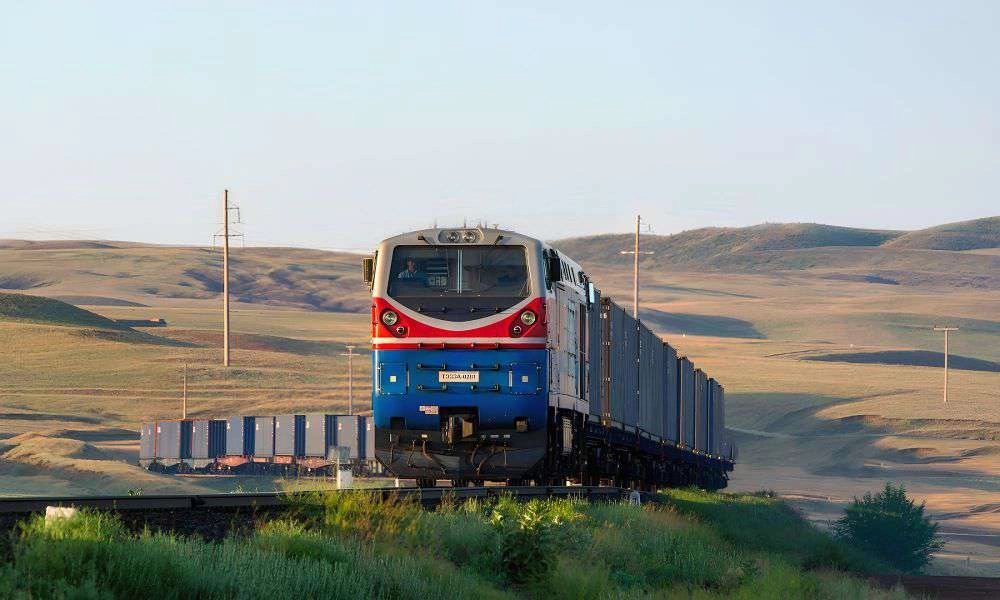
The basis of this strategy is several railway projects. These
include the construction of a second track on the Dostik-Moyintsi
line and increasing its capacity, the approximately 300-kilometer
Bakhti-Ayagoz railway line, which will create additional access to
China, as well as the development of a railway line around Almaty
to eliminate obstacles in freight transportation.
According to Fashkhami, this strategy creates a number of
practical opportunities for Pakistan.
Transit partnership: coordinating port and inland logistics
capabilities to attract part of the cargo flows across Eurasia;
Corridor integration: connecting Pakistan's sea outlet with
Central Asian land transport routes and creating faster, more
diversified trade routes;
Joint investments: Joint development of multimodal logistics
centers, customs simplification mechanisms, and digital cargo
tracking systems to reduce transit times and costs.
The Middle Corridor is a transport and trade route connecting
Asia with Europe through Central Asia, the Caspian Sea, Azerbaijan,
Georgia, and Türkiye. It serves as an alternative to the
traditional Northern and Southern corridors and provides a
land-based link between China and Europe.
Anzali Free Trade and Industrial Zone is an economic and
logistics hub located in Gilan Province, Iran, on the southern
coast of the Caspian Sea. The zone, which has been operating since
2005, covers an area of approximately 2,300 hectares and 40 km of
coastline. Its access to Anzali and Caspian ports, road, rail, and
air routes, as well as its location on the North-South
International Transport Corridor, increases the zone's transit and
trade opportunities. There are investment opportunities in the
fields of industry, logistics, tourism, export, and re-export.