BAKU, Azerbaijan, August 14. Kazakhstan has
allocated 1.4 billion tenge ($2.9 million) from the Special State
Fund to modernize water supply and wastewater infrastructure in the
Burabay resort district and Shchuchinsk city.
This was announced in the statement of the government of
Kazakhstan.
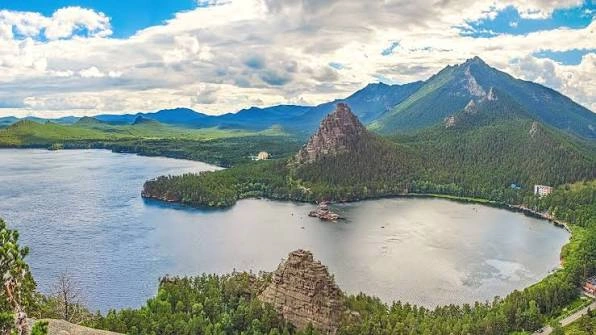
The funds will be directed to four projects. In the Burabay
district, the allocation will support modernization of water
pipeline networks serving children's health centers near Lake
Katarkol, improving the reliability of utilities during periods of
high seasonal demand. In Shchuchinsk, the financing will cover the
fourth phase of construction and reconstruction of the main water
supply network, repairs to sewage facilities and networks, as well
as the installation of intra-block sewage systems.
According to the Kazakh government, the projects will reduce
network accident rates and create capacity for connecting new
residential, social, and tourism facilities that are currently
restricted due to infrastructure limitations. The upgrades are also
expected to improve conditions for attracting investment into the
region.
The projects are financed through Kazakhstan’s Special State
Fund, which accumulates assets returned through anti-corruption and
asset recovery proceedings. Since 2024, the fund has approved 610
billion tenge ($1.27 billion) for more than 500 social projects. Of
these, 267 projects worth 226.5 billion tenge ($473 million) are
related to water infrastructure.
The Burabay allocation comes as Kazakhstan’s water sector
increasingly focuses not only on expanding infrastructure but also
on improving efficiency, digital monitoring, and sustainable use of
water resources. Meanwhile, the Eurasian Development Bank’s (EDB)
Analytical Department told Trend that modern water management requires combining
infrastructure upgrades with digital technologies, professional
training, and improved regulation.
"Water conservation is not limited to installing individual
sensors or providing one-time training. Data must be transformed
into management decisions, technologies into practical skills, and
pilot solutions into a foundation for further scaling. This is how
digitalization, competencies, infrastructure, and regulation come
together into a single business ecosystem," the source said.
According to the EDB, these principles are being tested in
Kazakhstan through the bank’s $5.3 million project "Development of
a Business Ecosystem for Sustainable Irrigation in Kazakhstan,"
implemented in partnership with the Ministry of Water Resources and
Irrigation and the UN Development Programme.
Trend's analysis
shows that the Burabay-Shchuchinsk project differs from
Kazakhstan’s other recent water infrastructure allocations financed
through the Special State Fund. Unlike projects aimed at connecting
previously underserved rural settlements, this initiative focuses
on upgrading an existing system where infrastructure capacity has
become a constraint on further development. The distinction is
important because Burabay is one of Kazakhstan’s main tourism
destinations, attracting millions of visitors annually. Water and
wastewater capacity therefore directly affects not only residents
but also hotels, health centers, recreation facilities, and future
investment projects. In this context, utility modernization becomes
an economic development tool rather than a purely social
infrastructure measure. Expanding water capacity allows tourism
businesses to scale operations and reduces infrastructure-related
barriers for new projects.