BAKU, Azerbaijan, August 12. Development in
Nakhchivan under President Ilham Aliyev is moving well beyond
regional projects, as new railways, transport routes and energy
infrastructure gradually reshape its position on the South Caucasus
map.
For the Nakhchivan Autonomous Republic, this marks a new stage
of development. For Azerbaijan, however, the implications are much
broader. Railway projects, the restoration of regional transport
links, the TRIPP route, expanding ties with Türkiye and Iran,
industrial development and energy projects are gradually changing
Nakhchivan’s role in the region.
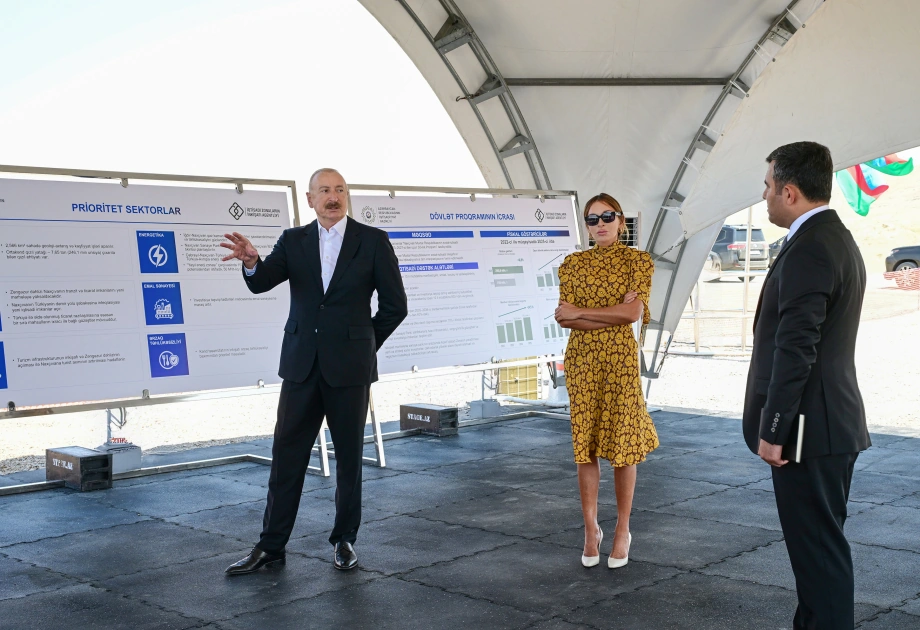
During his visit to Nakhchivan on August 11, President Ilham
Aliyev stressed that the autonomous republic is developing across
multiple sectors, noting that many major projects have been
implemented there during his presidency. “Every visit of mine is of
great significance and produces important results. Over these
years, many important projects have been implemented, ensuring the
overall development of Nakhchivan,” the President said.
What sets the current phase apart, however, is that Nakhchivan’s
development is increasingly tied to the restoration of its historic
role as a crossroads for trade routes running in different
directions.
Railway links are restoring Nakhchivan’s transit
role
For decades, Nakhchivan’s geography was both an advantage and a
constraint. The region borders Türkiye and Iran and lies close to
Armenia, but the lack of a direct land connection with mainland
Azerbaijan significantly limited the economic value of this
location.
That is now changing. One of the key elements of this process is
the restoration and expansion of railway connectivity. The
Nakhchivan railway project will extend the line to 194.2 kilometers
and includes the reconstruction of 10 stations and three passenger
platforms. Work has already begun on a seven-kilometer section from
Salam Malik station to the Armenian border.
The railway infrastructure is also being developed as part of
the broader Zangezur Corridor project. Once the relevant projects
are completed, the railway will have an annual capacity of 15
million tons of freight. “As you know, the creation of the Zangezur
Corridor was our initiative. Connecting the main part of Azerbaijan
with Nakhchivan, which is an integral part of it, has been our
long-standing dream,” President Ilham Aliyev said.
According to the President, Azerbaijan has moved steadily toward
achieving this goal. The project, however, is about more than
restoring an internal connection. The Nakhchivan railway section is
expected to be technically and structurally aligned with the
Kars–Igdir–Dilucu railway being built in Türkiye. At the same time,
work on the section near the Armenian border is planned to be
coordinated with the TRIPP project.
This could create an integrated chain linking mainland
Azerbaijan with Türkiye and wider international transport routes,
putting Nakhchivan at the center of several emerging
connections.
TRIPP raises Nakhchivan’s regional
significance
This is where Nakhchivan’s transport agenda takes on a broader
regional dimension. A joint statement by the United States, Armenia
and Azerbaijan marking the first anniversary of the White House
peace summit said that the Trump Route for International Peace and
Prosperity, or TRIPP, is gradually moving from an idea toward
implementation.
Engineering and surveying work is already underway in Armenia,
while Azerbaijan has nearly completed the road and railway
infrastructure on its territory that will connect with TRIPP in
Armenia. The parties also support the construction of a power
transmission line along the route. The emerging infrastructure
network therefore goes beyond a single transport link. It could
reshape the movement of goods and energy across the South
Caucasus.
President Ilham Aliyev has also pointed to growing international
interest in the route. “Many international organizations and some
countries are interested in this railway, particularly in the
Nakhchivan segment of Azerbaijan’s railway. One of them is the
European Union,” he said.
This is particularly relevant as the Middle Corridor continues
to develop. While a significant share of freight between the
Caspian region and Europe currently moves through Georgia,
additional routes through Nakhchivan could diversify the region’s
transport geography.
President Ilham Aliyev has pointed to the scale of the potential
impact. “Of course, the transportation of, say, 15 million tons or
perhaps more of cargo through here (the Zangezur Corridor – ed.)
will lead to much greater activity. More jobs will be created,
economic activity will increase, and Nakhchivan, I can say, will
become one of the indispensable transportation hubs. This is
entirely possible,” he said.
This is where a transport project begins to translate into an
economic opportunity.
Transit can support industrial growth
Transit alone does not guarantee a lasting economic impact. To
achieve that, part of the infrastructure and business activity
generated by new routes must remain in the region. Against this
backdrop, the 310-hectare Nakhchivan Industrial Park is an
important project. Its development includes engineering, transport,
energy and production infrastructure, while talks are already
underway with potential residents.
The experience of Azerbaijan’s existing industrial parks
illustrates the scale of this model. Eight industrial parks
currently operate in the country, with 184 registered residents,
101 of which are already active. Their investments have exceeded
7.1 billion manats ($4.17 billion), while more than 11,500 jobs
have been created. As of July 1, 2026, industrial parks had
produced goods worth 21.4 billion manats ($12.5 billion), including
6.7 billion manats ($3.9 billion) in exports.
For Nakhchivan, this creates an opportunity to move beyond being
a territory through which goods simply pass and become a place
where some of those goods are produced, processed and generate
additional value. Over time, this model could expand into
logistics, warehousing, manufacturing and other industries serving
both the domestic market and neighboring countries.
Energy adds another dimension
Energy is another factor reshaping Nakhchivan’s economic
outlook. On August 11, President Ilham Aliyev reviewed the
construction of two solar power plants, Shams 1 and Garbi Ufug,
with a combined capacity of 50 MW. Once operational, they are
expected to generate about 118 million kilowatt-hours of
electricity annually, enough to supply around 40,000
households.
Nakhchivan, however, has much greater solar potential. “The
solar energy potential in Nakhchivan is immense. Based on
monitoring and precise analysis, Nakhchivan is the most favorable
location within the territory of Azerbaijan for solar power
generation,” President Ilham Aliyev said.
A total of 688 hectares in the autonomous republic has been
designated for solar power projects. Nakhchivan currently accounts
for 108 MW, or 5.2%, of Azerbaijan’s total installed renewable
energy capacity. Once the two new plants are commissioned, the
figure will rise to 158 MW.
This is where the transport and energy agendas begin to
converge. President Ilham Aliyev has said that the Zangezur
Corridor is now being viewed more broadly than its original
transport concept. “We already have a project ready for laying
power transmission lines from mainland Azerbaijan to Nakhchivan
through the territory of Armenia,” he said.
Together with the power transmission line supported by the
parties along the TRIPP route, this opens the possibility of
creating new regional energy links alongside transport connections.
For Nakhchivan, that could strengthen energy security while
creating longer-term opportunities to use its renewable energy
potential for wider markets.
Nakhchivan is being planned for 2044
Economic transformation requires a city capable of supporting
it. This is why infrastructure development is also taking place
within Nakhchivan itself. The city’s new master plan runs through
2044. It envisages expanding the urban settlement area by about
44%, increasing the population from 97,200 to 130,000 and raising
employment by almost 40% to 78,000. The plan calls for improvements
in transport, recreational areas, social infrastructure and
tourism. The cycling network is expected to reach 122 kilometers,
while green space per capita is projected to increase from 15 to 27
square meters.
At the same time, Nakhchivan is getting a modern public
transport system. Sixty electric buses have been purchased for nine
routes, while a digital monitoring system is being introduced and
fare payments are being moved to cashless formats. These projects
may appear disconnected from international transport corridors. But
they show that Nakhchivan’s development is being planned with
future growth in passenger flows, employment and business activity
in mind.
President Ilham Aliyev said Nakhchivan, Eastern Zangazur and
Karabakh should develop under a unified approach. “I instructed
that a Master Plan for Nakhchivan city should also be developed and
prepared, which was presented to me today, and that additional
measures should be taken to ensure the city’s development and the
creation of modern infrastructure,” he said.
In this sense, the changes underway in Nakhchivan reflect a
broader policy that began with the emergence of new political and
security realities following Azerbaijan’s victory and is now
extending into the economic and infrastructure sphere. The military
victory changed the conditions under which regional policy could be
pursued. Peace agreements and new mechanisms for cooperation are
creating space for the restoration of connectivity. Railways,
TRIPP, the industrial park, power transmission lines and renewable
energy projects are turning those changes into long-term
infrastructure.
That is why Nakhchivan’s current development goes well beyond a
regional socioeconomic program. President Ilham Aliyev’s policy is
gradually giving Nakhchivan a new role — not only as a region to be
developed and more closely integrated with the rest of Azerbaijan,
but also as a potential node in the emerging transport and economic
map of the South Caucasus.
If the railway projects are completed as planned and TRIPP and
other regional connections move into sustained operation,
Nakhchivan will have an opportunity to turn its geography into an
economic advantage once again. Its links with mainland Azerbaijan,
Türkiye and neighboring markets could strengthen East-West trade
flows while also adding weight to the North-South route.
This is how the next phase of Azerbaijan’s regional strategy is
taking shape: the military victory created new realities, while
peace and development are embedding them through infrastructure,
trade and economic ties. Nakhchivan is becoming one of the clearest
examples of how a shift in regional geography can gradually
translate into a new economic reality.