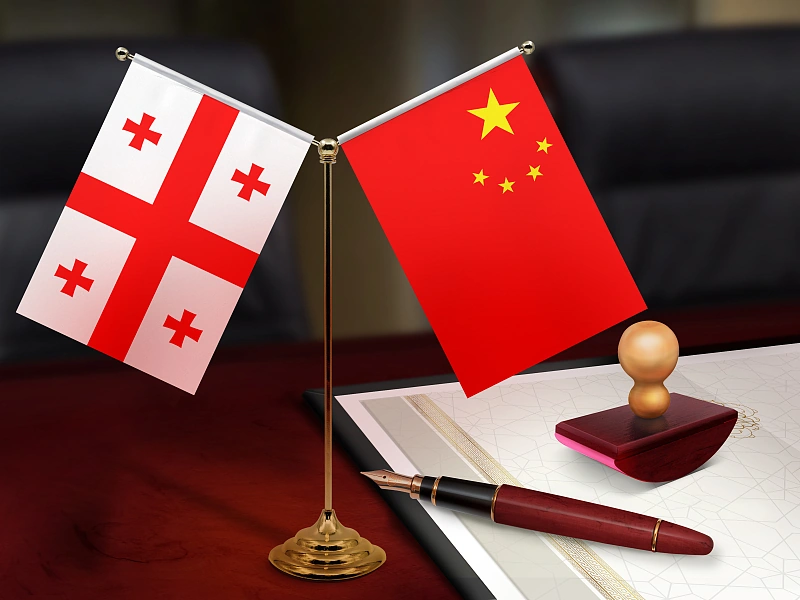
BAKU, Azerbaijan, August 6. Trade turnover
between China and Georgia reached $1.8 billion in the first half of
2026, increasing by 20.5% year-on-year, according to data from the
General Administration of Customs of the People’s Republic of
China.
China’s exports to Georgia amounted to $1.41 billion in
January-June 2026, while Georgian exports to China reached $389.7
million. The fastest growth was recorded in Georgia’s exports to
China, which increased by 195% compared with the same period of
2025. In June alone, bilateral trade amounted to $352.9 million,
including $286.5 million in Chinese exports and $66.4 million in
imports from Georgia.
The growth in trade flows comes amid efforts to further develop
connectivity between Asia and Europe through the Trans-Caspian
International Transport Route (TITR), also known as the Middle
Corridor. The route connects China with European markets through
Central Asia, the Caspian Sea, Azerbaijan, Georgia and Türkiye,
providing an alternative logistics link between East and West.
Commenting on the development of the Middle Corridor, the
Organisation for Economic Co-operation and Development (OECD) told
Trend that the route offers significant opportunities for
strengthening trade links between Europe and Asia.
"The development of the Trans-Caspian International Transport
Route, or Middle Corridor, offers a major opportunity to strengthen
trade links between Europe and Asia. By improving infrastructure,
streamlining border procedures and deepening regional cooperation,
countries along the route can help create more efficient, resilient
and sustainable trade routes," the OECD said.
The organization noted that Kazakhstan’s role in Eurasian
connectivity is closely linked with the development of the Middle
Corridor, while emphasizing the importance of infrastructure
modernization and regional cooperation for expanding trade
opportunities.
Georgia plays a key role in the Middle Corridor as a link
between the Caspian region and European markets through its railway
network, ports on the Black Sea and logistics infrastructure.
The expansion of China-Georgia trade also takes place within the
framework of the China-Georgia Free Trade Agreement, which entered
into force in 2017 and was the first such agreement signed by China
with a Eurasian country.
Trend’s analysis
shows that the 20.5% increase in China-Georgia trade is notable,
but the more significant development is the structure of growth.
While Chinese exports continue to represent the larger share of
bilateral trade, Georgian exports to China increased nearly three
times year-on-year, indicating stronger access for Georgian
products in the Chinese market.
The growth of Georgian exports reflects the gradual expansion of
trade beyond traditional regional markets. Georgia has been
promoting agricultural and food products, including wine, mineral
water, nuts and other goods, in China, supported by preferential
trade conditions under the bilateral free trade agreement.
The figures also highlight the growing importance of transport
connectivity for bilateral economic relations. As trade volumes
between China and Georgia expand, efficient logistics routes become
increasingly important, particularly through the Middle Corridor,
where Georgia serves as a key transit link between Central Asia and
European markets.
For the Middle Corridor, rising trade between China and
countries along the route provides an additional economic
foundation for infrastructure development. The corridor’s
competitiveness depends not only on physical infrastructure such as
railways and ports, but also on coordinated customs procedures,
digitalization and closer cooperation among participating
countries.
At the same time, China-Georgia trade remains relatively
balanced in terms of growth dynamics rather than absolute volumes,
with Chinese exports still significantly exceeding Georgian
supplies. Further development of logistics capacity and broader
market access could help Georgia increase its role from a transit
country to a more active participant in Eurasian trade flows.
In Trend’s
assessment, the combination of expanding bilateral trade and
continued investment in Middle Corridor infrastructure creates
additional opportunities for Georgia and other participating
countries to strengthen their position in Asia-Europe supply
chains.