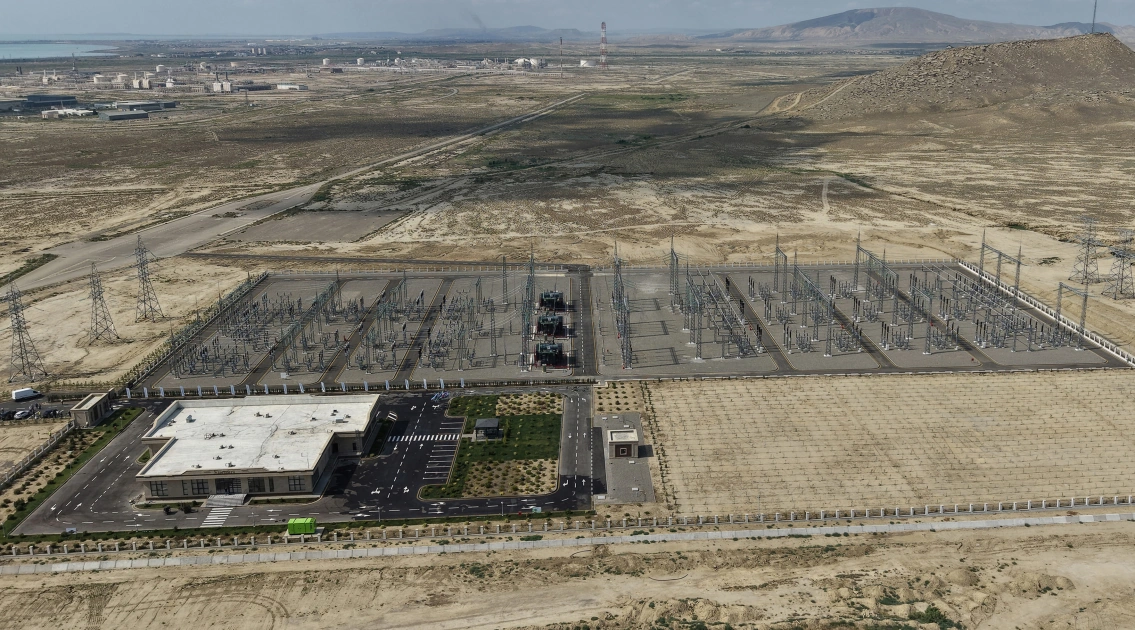
BAKU, Azerbaijan, August 3. The opening of the
220/110/10-kilovolt Yeni Sangachal substation took place with the
participation of President of the Republic of Azerbaijan Ilham
Aliyev today. This project marks the next stage in the
transformation of Azerbaijan's energy sector, where the development
of renewable energy sources is increasingly integrated with
traditional oil and gas infrastructure.
Just a few years ago, the implementation of renewable energy
projects was seen mainly as part of a decarbonization policy,
whilst today they are becoming an element of a broader strategy
aimed at simultaneously increasing the efficiency of the national
energy system, strengthening the country's export potential, and
ensuring the long-term sustainability of the energy sector.
The project, connecting the Shafag solar power plant under
construction in the Jabrayil district and the Sangachal terminal
via Azerbaijan's unified power grid, is one of the most
illustrative examples of this approach. This project will not only
reduce carbon emissions and transition one of the key oil and gas
industry facilities to renewable energy sources, but will also
annually release significant volumes of natural gas that can be
exported. Given the continued demand for Azerbaijani gas in Europe,
such projects are acquiring not only environmental but also
strategic economic significance.
This large-scale project envisages the integration of the 240 MW
Shafag solar power plant, currently under construction in the
Jabrayil district, into Azerbaijan's power grid and the provision
of electricity to the Sangachal terminal via the country's unified
power grid. The project is being implemented under a cooperation
agreement between Azerenergy OJSC and bp.
The first stage of the project was the opening of the
330-kilovolt Shafag substation in Soltanli village of the Jabrayil
district on May 9 of this year. The next step was the construction
of the Yeni Sangachal substation, which will ensure the
transmission of electricity to the Sangachal terminal.
Once the project is commissioned, the terminal's existing
gas-fired power plant will be shut down, and electricity generated
by the Shafag solar power plant will be supplied to the facility
via the national grid. As a result, the Sangachal Terminal's annual
electricity demand of approximately 500 million kWh will be
entirely met by renewable energy sources. This will save 120-150
million cubic meters of natural gas annually and reduce carbon
dioxide emissions by 260,000-330,000 tons.
Furthermore, the new substation will supply power to bp's 80 MW
Sangachal Terminal and 85 MW Shah Deniz Compressor Station. Thus,
the combined demand of these two strategic facilities, exceeding 1
billion kWh per year, will be covered by Azerbaijan's unified power
grid.
Liberated territories become energy hubs
The project also reflects the new role of the liberated
territories in the country's energy policy. The Jabrayil district
is gradually becoming not only a site for renewable energy
facilities but also a source of electricity for Azerbaijan's
strategic oil and gas infrastructure.
Construction of the 240 MW Shafag solar power plant is actively
underway. In April 2026, the first solar module was installed at
the site, the delivery of the main equipment was completed, and
approximately 30% of the towers and tracking systems have already
been installed. Upon completion in 2027, the plant will be able to
generate approximately 500 million kWh of electricity annually. The
project is being implemented by a consortium consisting of bp
(40.01%), SOCAR Green (39.99%), the Azerbaijan Business Development
Fund (10%), and the Hungarian MVM company (10%).
One of the project's key features is the implementation of a
"virtual energy transfer" mechanism, which will allow solar power
generated in Jabrayil to be supplied to the Sangachal terminal via
the national grid.
After fully electrification of the terminal, the seven gas
turbines currently used for power generation will be gradually
decommissioned. This means not only a reduction in operational
emissions by approximately 50%, but also the opportunity to export
the freed natural gas. Namely this component makes the project
important not only from a climate policy perspective but also from
an energy security and export strategy perspective for
Azerbaijan.
Renewable energy becomes new growth hub
In recent years, Azerbaijan has significantly accelerated the
development of renewable energy.
As President Ilham Aliyev noted, the country will have 2 GW of
solar and wind generation by the end of 2027, and this figure
should reach 8 GW by 2032.
"Our responsibility dictates that we invest in renewables. And
we are doing that, together with our partners, creating very good
conditions for investors, more or less the same as those that
existed in the beginning of the 1990s for oil companies. Now, the
same level of cooperation and investment-friendly approach is being
applied to companies in the renewable energy sector. We already
have several projects in operation. By the end of next year, we
will have 2 gigawatts of solar and wind capacity. By the end of
2032, we will have 8 gigawatts of solar and wind capacity. And if
we add hydropower, which we are actively developing, especially in
the liberated areas of Garabagh and East Zangezur, where more than
300 megawatts have already been commissioned, this represents
additional potential," said President Ilham Aliyev, speaking at the
opening of the Baku Energy Week on June 1.
Today, the installed capacity of renewable energy facilities in
the country is approximately 1.83 GW, and their share of the total
installed capacity of the power grid has reached almost 19%. This
positive trend is already reflected in the current indicators of
the country's electricity sector. According to data from the
Azerbaijani Ministry of Energy, from January through June 2026,
electricity production at thermal power plants amounted to 10.59
billion kWh, at hydropower plants – 1.89 billion kWh, and at other
generation facilities – 902 million kWh.
Of this volume, wind power plants accounted for 475.7 million
kWh, solar power plants – 282.7 million kWh, and another 143.6
million kWh was generated at the Municipal Solid Waste Incinerator
Plant.
Compared to the same period last year, hydropower generation
increased by 31.2 million kWh, while wind power generation
increased by 454.7 million kWh. Overall, renewable energy
generation, including hydropower, rose by 463.1 million kWh to 2.79
billion kWh, demonstrating the continued expansion of renewable
energy sources in the country's energy balance.
Leading international investors play a key role in the
implementation of renewable energy projects. One of Azerbaijan's
largest partners is Masdar (UAE), which has already commissioned
the country's first commercial-scale solar power plant, Garadagh,
with a capacity of 230 MW. Currently, the company is implementing
three more major projects in partnership with SOCAR Green: solar
power plants in Bilasuvar with a capacity of 445 MW and Neftchala
with a capacity of 315 MW, as well as the Absheron-Garadagh wind
farm with a capacity of 240 MW.
Saudi Arabia's ACWA Power is also steadily expanding its
presence in Azerbaijan. In January 2026, the country's largest wind
farm, the Khizi-Absheron wind farm with a capacity of 240 MW, was
officially opened. The company views Azerbaijan as a priority
market for further investment in the renewable energy sector.
Chinese companies are also showing growing interest in the
Azerbaijani market, participating in negotiations and the
implementation of new solar and wind energy projects. Thus, the
development of renewable energy is becoming not only an important
element of the national energy strategy but also one of the most
attractive areas for foreign investment.
Concurrently, Azerbaijan is promoting the creation of
international green energy corridors, including the Caspian-Black
Sea-Europe route, which has already entered the development stage
following the completion of feasibility studies.
The Yeni Sangachal project demonstrates that renewable energy
development in Azerbaijan extends far beyond the construction of
individual solar and wind power plants. The country is gradually
shaping a new energy model in which renewable energy sources are
becoming part of the oil and gas infrastructure, increasing its
efficiency and environmental friendliness.
Integrating solar generation with the country's largest export
terminal simultaneously reduces the country's carbon footprint,
modernizes the energy system, and frees up additional natural gas
volumes for export. With Azerbaijani gas exports expanding and
large-scale renewable energy projects underway, such solutions are
becoming an important element of the country's long-term strategy
to strengthen its role as a reliable supplier of both traditional
and green energy in regional and European markets.