BAKU, Azerbaijan, August 1. Azerbaijan and
Kyrgyzstan have significantly intensified their bilateral
cooperation In recent years. Along with developing transport
corridors, investment projects, and trade and economic ties, the
countries are beginning to develop a new area of cooperation:
energy. The memorandum on cooperation in the petroleum products
sector, signed during President of Azerbaijan Ilham Aliyev's state
visit to Kyrgyzstan, marks a shift from political agreements to the
implementation of specific economic projects.
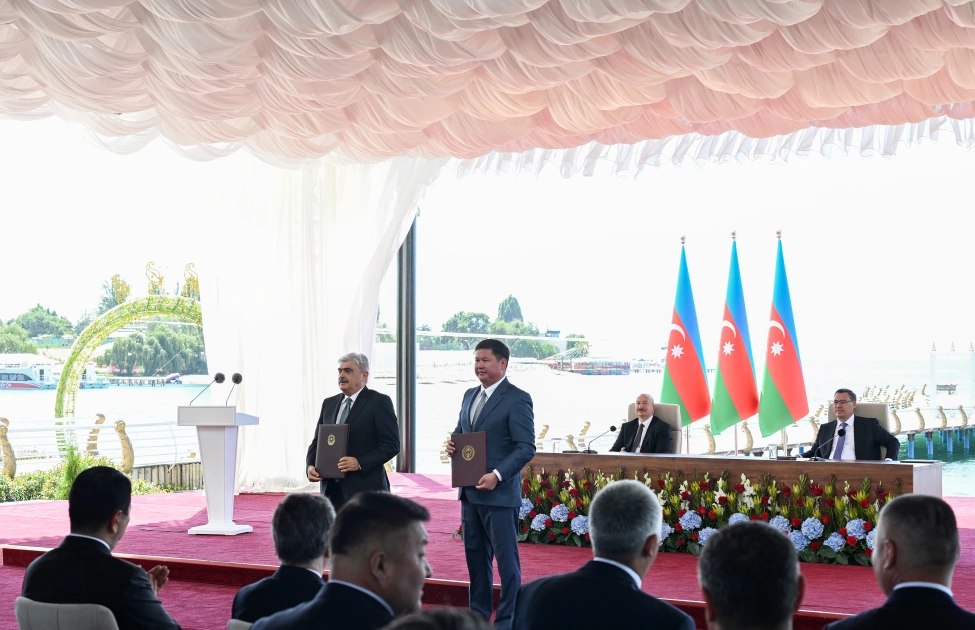
At a ceremony to exchange 15 documents attended by President of
Azerbaijan Ilham Aliyev and Kyrgyz President Sadyr Zhaparov,
Azerbaijani Deputy Prime Minister Samir Sharifov and Kyrgyz Energy
Minister Altynbek Rysbekov exchanged a Memorandum of Understanding
between the Ministry of Energy of Azerbaijan and the Ministry of
Energy of Kyrgyzstan on cooperation in the supply of petroleum
products and a Roadmap for cooperation between Azerbaijan and
Kyrgyzstan in the energy sector for 2026-2028.
At first glance, these are merely framework documents. However,
in reality, their significance is much broader. They reflect
ongoing changes on the region's energy landscape, where issues of
fuel supply diversification are becoming no less important than the
development of transport routes and trade links.
It's notable that after the signing ceremony, Kyrgyz Energy
Minister Altynbek Rysbekov, answering questions from Trend's special correspondent, spoke not about general
prospects, but about the practical implementation of the agreements
reached. He said that the parties intend to soon determine specific
cooperation mechanisms, supply volumes, and prepare a roadmap for
implementing the memorandum.
"The memorandum will give us the opportunity to build a good,
close partnership. This concerns cooperation specifically in the
supply of petroleum products. We already have preliminary
agreements. Now we need to work out the implementation mechanisms:
how supplies will be delivered and what path we'll take moving
forward," he said.
The minister also noted that similar work is underway in the
electric power sector. The parties also signed a roadmap in this
area. According to him, Kyrgyzstan has serious intentions to
develop cooperation in this area.
"I believe that good, friendly relations will develop between
our countries in both petroleum products and energy," he said.
Rysbekov noted that preliminary negotiations are currently
underway on petroleum product supply volumes. The parties have
already expressed mutual intentions, and specific volumes and
delivery mechanisms should be determined in the near future.
"Regarding the timeframe, a corresponding instruction was given
today during bilateral meetings. We will clearly outline the
mechanisms in the coming days. I believe that within a week, a
specific roadmap will be prepared, and a specific mechanism will be
announced. This concerns petroleum products, oil, and also energy
cooperation," the minister said.
This approach demonstrates that Baku and Bishkek expect to move
from political agreements to practical cooperation as quickly as
possible.
Why Kyrgyzstan seeking new partners
The signing of the document took place during a challenging
period for Kyrgyzstan.
For many years, the country was almost entirely dependent on
fuel imports from Russia. Today, annual fuel and lubricant
consumption amounts to approximately 1.6 million tons, with 90-95%
of supplies traditionally coming from the Russian market. This
model has long been effective, but recent events have exposed its
vulnerability.
The decline in oil refining volumes in Russia, temporary
restrictions on fuel exports, and increased tensions in the
domestic Russian market have inevitably impacted the countries of
Central Asia. Kyrgyzstan was one of the most sensitive countries to
these changes, as there were virtually no alternative sources of
sufficient supply.
The authorities responded with several measures. The government
imposed a temporary ban on the export of oil and most petroleum
products to ensure supplies for the domestic market. At the same
time, state fuel reserves were increased, an agreement was reached
with major oil traders to contain prices for socially important
fuels, and the geography of potential suppliers was expanded.
Kyrgyzstan is currently negotiating with Russia, Kazakhstan,
Uzbekistan, Belarus, and China.
Thus, the memorandum with Azerbaijan has become part of a larger
strategy to strengthen the country's energy security.
Why namely Azerbaijan was chosen
In recent years, Azerbaijan has strengthened its position as one
of the most reliable energy suppliers in Eurasia.
Energy cooperation of Baku was primarily focused on Europe, but
today the country is gradually expanding its presence in Central
Asia. Several factors contribute to this.
First, Azerbaijan has a sufficient resource base.
In the first half of 2026, the country exported over 10.1
million tons of crude oil and petroleum products, valued at over
$6.2 billion. During the same period, oil and gas condensate
production amounted to 13.27 million tons, and the value of refined
petroleum products exceeded 2.9 billion manat ($1.7 billion).
Second, Azerbaijan is today not only a major energy producer but
also a key transport and logistics hub between Europe and Central
Asia.
The development of the Baku International Sea Trade Port, the
modernization of railway infrastructure, and the active promotion
of the Middle Corridor are creating additional opportunities for
cargo delivery across the Caspian Sea. As countries in the region
strive to diversify trade and energy routes, this infrastructure is
becoming one of Azerbaijan's key advantages.
In recent years, Azerbaijan and the countries of Central Asia
have significantly intensified their political and economic
interaction. While initially the main unifying factor was transport
projects and the development of the Middle Corridor, today,
cooperation is gradually acquiring a new dimension—energy.
For Kyrgyzstan, a partnership with Azerbaijan offers the
opportunity to reduce dependence on a single supplier and make the
fuel supply system more sustainable. For Azerbaijan, this opens up
prospects for expanding its energy presence in Central Asia,
strengthening the country's status not only as an oil and gas
exporter but also as an important participant in the regional
energy architecture.
Logistics as key issue
The key question that inevitably arises after the signing of the
memorandum is how Azerbaijani petroleum products will reach the
Kyrgyz market.
Unlike Azerbaijan's traditional export routes, where pipelines
play a primary role, deliveries to Kyrgyzstan can be carried out
primarily through multimodal transport, using sea and rail.
The most realistic route appears to be via the Caspian Sea.
Petroleum products could be delivered from Azerbaijan to Kazakhstan
by sea via the Baku International Sea Trade Port, and then sent by
rail to Kyrgyzstan. This effectively utilizes the infrastructure of
the Middle Corridor, which has been developing in recent years not
only as a trade route but also as a strategic transport route
between the Caucasus and Central Asia.
Such option has several advantages
First, Kyrgyzstan gains an additional source of fuel, reducing
its dependence on a single supplier. For a country where up to 95%
of its petroleum product market has traditionally been met by
Russian imports, this means increased resilience of the entire
energy supply system. Second, Azerbaijan gains the opportunity to
expand the geography of its oil product exports.
Finally, such supplies could give the Middle Corridor new
meaning. Until now, it has been perceived primarily as a container
shipping route, but the development of oil product shipments could
significantly increase the economic utilization of the transport
infrastructure and expand the range of cargoes transported.
Of course, the parties still need to resolve a number of
practical issues—determining commercial terms, agreeing on
transportation tariffs, ensuring uninterrupted logistics, and
assessing the economic viability of the route. This is why Kyrgyz
Energy Minister Altynbek Rysbekov, after signing the memorandum,
emphasized that specific cooperation mechanisms and supply volumes
would be determined in the near future, and a roadmap for
implementing the agreement will be prepared.
The history of major energy projects begins not with the first
tankers or trains loaded with fuel, but with a political decision
on long-term cooperation. The documents signed during President of
Azerbaijan Ilham Aliyev's state visit to Kyrgyzstan constituted
precisely such a decision.