BAKU, Azerbaijan,
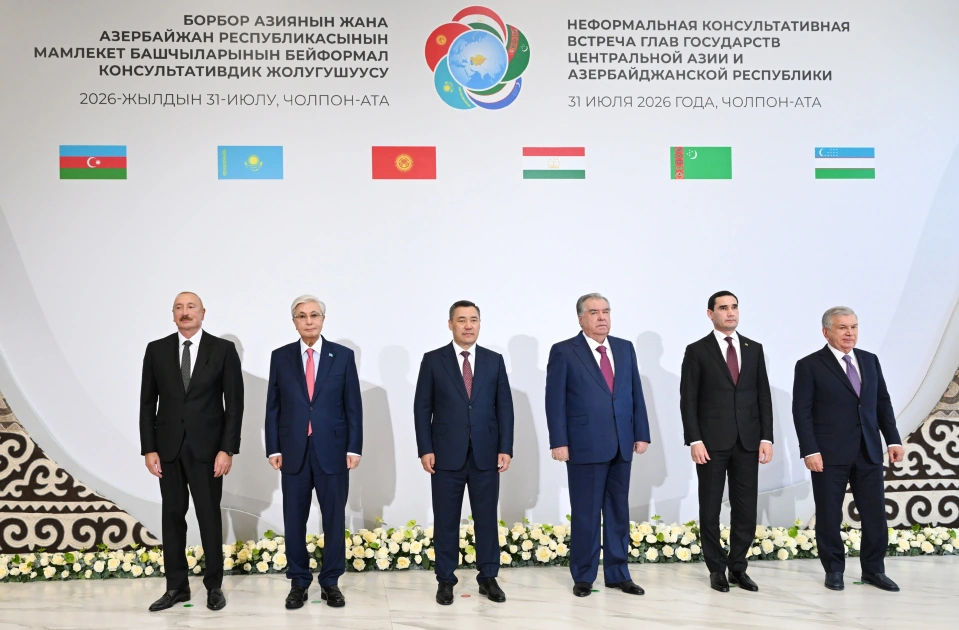
August 1. The Consultative Meeting of the Heads of
State of Central Asia and Azerbaijan took place on the shores of
Lake Issyk-Kul in the Kyrgyz city of Cholpon-Ata on July 31. For
Baku, the summit marked a milestone: President of Azerbaijan Ilham
Aliyev participated in the meeting for the first time as a
full-fledged member of the format rather than as an honorary guest.
The decision to admit Azerbaijan was taken by the region's leaders
at last year's meeting in Uzbekistan, and the six-party mechanism
has now become fully operational.
President Ilham Aliyev himself cited figures illustrating why
Azerbaijan's accession is a logical development rather than a
symbolic gesture. Since the beginning of 2023, over the past three
and a half years, he has visited Central Asian countries 16 times,
while leaders from the region have made 26 visits to Azerbaijan.
"These figures speak louder than any words about the closeness of
our relations and demonstrate that Central Asia and Azerbaijan have
effectively become a single geopolitical and geoeconomic space,"
President Ilham Aliyev said in his address to the summit.
On the eve of the meeting, Baku and Bishkek signed a Treaty on
Allied Relations, elevating bilateral ties to their highest level,
alongside a package of agreements covering energy, transport,
cybersecurity, and statistics. The authorized capital of the
Azerbaijan-Kyrgyz Development Fund was doubled from $100 million to
$200 million. "I would also like to note that I am glad to see how
successfully trade and economic relations are developing between
our two brotherly countries. Today, one of the documents we signed
provides for an increase in the capital of the joint
Azerbaijan-Kyrgyzstan Development Fund from $100 million to $200
million. We were provided with information on the progress achieved
and on the projects that have already been implemented through
financing from the joint fund. Several enterprises are already
operational, and the potential, of course, is quite significant,"
President Ilham Aliyev said.
The fund's co-chairman, Zamirbek Osmonov, said it has already
approved 11 projects, created around 1,000 jobs, and is currently
reviewing about 30 more initiatives spanning energy, logistics,
light industry, and agricultural processing.
Meanwhile, Kyrgyz Energy Minister Altynbek Rysbekov said the
mechanism for oil and petroleum product supplies between the two
countries would be finalized within a week. "Today's memorandum
will give us the opportunity to build a good, close partnership.
This concerns cooperation in the supply of petroleum products. We
already have preliminary agreements. Now we need to work out the
implementation mechanisms: how supplies will be carried out and
what
Against this backdrop, the leaders of the Central Asian
countries outlined the role they see Azerbaijan playing in the
region's future development.
Kazakh President Kassym-Jomart Tokayev described Azerbaijan's
accession as a new stage in the evolution of the consultative
format. "Central Asia is experiencing the most successful period in
its modern history. Azerbaijan's accession as a full participant in
the consultative meetings marked a new stage in the positive
evolution of our format. Thanks to our joint efforts, conditions
are being created for further deepening political dialogue,
expanding cooperation in investment, energy, and industry, and
establishing a unified transport and logistics system," he said.
According to Tokayev, the region is steadily increasing
intraregional trade and investment, and Azerbaijan's participation
further strengthens this momentum.
For Uzbek President Shavkat Mirziyoyev, Azerbaijan's
participation opens the way to creating a unified development space
linking Central Asia, the South Caucasus, and Afghanistan. "We are
facing a historic opportunity to create a unified development space
uniting Central Asia, the South Caucasus, and our close neighbor,
Afghanistan. We must fully utilize this momentum and, through joint
efforts, lay a solid foundation for sustainable development,
connectivity, and good-neighborliness in the heart of Eurasia," he
said.
Tajik President Emomali Rahmon linked Azerbaijan's role to
regional energy security, an issue he said has become increasingly
pressing amid tensions in global energy markets. He proposed
jointly exploring the construction of a large, technologically
advanced oil refinery in the region. "It is well known that the
tense situation currently unfolding in regional and global energy
markets directly affects our interests. In this regard, I would
like to expand on the issue of energy security, one of the key
factors for sustainable development. I have previously addressed
this issue at our previous meetings. Let us all, taking into
account the current situation, seriously consider this pressing
issue. Specifically, I propose instructing our relevant agencies to
consider the construction of a large oil refinery in the region
using the latest technologies," Rahmon said.
Kyrgyz President Sadyr Zhaparov highlighted transport
connectivity and tourism, noting that the Central Asian countries
and Azerbaijan are jointly implementing railway, road, and
multimodal infrastructure projects, including the
China-Kyrgyzstan-Uzbekistan railway. He also proposed introducing a
single tourist visa for foreign visitors wishing to travel across
Central Asia. "Cultural affinity, shared history, and traditional
ties between our peoples remain the solid foundation of our
relations. Cooperation in tourism has great potential. Central Asia
and Azerbaijan have a unique heritage to offer the world: ancient
cities, Silk Road monuments, mountain and lake landscapes, national
traditions, and cultural diversity," he stated.
Turkmen President Serdar Berdimuhamedov confirmed that the
eighth Consultative Meeting will be held in the Turkmen resort city
of Avaza on October 8, 2026. "I am convinced that the new six-party
mechanism of interstate cooperation will contribute to an even
greater rapprochement of our peoples and countries, strengthening
of brotherly ties, as well as will give additional impetus and open
up prospects for cooperation using the increased joint potential,"
he added.
Taken together, the statements made in Cholpon-Ata point to a
clear conclusion: Azerbaijan is increasingly viewed as a key driver
of regional cooperation. Kazakhstan sees Baku's participation as
enhancing the region's international standing; Uzbekistan views it
as an essential link in building a common development space;
Tajikistan regards Azerbaijan as an important partner in
strengthening energy security; Kyrgyzstan sees it as a pivotal
partner in advancing regional transport connectivity and joint
infrastructure projects; and Turkmenistan considers Azerbaijan an
important participant in the new six-party mechanism capable of
injecting fresh momentum into regional integration.
Collectively, these positions underscore that the Central Asian
states increasingly regard Azerbaijan as an integral part of the
emerging regional architecture for cooperation.