BAKU, Azerbaijan, July
30. Azerbaijan and Kyrgyzstan have reached a point where
years of political trust are poised to evolve into their highest
form of bilateral cooperation - an alliance.
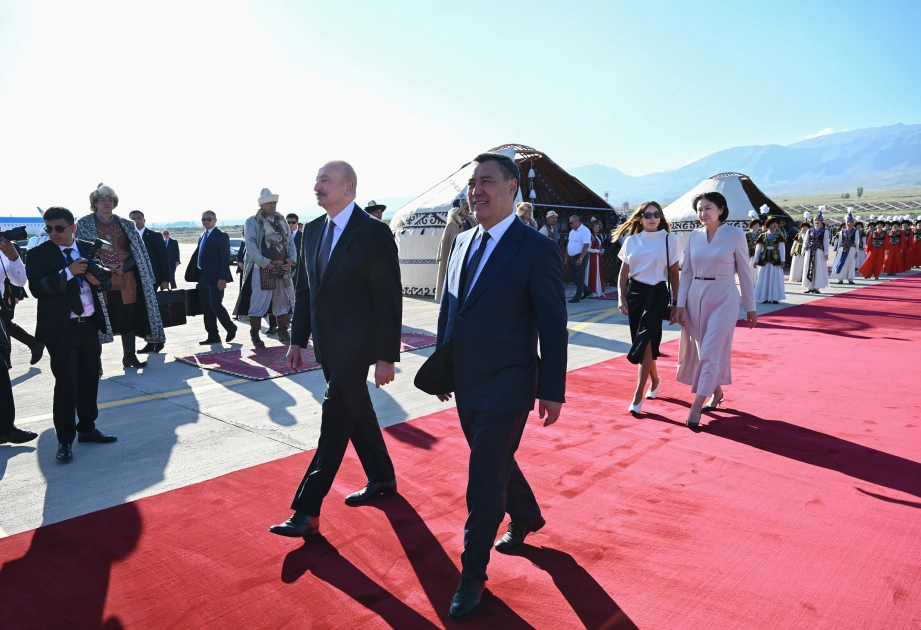
President of Azerbaijan Ilham Aliyev's state visit to Kyrgyzstan
on July 30–31 is the latest confirmation that Central Asia remains
one of the key priorities of Baku's foreign policy. Over the past
several years, relations between the two countries have advanced
steadily - from intensified political dialogue to a strategic
partnership, and now toward the anticipated signing of the Treaty
on Allied Relations, which is expected to become the central
outcome of the visit.
Such a step comes as no surprise. Rather, it is the logical
continuation of a policy that has been consistently pursued in
recent years. Over the past five years, the leaders of the two
countries have held around 13 high-level meetings, while the
Interstate Council, established in 2022, has become the principal
platform for shaping the future course of bilateral cooperation.
Its third meeting is expected to take place during the current
visit.
A defining feature of this process has been the high level of
trust between President Ilham Aliyev and President of Kyrgyzstan
Sadyr Japarov. Regular reciprocal visits and sustained political
dialogue have elevated bilateral cooperation well beyond the
framework of traditional diplomatic engagement.
During President Japarov's state visit to Baku in April 2024,
both sides made it clear that they intended to take relations to a
new level. At the time, President Ilham Aliyev stated: "We have
just signed documents that will in many respects predetermine the
future development of our relations. Each of them is of enormous
importance." President Sadyr Japarov, in turn, emphasized: "The
signing formalizes the profound nature of bilateral strategic
relations we have established between our countries."
Today, that trajectory is entering a new phase.
Political rapprochement is being reinforced by concrete economic
decisions. One of the clearest examples is the
Azerbaijan-Kyrgyzstan Development Fund, established in 2022. In
2024, its authorized capital was increased fourfold to $100
million.
"We have quadrupled the authorized fund from 25 million to 100
million dollars. The main reason is that there are a lot of
applications. We have been informed that more than 40 applications
have been submitted to the Fund for realization of investment
projects in Kyrgyzstan," President Ilham Aliyev said.
The fund is already financing projects in the energy, industrial
and manufacturing sectors, while bilateral trade continues to
expand and nearly 100 Kyrgyz companies are now operating in
Azerbaijan. Transport connectivity, particularly through the
Trans-Caspian International Transport Route (Middle Corridor), is
providing additional momentum, as the route increasingly serves as
one of the main transport arteries linking Central Asia, the South
Caucasus and Europe.
Humanitarian cooperation has become another visible reflection
of the growing political trust between the two countries.
During his first state visit to Kyrgyzstan in 2022, President
Ilham Aliyev attended the inauguration of the Azerbaijan-Kyrgyz
Friendship Park and educational institutions in Bishkek. In turn,
Kyrgyzstan financed the construction of the Aikol Manas School in
Azerbaijan's Aghdam district, becoming one of the first countries
to implement a major reconstruction project in Azerbaijan's
liberated territories.
"The construction of the school is Kyrgyzstan's contribution to
restoring peace in regions affected by the conflict," President
Japarov said.
At the same time, cultural exchanges continue to expand, air
connectivity is improving, regional partnerships are deepening, and
cooperation within the Organization of Turkic States is gaining
momentum. Together, these developments have shaped a relationship
that has long moved beyond conventional interstate cooperation.
The current rapprochement also carries broader regional
significance. Against the backdrop of Central Asia's growing
geopolitical importance and the rising role of the Middle Corridor,
Azerbaijan has consistently strengthened ties with fellow Turkic
states, transforming political partnership into practical
cooperation in transport, investment, trade and infrastructure.
If 2022 laid the foundations for a strategic partnership and
2024 significantly deepened it, the current state visit may mark
the transition to an allied relationship. This is not a one-off
diplomatic achievement, but the result of President Ilham Aliyev's
consistent foreign policy, which has made stronger engagement with
Central Asia one of Azerbaijan's key strategic priorities. Against
this backdrop, the partnership between Baku and Bishkek is becoming
not only stronger, but also increasingly strategic in the long
term, extending beyond the bilateral agenda and reinforcing
cooperation across the wider Turkic world.