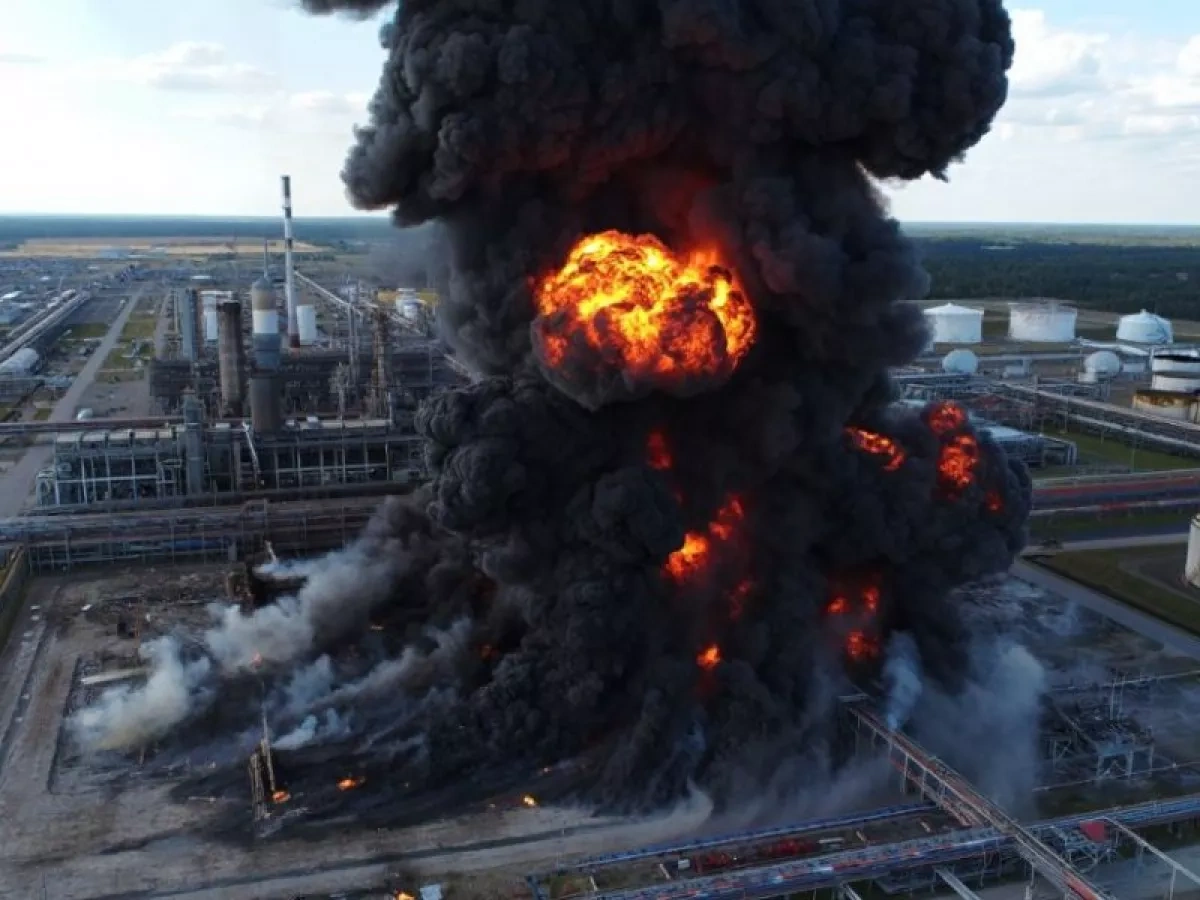
Ukraine's campaign of long-range drone strikes against Russian oil refineries has severely disrupted the country's refining sector, knocking out more than 30% of its operational capacity and over 45% of its nominal capacity, Financial Times reports, citing satellite imagery, thermal-infrared data, refinery analysis, and industry experts.
The newspaper said many of the attacks deliberately targeted critical processing units that are difficult to replace, leaving several of Russia's largest refineries partially or completely out of operation for weeks or even months.
Among the hardest-hit facilities is the Tuapse refinery on Russia's Black Sea coast, where Ukrainian drone strikes in late April destroyed more than a dozen storage tanks with an estimated combined capacity of 80,000 cubic meters, according to the Financial Times. The attacks also appear to have damaged a key secondary processing unit installed during a modernisation program launched under President Vladimir Putin.
The report noted that these processing units convert heavy crude into higher-value products such as diesel, gasoline, and jet fuel. While a refinery can continue operating without them, production quality and efficiency are significantly reduced.
Other strategically important targets include desalting units, which remove salt and water from crude oil before refining. One such facility at the Omsk refinery—one of the world's largest and located roughly 2,500 kilometres from Ukraine's border—was also struck. Experts told the newspaper that damage to these units can sharply reduce a refinery's ability to process crude, even if other equipment remains operational.
According to the report, repairs to critical refinery infrastructure can take several months, while restoring full production may require more than a year.
Satellite imagery analysed by the Financial Times showed that visible damage remained at many of Russia's 10 largest refineries—including those in Omsk, Moscow, and Tuapse—long after the attacks. Images also indicated that repair work has progressed slowly.
At the Moscow refinery, satellite photographs taken more than a month after one strike still showed the collapsed roof of a large oil storage tank, along with damage to several smaller tanks, a pumping station, and connecting pipelines.
Researchers cited by the newspaper also found that refinery activity remained depressed long after attacks. A study tracking nighttime light emissions around 29 major Russian refineries found that activity dropped sharply following drone strikes and, in some cases, remained below normal levels for more than 13 months.
The Financial Times also said the attacks have contributed to Russia's most severe fuel shortages since the collapse of the Soviet Union, leading authorities to impose fuel sales restrictions across much of the country and prompting long lines at filling stations.
Although Russia has restored some refining capacity, including by bringing the Omsk refinery back online, analysts told the newspaper that significant capacity remains offline, making it increasingly difficult to balance domestic fuel supply.
The report added that Russia has expanded drone defences around refineries since 2022, but repeated waves of Ukrainian drones have frequently overwhelmed those systems. A Russian businessman quoted by the newspaper remarked that protective measures that had proven effective earlier in the conflict have struggled to stop coordinated drone attacks targeting the same location simultaneously.
By Bakhtiyar Abbasov