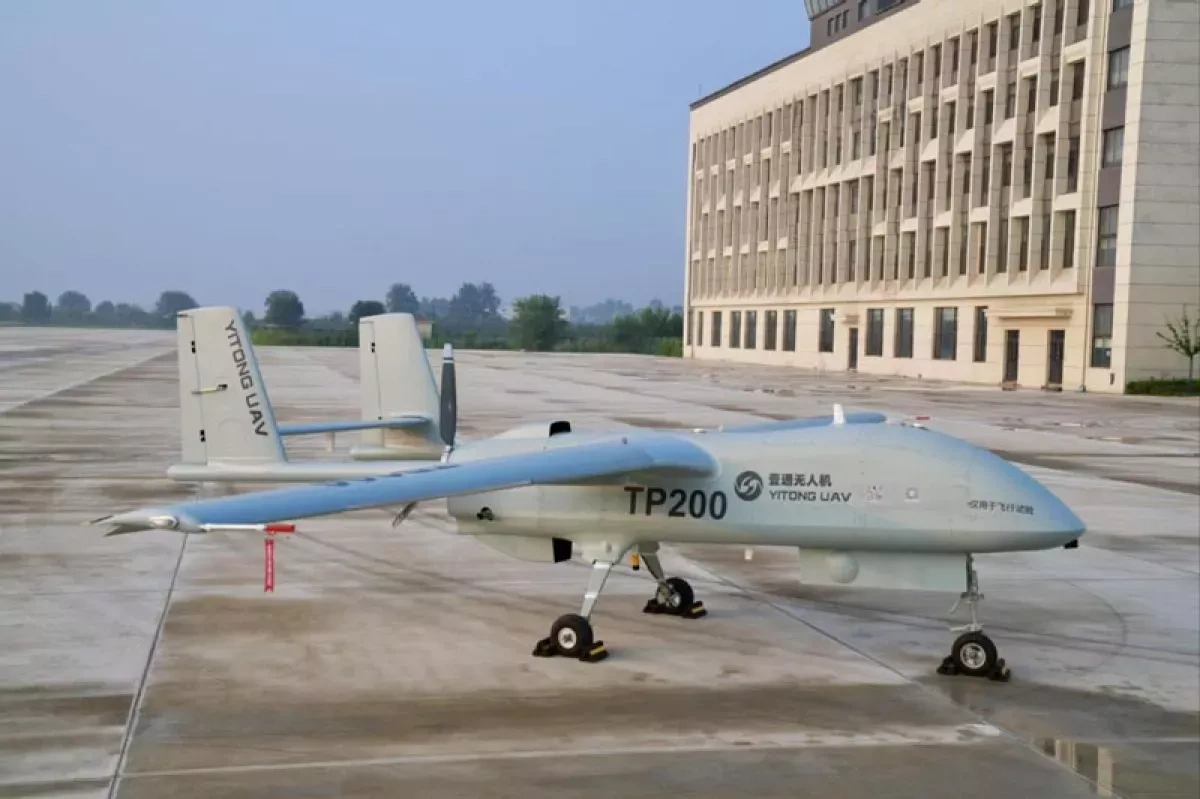
Chinese company Yitong UAV System has successfully completed the maiden flight of its TP200 multi-purpose unmanned aerial vehicle, a 700-kilogram aircraft designed for long-endurance civilian operations.
The test flight took place on July 26 in Yantai, Shandong Province. According to the company, the aircraft demonstrated stable and controllable flight, with its climb rate and speed matching projected performance.
The developers describe the TP200 as China's first multi-purpose civilian drone in its class to be designed from the outset to meet the airworthiness requirements of the Civil Aviation Administration of China, rather than being adapted to comply after the prototype had been built.
With a full payload, the UAV can remain airborne for up to 24 hours, making it suitable for long-range missions and specialised civilian applications.
The TP200 is a gasoline-powered fixed-wing aircraft featuring a high-mounted wing and a rear-mounted piston engine driving a pusher propeller. It measures 6 meters in length, has a wingspan of 10 meters, and stands 2.4 meters high.
The aircraft has an empty weight of 450 kilograms, a maximum takeoff weight of 700 kilograms, and can carry a payload of up to 200 kilograms.
Its maximum speed is 225 km/h, while its service ceiling reaches 7,620 meters. The drone can also operate from airfields located at elevations of up to 4,500 meters above sea level.
The TP200 has a maximum range of 3,000 kilometres, although this is reduced to about 2,000 kilometres when carrying its full 200-kilogram payload.
The aircraft requires a runway of only about 300 meters for takeoff and landing, can operate from unpaved airstrips, and is capable of flying in crosswinds of at least 15 meters per second. These characteristics allow it to be deployed from small islands, mountainous areas, and temporary airfields.
Its modular design enables operators to swap mission equipment depending on operational requirements.
The drone is intended for maritime patrol, search and rescue, coastal surveillance, mapping, environmental monitoring, wildfire reconnaissance, meteorological research, and cargo delivery to remote areas.
Its payload options include electro-optical cameras, LiDAR systems, meteorological instruments, maritime radar, or a cargo compartment.
Following the successful maiden flight, the aircraft will undergo an expanded testing program, further design refinements, and the certification process required to obtain airworthiness approval for routine operations in civilian airspace.
By Jeyhun Aghazada