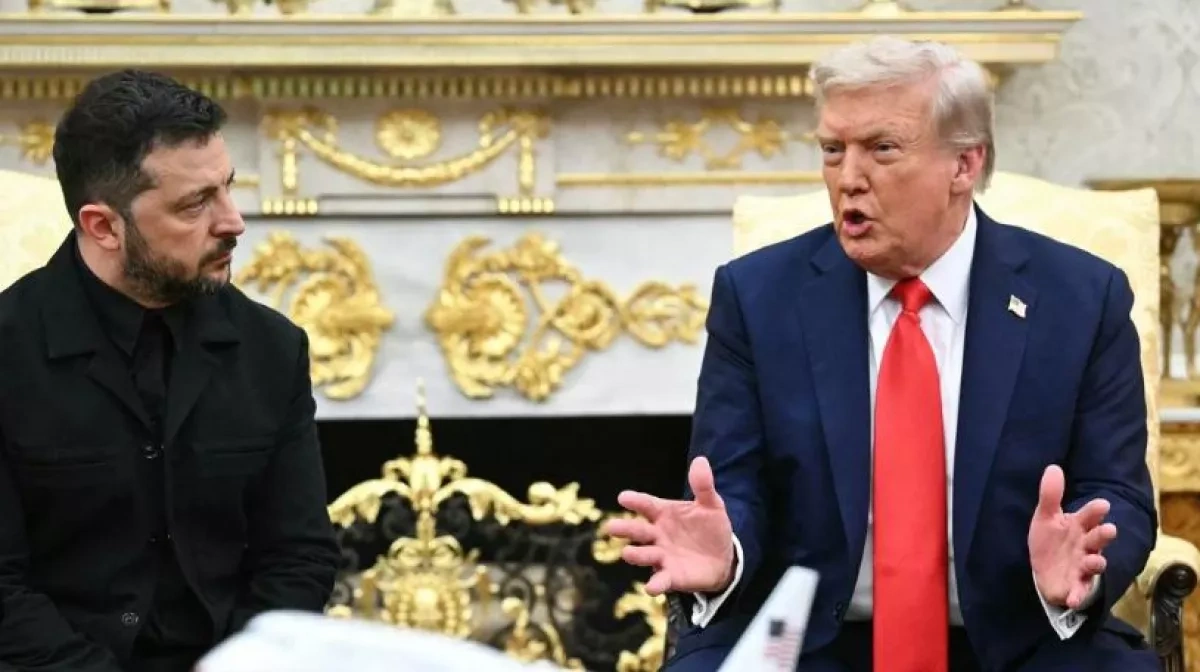
Ukrainian President Volodymyr Zelenskyy has urged US President Donald Trump to provide an emergency "winter package" of Patriot air defence interceptors, warning that Ukraine faces a humanitarian crisis if it cannot protect its energy infrastructure from Russian missile attacks before winter.
In an interview with Axios published on July 28, Zelenskyy said Ukraine’s supply of Patriot interceptors is nearly exhausted, leaving the country unable to effectively defend against ballistic missile strikes, Caliber.Az reports.
He said the shortage contributed to Ukraine’s inability to stop recent Russian attacks on Kyiv.
According to Zelenskyy, unless the issue is addressed before winter, Russian missile strikes could severely damage Ukraine’s power grid, cutting off heating for millions of people.
He also noted that the conflict with Iran has reduced U.S. stocks of Patriot interceptors, making it more difficult for Washington to supply additional missiles to Ukraine.
During the NATO summit in Türkiye earlier this month, Zelenskyy and Trump discussed granting Ukraine licenses to manufacture Patriot interceptors domestically, a move intended to reduce Kyiv’s dependence on U.S. stockpiles while expanding overall production.
Zelenskyy said Trump agreed during their Tuesday meeting to move forward with the production licenses.
Following his visit to the White House, the Ukrainian leader also met representatives of Lockheed Martin and Raytheon, the companies that manufacture Patriot interceptors, to discuss the initiative.
However, Zelenskyy acknowledged that even if Ukraine receives the necessary licenses, producing significant numbers of interceptors could take between one and five years.
"We need the Patriots yesterday," he remarked, adding that Ukraine hopes to secure 300 interceptors before winter.
In his words, Trump pledged to try to help but emphasised that meeting Ukraine’s request would be challenging because of the demand for Patriot systems linked to the conflict with Iran.
The Ukrainian president said Russia typically launches between 30 and 40 ballistic missiles during each large-scale strike against Ukraine and carries out three to five such attacks every month.
He stressed that Kyiv is prepared to share any military technology or expertise requested by the United States in exchange for additional Patriot interceptors.
Zelenskyy also revealed that Ukraine is working with U.S. defence companies on the possibility of converting domestically produced ballistic missiles into air defence interceptors with capabilities similar to Patriot missiles.
"It will be faster and cheaper," he said.
While fighting along the front line remains largely at a stalemate, Zelenskyy said Ukraine has achieved significant results through long-range drone and missile strikes targeting oil facilities and other critical infrastructure deep inside Russia.
He argued that these attacks have contributed to fuel shortages in Russia and growing public criticism of the war.
Zelenskyy further stated that Ukraine’s recent battlefield successes have also improved its relationship with Trump.
"Our relations are much better and more constructive. Not so emotional like it was. And I think that it's good that it's better," he added.
He said he had explained to Trump that Ukrainian precision strikes have avoided civilian casualties while disrupting fuel supplies in Russian-occupied Crimea and weakening the morale of Russian forces.
"People who are there and the Russian soldiers can't live without diesel and petrol. So of course, immediately in the polls, support for the war decreased in Russia," he stressed.
Zelenskyy also said U.S. diplomatic efforts to end the war have slowed since the outbreak of the conflict with Iran. He noted that Trump envoys Jared Kushner and Steve Witkoff remain in contact with both Russian and Ukrainian negotiators, although much of their attention is currently focused on Iran.
The Ukrainian president said Kushner and Witkoff are expected to visit Kyiv within the next two weeks, marking their first trip to Ukraine after several visits to Russia.
Zelenskyy expressed his intention to discuss proposals for restarting peace negotiations and give the envoys a firsthand view of conditions in Ukraine.
He said both Kushner and Witkoff continue to support achieving a ceasefire to create space for diplomacy but added that he does not believe Russian President Vladimir Putin is willing to halt the fighting.
Despite expressing scepticism about Putin’s intentions, Zelenskyy made it clear that Ukraine remains open to resuming peace talks with Russia.
He also warned that the Kremlin may be preparing to further escalate the conflict, suggesting Putin could seek to provoke other countries in the region in pursuit of "a more simple victory to sell to his audience."
Zelenskyy further claimed that Russia continues to receive weapons from Iran, is building infrastructure to accommodate an additional 30,000 North Korean troops expected to fight in Ukraine, and is receiving ballistic missiles and other military equipment from Pyongyang.
He also alleged that Moscow is quietly laying the groundwork for the possible mobilisation of another 500,000 troops.
"This is what we see," he said. "It's not the signal that he wants to stop the war."
By Bakhtiyar Abbasov