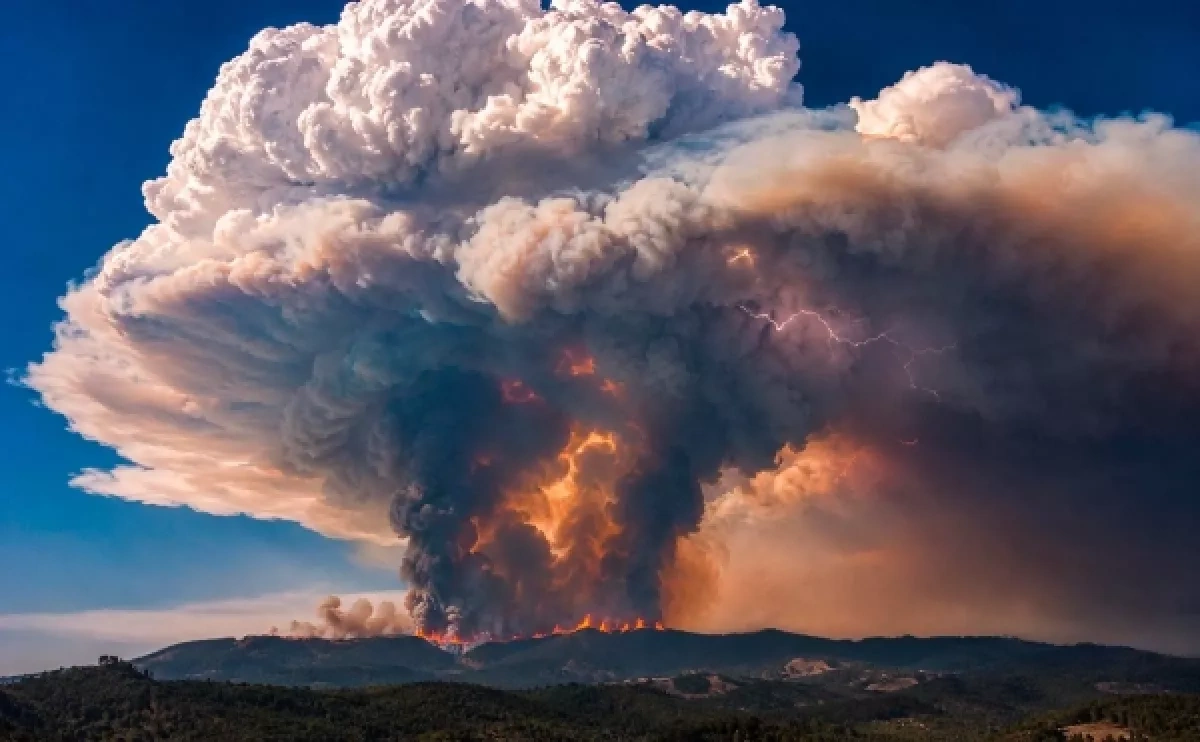
Firefighters battling large wildfires in France are facing an additional massive “fire cloud” capable of generating their own wind systems and lightning, potentially igniting new blazes.
These formations, known as pyrocumulonimbus clouds, develop above intense fires and can significantly worsen already dangerous conditions. According to French wildfire researcher Jean-Baptiste Filippi, the phenomenon is a growing concern and is linked to climate change.
Speaking to AFP as crews worked to contain a major forest fire in southwest France ahead of another expected heatwave, Filippi explained how the clouds form. “It is a storm where a column of air forms above a fire,” he said.
The process begins with a small cumulus cloud formed by condensed water vapour. As heat from the ground intensifies, the cloud expands, holding large amounts of moisture. Under sufficient heating, it evolves into a cumulonimbus cloud with a characteristic anvil shape.
“This condenses even more air and generates more energy, with updrafts of more than 150 kilometres (90 miles) an hour,” Filippi said. Although rain may form, it often evaporates before reaching the ground, cooling the air and creating powerful downdrafts.
Such fire-driven storms are more familiar in regions like Portugal, California and Australia. In Portugal, they were rare until the deadly 2017 fires in Pedrogao Grande. In France, they have only recently been observed, including a brief occurrence near Landiras, south of Bordeaux, in 2022.
“Therefore, we need to learn how to manage fires that create their own wind – this is something relatively new,” Filippi said.
He attributed the emergence of these conditions to climate change. “A consequence of global warming is more frequent heatwaves. While thunderstorms are common in the region of this fire, thunderstorm conditions after three successive heatwaves are a new combination,” he said.
Forecasting such events remains difficult. While meteorological services can predict general thunderstorm conditions, pinpointing where fire clouds will form is not possible because it depends on the exact location and behaviour of a wildfire.
“The biggest challenge is how unpredictable they are,” Filippi said, describing rapidly shifting winds during a recent fire in the Gironde region. He added that intense atmospheric energy allowed convection columns to carry embers over long distances, dramatically accelerating the spread of the fire.
“The local conditions became catastrophic, and the rate of the fire's spread was staggering,” he said.
By Tamilla Hasanova