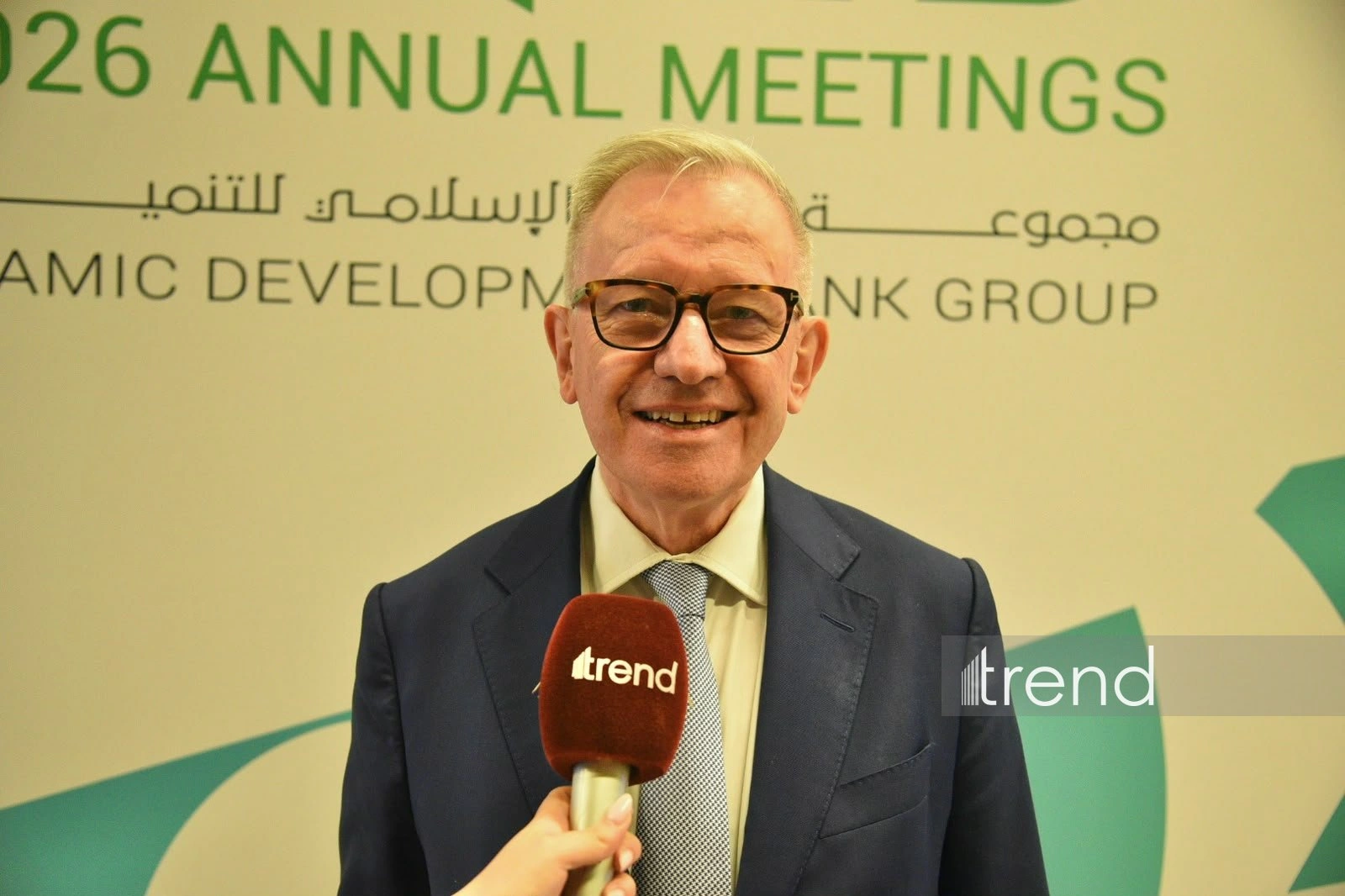
BAKU, Azerbaijan, July 16. The Asian
Infrastructure Investment Bank (AIIB) sees a real scope for
cooperation with Azerbaijan in creating a green energy hub, Sir
Sherard Cowper-Coles, Vice President and Corporate Secretary at
AIIB said in an exclusive interview with Trend.
Cowper-Coles pointed out that green infrastructure is one of the
Bank's thematic priorities alongside connectivity,
technology-enabled infrastructure and mobilizing private
capital.
"This means that, since July 2023, every new operation must be
aligned with the Paris Agreement. We also committed that climate
finance would account for half of our financing approvals by 2025 –
and have far surpassed that. Our climate financing has now reached
71% of total approved financing," he said.
The AIIB VP noted that the Bank supports Azerbaijan’s goal of
becoming a green energy hub because it aligns perfectly with its
goals.
"The clearest example in Azerbaijan is the Banka and Bilasuvar
solar project, with two plants totaling 760 megawatts, which we
signed at COP29 in Baku in 2024. The USD160 million we provided was
our first private-sector financing in the country. We worked with
Masdar as developer and SOCAR Green as the local partner, alongside
the Asian Development Bank and EBRD as co-financiers. The project
qualifies as 100% climate mitigation finance, and is expected to
eliminate about 757,000 tonnes of carbon dioxide emissions a year.
We are also tackling together the harder problem of moving clean
power across borders through the Caspian Green Energy Corridor. In
April 2025 we signed a memorandum with the ADB and the governments
of Azerbaijan, Kazakhstan and Uzbekistan to take forward the
feasibility work on cross-border electricity trade. This project
includes not only generation and transmission but also the market
of green electricity – a veritable green energy hub. This is where
we see real scope to work with Azerbaijan," he added.
Catalysing investment through standards and
partnerships
Cowper-Coles pointed out that apart from financing, AIIB
provides discipline and confidence for other investors and
partners.
"Every project we finance is prepared and supervised against our
Environmental and Social Framework, procured under international
rules, and backed by an independent route for affected communities
to raise concerns through our Project-affected People’s Mechanism.
These safeguards help make each project bankable for other partners
and lenders. A great example is the Banka and Bilasuvar solar
project I mentioned. Our involvement and triple-A balance sheet
helped bring the ADB and EBRD in as co-financiers, and gave private
capital, through Masdar, the comfort to commit for the long term.
That is the mobilization effect: our USD160 million is doing more
than its face value because it crowds others in rather than
crowding them out. For large and complex infrastructure, where the
financing is long and the risks are real, that catalytic role is
often the difference between a project that gets built and one that
stays on paper," he added.
Connectivity and Azerbaijan’s role as a strategic
partner
The VP noted that connectivity and regional cooperation are
built into the Bank's mandate.
"We interpret them broadly. For us, supporting arailway
rehabilitation or extension, a port expansion or a border-crossing
construction means better and larger trade and travel, which bring
regions closer together. The Middle Corridor, the route across the
Caspian linking Asia and Europe, has moved up everyone’s agenda,
and Azerbaijan sits squarely across it," he said.
Cowper-Coles believes that what makes Azerbaijan distinctive is
the combination of geography and intent.
"The country has invested in its own ports, roads and railways –
and it has a clear view of the regional role it wants to play. When
President Ilham Aliyev witnessed the signing our joint declaration,
he pointed specifically to the Middle Corridor, its railways, roads
and ports, as well as to metro, water and sanitation, renewable
energy and digitalization. The second pillar of the declaration,
building the next generation of transport, energy and digital
infrastructure to anchor Azerbaijan as a trade and logistics
corridor, reflects exactly that. For a bank whose job is
connectivity, a member that is itself a natural connector is a
natural partner," he added.
A programmatic framework for long-term
cooperation
"For most of our first decade we worked with Azerbaijan deal by
deal. The joint declaration we signed in Tianjin last year moves us
to a programmatic footing, and there is a clear governance logic to
that. It anchors our support in the country’s own plans, in this
case Azerbaijan’s 2030 National Priorities for Socio-Economic
Development, rather than in a series of one-off transactions," said
Cowper-Coles.
The VP noted that the declaration has three pillars:
climate-resilient infrastructure that supports decarbonization and
national climate goals; the next generation of transport, energy
and digital infrastructure; and catalyzing of private investment
through new financing models and stronger public-private
partnerships.
"This framework brings more than just a list of separate
projects. First of all, predictability, so that government and Bank
can plan together over several years. It brings consistency of
standards, because the same environmental, social and procurement
rules apply across the whole program. And it brings accountability,
because progress is measured against a shared set of objectives
that our Board, on which Azerbaijan sits, can hold us to. It is, in
short, a more mature way for a member and the Bank to work
together, and it reflects how far this partnership has come," he
explained.
A decade of AIIB–Azerbaijan partnership
Cowper-Coles noted that the Bank today has 111 approved members
and is capitalized at USD100 billion, with a triple-A rating from
all three major agencies and Azerbaijan has been part of that story
from the first day.
"It is one of the 57 founding members and has been a shareholder
and a partner ever since we started our operations in 2016.
Azerbaijan therefore has an important voice in AIIB’s governance,
which allows it to contribute to shaping the Bank’s direction and
priorities as we continue to grow together," said the VP.
He recalled that the Bank's first investment in Azerbaijan came
in 2016, a USD600 million loan for the Trans Anatolian Natural Gas
Pipeline, part of the Southern Gas Corridor.
"Since then, the relationship has broadened from energy into
transport and, most recently, private-sector renewables. Last
September, in Tianjin, the Bank and the Government signed a joint
declaration on strategic cooperation witnessed by President Ilham
Aliyev and our then-President, Jin Liqun. That is the clearest
signal yet of where we stand: a decade of solid,
project-by-project, work, and now a shared intention to do more,
and do so more strategically," Cowper-Coles added.