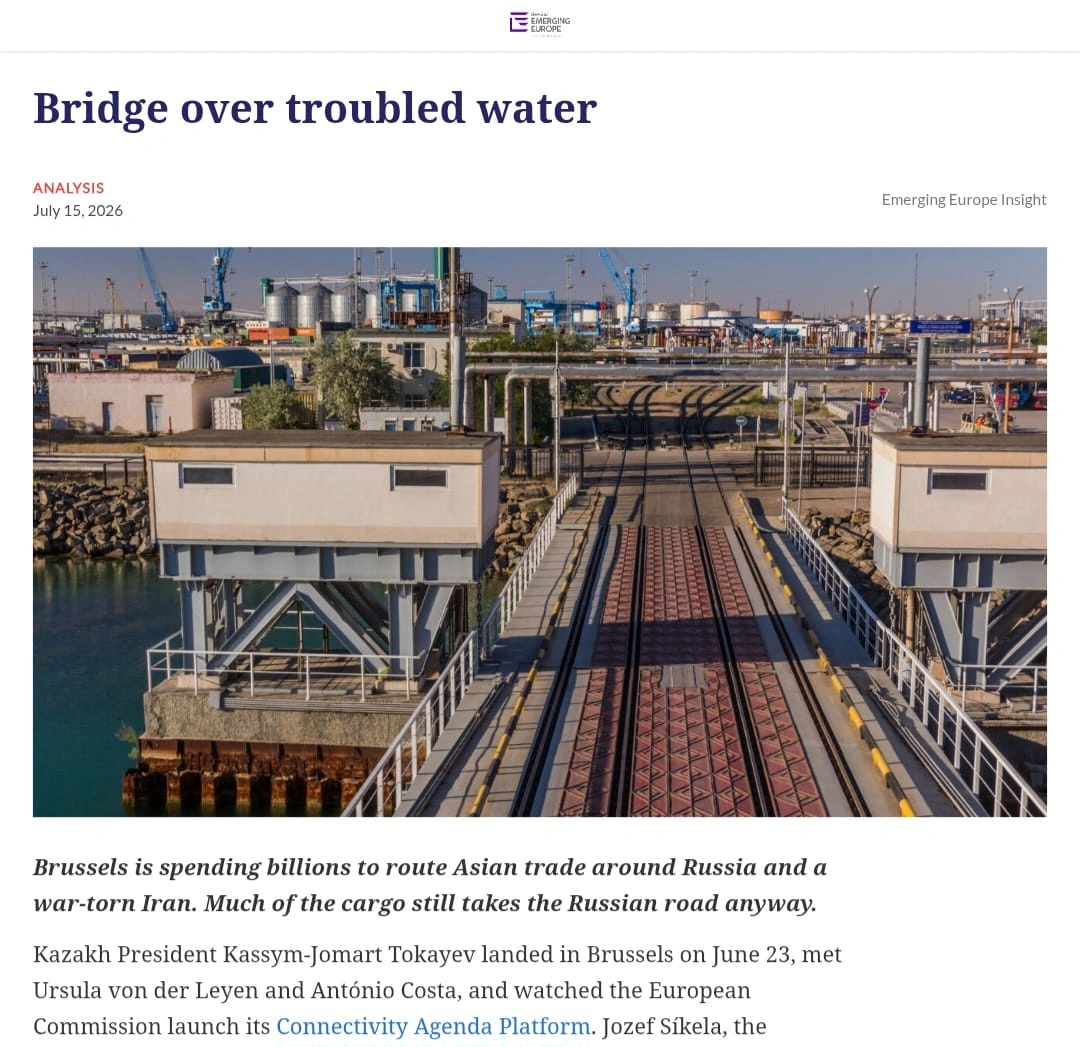
BAKU, Azerbaijan, July 15. Beyond Emerging
Europe has published an article highlighting Kazakh President Kassym-Jomart
Tokayev’s efforts to expand transport connectivity between Europe
and Asia and Kazakhstan’s role in developing the Trans-Caspian
International Transport Route, also known as the Middle
Corridor.
According to the publication, President Tokayev’s visit to
Brussels and his participation in the launch of the European
Commission’s Connectivity Agenda Platform underscored Kazakhstan’s
growing importance in strengthening alternative trade routes
linking Europe and Central Asia.
"Jozef Síkela, the commissioner for international partnerships,
called the Trans-Caspian route (or Middle Corridor) a 'vital bridge
between Europe and Asia'," the article states.
The publication notes that during a Kazakhstan-EU roundtable in
Brussels, President Tokayev highlighted the country’s investments
in transport infrastructure, saying that Kazakhstan had spent more
than $35 billion on transport and logistics development over the
past 15 years.
The article cites President Tokayev’s remarks that cargo volumes
along the Middle Corridor had increased fivefold since 2019,
reaching 4.1 million tonnes, with Kazakhstan aiming to raise annual
freight volumes to 10 million tonnes.
Beyond Emerging Europe also highlights the growing international
interest in the route amid disruptions affecting other trade
corridors, noting that the Middle Corridor has gained additional
attention due to instability in the Middle East and challenges
facing traditional maritime routes.
The publication points out that Kazakhstan has continued
expanding its logistics capabilities, including through investments
by KTZ Express in Caspian Sea shipping infrastructure and
cooperation with Azerbaijan and Georgia within the Middle Corridor
Multimodal initiative.
At the same time, the article notes that the route still faces
challenges related to infrastructure capacity, reliability, and
competitiveness compared with the northern route through
Russia.
"The Middle Corridor’s moment is unquestionably now, but it does
yet look capable of making the most of the opportunity," the
article reads.