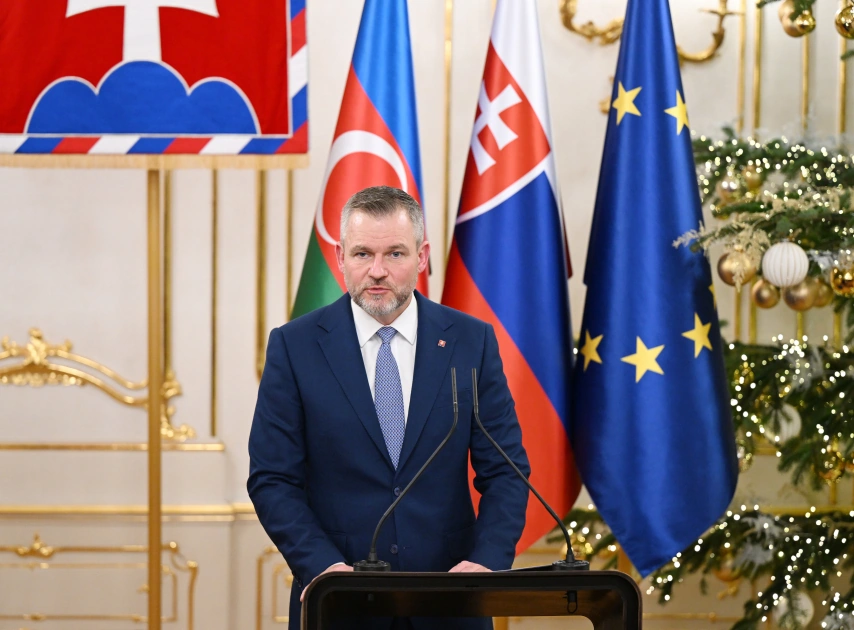
BAKU, Azerbaijan, July 12. Slovak President
Peter Pellegrini’s visit to Azerbaijan on July 13 is set to mark a
new stage in the development of strategic and friendly relations
between Baku and Bratislava.
The visit carries particular symbolic significance because it
includes a trip to Karabakh, where Slovakia is participating in the
reconstruction of Azerbaijan’s liberated territories through one of
the largest international projects currently underway — the
construction of a modern smart village.
Karabakh has become one of the clearest examples of the
practical expansion of Azerbaijani-Slovak cooperation. While energy
once served as the primary pillar of bilateral ties, the
partnership now extends to reconstruction, industry, transport,
technology, humanitarian cooperation and parliamentary
diplomacy.
A Symbolic Visit to Aghdam
One of the key elements of President Pellegrini’s program will
be a visit to Aghdam district, where he will review progress on the
Smart Village project in Bash Garvand and take part in the
foundation-stone ceremony for a new school named after Slovak
national hero General Milan Rastislav Štefánik. The establishment
of a school bearing the name of a prominent Slovak figure on
Azerbaijan’s liberated territories is being viewed as a symbol of
trust and friendship between the two countries.
The Bash Garvand Smart Village is among the largest
international reconstruction projects in Karabakh. It includes 851
individual homes, 10 apartment buildings, a school, a kindergarten,
a medical center and modern infrastructure.
During his official visit to Slovakia in December 2025, Azerbaijani
President Ilham Aliyev highlighted the importance of the
project.
“The “smart village,” which is now in the process of
construction, will be a symbol of Slovakian success in the
liberated areas. The village, which consists of 851 houses and 10
apartment buildings, as well as a school, a kindergarten, and a
medical center, will be a reflection of your achievements and a
symbol of our friendship forever,” President Ilham Aliyev said.
Those remarks have gained added significance ahead of
Pellegrini’s trip. If President Ilham Aliyev’s visit to Bratislava
represented an important milestone in bilateral relations, the
Slovak president’s visit to Karabakh demonstrates that the
agreements reached then are now being implemented on the
ground.
Slovakia’s contribution is not limited to construction.
Bratislava has also provided equipment for humanitarian demining
operations, helping clear liberated areas of mines and unexploded
ordnance and facilitating the return of former internally displaced
persons.
Strategic Partnership Expands
The official visit of President Ilham Aliyev to Slovakia in
December 2025 gave a major boost to bilateral relations.
At the time, President Pellegrini emphasized Azerbaijan’s
importance for the region.
“Slovakia views Azerbaijan as a partner of strategic importance
in the region in which it is located. Azerbaijan is the largest
economy in the South Caucasus. It is situated at the crossroads of
Asia and Europe and is rich in energy resources,” the Slovak leader
said.
President Ilham Aliyev described Slovakia and Azerbaijan as
genuinely friendly countries and strategic partners.
During that visit, the two sides signed a broad package of
agreements covering consular cooperation, animal health and food
safety, defense industry cooperation, cultural exchanges and
cooperation between Azerbaijan’s Small and Medium Business
Development Agency and the Slovak Chamber of Commerce and
Industry.
High-Level Delegation Reflects Strong
Interest
Pellegrini is accompanied by one of the most senior Slovak
delegations to visit Azerbaijan in recent years, including Deputy
Prime Minister and Defense Minister Robert Kaliňák, Deputy Prime
Minister and Economy Minister Denisa Saková, Interior Minister
Matúš Šutaj Eštok and National Bank of Slovakia Governor Peter
Kažimír.
The composition of the delegation indicates that Bratislava
views cooperation with Azerbaijan in a comprehensive way,
encompassing politics, economics, industry, investment, security
and finance.
According to the presidential office, the talks will focus on
expanding energy cooperation, supporting Slovak exports, developing
industrial and technological partnerships, improving transport
links and increasing the participation of Slovak companies in
reconstruction projects in Azerbaijan’s liberated territories.
A Slovak-Azerbaijani business forum will also be held in Baku,
bringing together business representatives from both countries to
promote trade, new partnerships and Slovak investment opportunities
in Azerbaijan.
Energy Remains the Foundation
Energy continues to be one of the main pillars of bilateral
relations. In December 2024, Slovakia became the twelfth country to
begin importing Azerbaijani natural gas. Supplies from SOCAR to the
state operator SPP started under a pilot agreement and formed part
of Europe’s broader effort to diversify energy sources.
Azerbaijan also took part in the first EU-Slovakia working group
on energy security, where both sides reaffirmed the strategic
importance of Azerbaijani gas for Central Europe and expressed
readiness to deepen cooperation in renewable energy.
Slovakia is also among the participants in the “Solidarity Ring”
initiative aimed at increasing Azerbaijani gas supplies to Central
Europe.
At the same time, energy cooperation has moved beyond natural
gas. Slovakia, which has one of Europe’s cleanest energy systems
thanks to its nuclear sector, has significant expertise in energy
efficiency. Slovak heat pumps are already being supplied to
Azerbaijan, while Slovak companies specializing in nuclear energy
and energy-efficient technologies are exploring joint projects with
Azerbaijani partners.
This cooperation has become particularly relevant following
COP29 in Baku, where energy transition and decarbonization featured
prominently on the international agenda.
Intensifying Political Dialogue
Pellegrini’s visit is part of a rapidly expanding political
dialogue between the two countries.
In May 2026, Azerbaijani Defense Minister Zakir Hasanov visited
Slovakia. The same month, Azerbaijan hosted a delegation led by
Slovak National Council Speaker Richard Raši, resulting in the
signing of a parliamentary cooperation memorandum.
Also in May, Slovak Deputy Prime Minister and Environment
Minister Tomáš Taraba visited Azerbaijan. In June, State Secretary
of the Slovak Ministry of Foreign and European Affairs Marek Eštok
traveled to Baku, where another round of political consultations
between the two foreign ministries was held.
The frequency of these contacts underscores the growing momentum
of cooperation across multiple sectors.
New Opportunities for Business and Tourism
Transport links are also being strengthened.
Beginning September 29, 2026, Europe’s largest low-cost airline,
Wizz Air, will launch direct scheduled flights between Bratislava
and Baku, operating twice weekly on Tuesdays and Saturdays.
The new route is expected to improve connectivity, facilitate
business and tourism travel and provide an additional boost to
economic cooperation.
From Political Declarations to Practical
Projects
Azerbaijani-Slovak relations are increasingly moving from
political declarations toward the implementation of concrete joint
projects.
Nowhere is this more visible than in Karabakh, where cooperation
has taken tangible form through the construction of a smart
village, humanitarian demining operations, social infrastructure
development and the involvement of Slovak companies in
reconstruction efforts.
For that reason, President Pellegrini’s visit to Aghdam is
expected to be more than a ceremonial stop. It is being viewed as
confirmation that Karabakh has become an important element of the
bilateral agenda and that the projects underway there have already
evolved into a symbol of the growing strategic partnership between
Azerbaijan and Slovakia.
The visit is expected to give fresh momentum to that partnership
and open new opportunities for expanding cooperation between the
two countries.