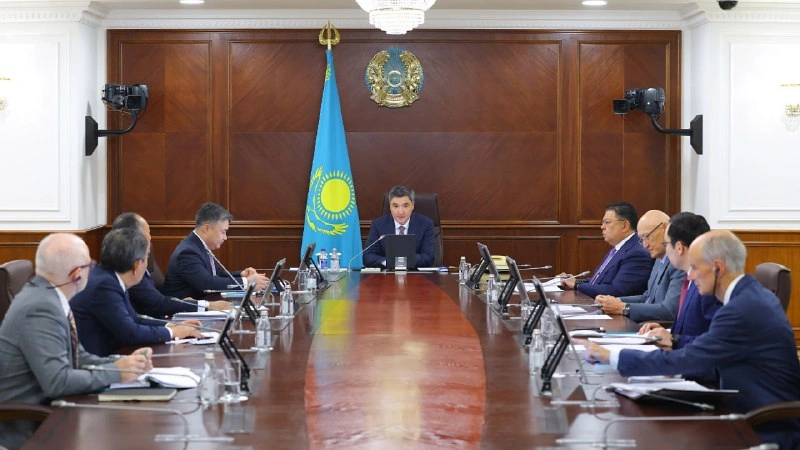
BAKU, Azerbaijan, July 10. Kazakhstan's Prime
Minister Olzhas Bektenov has chaired a meeting of the Alatau City
Council to review the implementation of President Kassym-Jomart
Tokayev's instructions on the development of the new city and the
rollout of its special legal regime, according to the government's
press service.
During the meeting, participants discussed the implementation of
the Constitutional Law "On the Special Legal Regime of Alatau City"
and further steps to advance the Alatau City project.
"With the Constitutional Law 'On the Special Legal Regime of
Alatau City' entering into force in line with the provisions of the
new Constitution, the Alatau City project is expected to become one
of the drivers of Kazakhstan's economic development in accordance
with the President's instructions. Therefore, the main task of the
Alatau City Council is to ensure the timely and effective
implementation of the special legal regime," Bektenov said.
During the meeting, Chief Executive Officer of Alatau City
Authority Alisher Abdykadyrov presented the organization's current
activities and development plans. Work is underway to establish the
city's regulatory framework, prepare strategic planning documents,
build a modern public administration system, attract investment and
support investment projects.
Infrastructure development is also continuing in Alatau's
existing settlements, including the Yntymaq, Qoyanqus, Zhetigen,
Zhanadauir and Zhanatalap districts.
He noted that by the end of this year, authorities plan to
complete the city's Long-Term Development Plan through 2055, the
Development Strategy and the Master Plan through 2040 with the
participation of international consulting firms ARUP and BCG.
The meeting also reviewed several flagship initiatives,
including K-Smart City, Alatau AI-Driven City and Alatau Crypto
City. The projects envisage the creation of a 330-hectare smart
district based on South Korean technologies, deployment of AI, Big
Data and a digital twin for real-time city management, as well as
the development of tokenization projects and a Web3 ecosystem.
According to the Alatau City Authority, the city has compiled a
portfolio of 53 investment projects worth 2 trillion tenge (about
$4.2 billion), expected to create around 51,000 jobs. Major
projects include the over $1 billion Iconic Complex, production
facilities for PepsiCo, Mars and Hyundai Green Food, the Khan
Tengri Biopharma plant, urban air mobility projects with AutoFlight
and Joby, and the construction of a KAIST university campus.
The authority also plans to launch the first tokenization
projects by the end of 2026, attract residents and establish an
integrated virtual and real economy ecosystem.
Following the meeting, the Council approved the regulations
governing the Alatau City Authority, transforming the state fund
into a specialized government body responsible for managing and
developing the city.
The Council also approved the establishment of an Operational
Committee to address urgent issues and a Regulatory Commission to
adopt legal acts and introduce international best practices under
the city's special legal regime.
In addition, members supported the creation of a Temporary Land
Relations Commission under the Alatau city administration to
oversee land-related transition issues and facilitate priority
investment projects until the city's Master Plan is approved.
Bektenov instructed government agencies and the Alatau City
Authority to accelerate work on the project's key development
priorities.