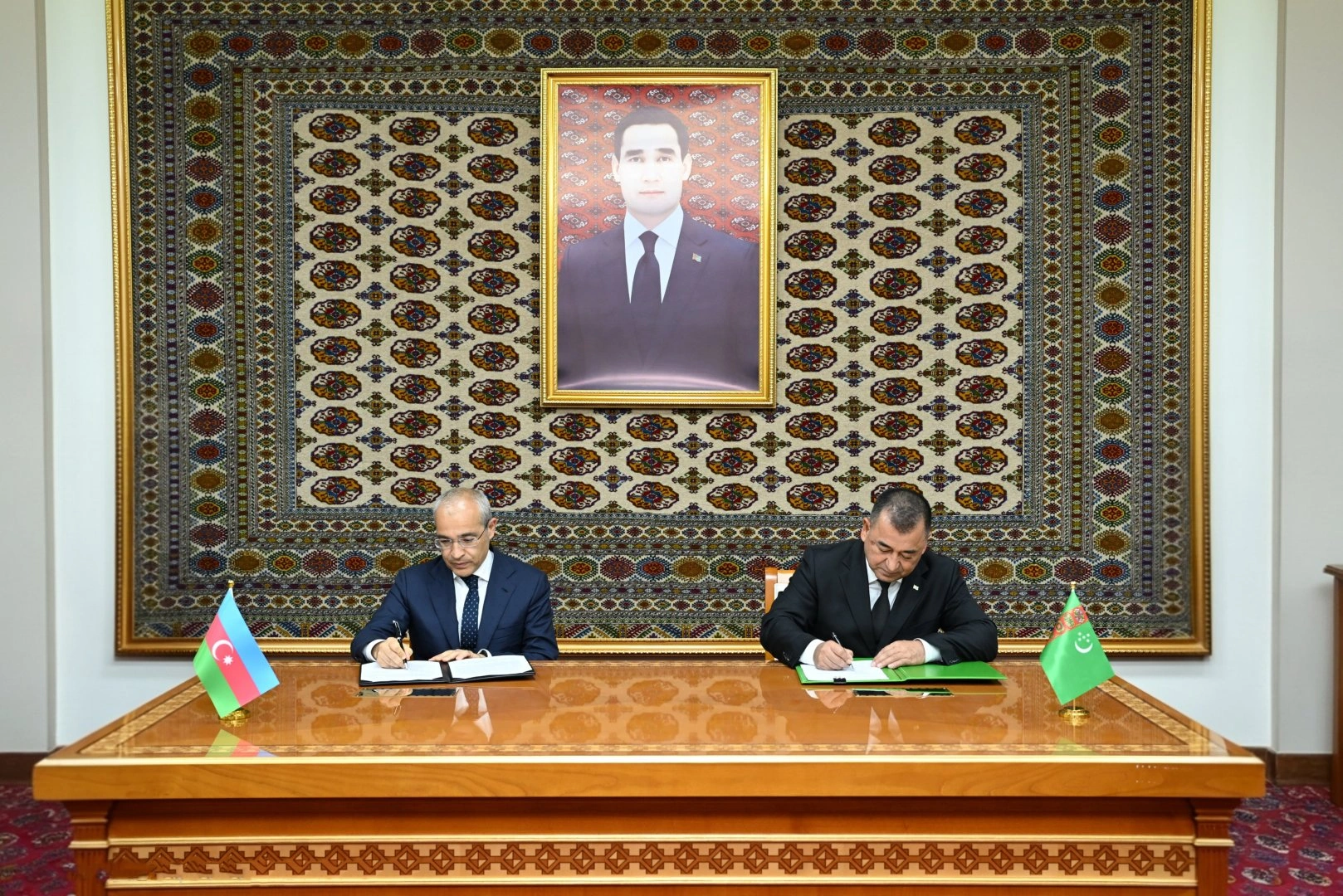
BAKU, Azerbaijan, July 10. On July 8, Ashgabat
hosted the 9th meeting of the Joint Intergovernmental Commission on
Economic Cooperation between Azerbaijan and Turkmenistan. Following
the meeting, the parties signed the relevant protocol, discussed
expanding cooperation in trade, energy, transport, industry,
agriculture, environmental protection and finance, and agreed to
accelerate the establishment of the Azerbaijan-Turkmenistan
Business Council. During the visit, Azerbaijan's Minister of
Economy Mikayil Jabbarov was also received by President of
Turkmenistan Serdar Berdimuhamedov, who emphasized the steady
development of bilateral partnership and reaffirmed Ashgabat's
readiness to further expand economic cooperation.
The meeting in Ashgabat became a direct continuation of the
agreements reached during President of Turkmenistan Serdar
Berdimuhamedov's state visit to Azerbaijan on June 22-23. During
the visit, Presidents Ilham Aliyev and Serdar Berdimuhamedov signed
a Joint Statement, while the governments of the two countries
concluded a package of agreements covering energy, industry,
transport, maritime shipping, investment and customs cooperation. A
separate symbol of this new stage of engagement was Azerbaijan's
transfer of the Dostlug oil tanker to Turkmenistan, highlighting
the two countries' intention to expand cooperation not only at the
political level but also through practical collaboration in Caspian
logistics and energy.
Following the talks in Baku, the two presidents also stressed
the need to intensify the work of the Intergovernmental Commission
on Economic Cooperation, viewing it as the main mechanism for
implementing the agreements reached. Against this backdrop, the
latest meeting in Ashgabat can be regarded as the first practical
step toward translating the political decisions made in June into
interagency coordination and concrete joint projects.
Against this backdrop, economic cooperation between Azerbaijan
and Turkmenistan has demonstrated steady positive momentum in
recent years. Bilateral trade approached $303 million in 2024,
while Azerbaijani exports to Turkmenistan exceeded $80 million. The
upward trend continued in 2025: trade turnover reached $140.2
million in the first half of the year, including $30.3 million in
Azerbaijani exports and $109.8 million in imports from
Turkmenistan. By the end of July, total trade had increased to
approximately $154 million.
At the same time, the bilateral agenda has long extended beyond
trade. Azerbaijan and Turkmenistan have been steadily expanding
cooperation in transport, transit, energy, industrial cooperation
and Caspian maritime shipping. Energy collaboration, including the
development of the Dostlug field, continues to play an important
role. Maritime logistics cooperation has also gained additional
momentum following President Serdar Berdimuhamedov's state visit to
Baku.
As a result, bilateral economic relations are gradually evolving
into a more comprehensive partnership encompassing not only trade
but also joint infrastructure, energy and logistics projects. This
trend largely explains the growing attention both countries are
paying to building mechanisms for long-term economic
cooperation.
The latest meeting marked the first practical stage following
the high-level agreements reached in June. While the state visit
defined the strategic directions of cooperation, the parties are
now moving toward establishing mechanisms for their implementation.
The signed protocol, the decision to develop the
Azerbaijan-Turkmenistan Business Council and the involvement of
relevant ministries and agencies create an institutional framework
for supporting joint projects, transforming political agreements
into a permanent format of economic cooperation.
The intensification of bilateral economic cooperation also
coincides with what Trend previously described as the beginning of
Turkmenistan's new investment cycle. In recent months, the country
launched the fourth phase of development of the Galkynysh gas
field, signed a new production sharing agreement with PETRONAS for
offshore Blocks 19 and 20 in the Turkmen sector of the Caspian Sea,
expanded its petrochemical industry, continued developing transport
infrastructure and steadily advanced new export routes. At the same
time, Turkmenistan is implementing its 2026-2028 State Program for
Socio-Economic Development and Investments, which envisages
large-scale modernization of industry, logistics and the
manufacturing sector.
Under these conditions, demand is growing not only for financing
new projects but also for partners capable of participating in
their implementation. This largely explains why
Azerbaijan-Turkmenistan relations are evolving from discussions of
individual initiatives toward building sustainable mechanisms for
economic cooperation. For Azerbaijani businesses, this creates an
opportunity to enter projects at a stage when investment activity
in Turkmenistan is only beginning to accelerate, while for Ashgabat
it offers access to additional expertise, technologies and
logistics capabilities needed to implement its national development
agenda.
For this reason, the current intensification of cooperation
should be viewed as part of a broader process. As investment
activity in Turkmenistan gathers pace, relations between the two
countries are gradually evolving from trade and individual joint
initiatives toward a more comprehensive economic partnership based
on long-term business cooperation, investment and the joint
development of regional logistics.