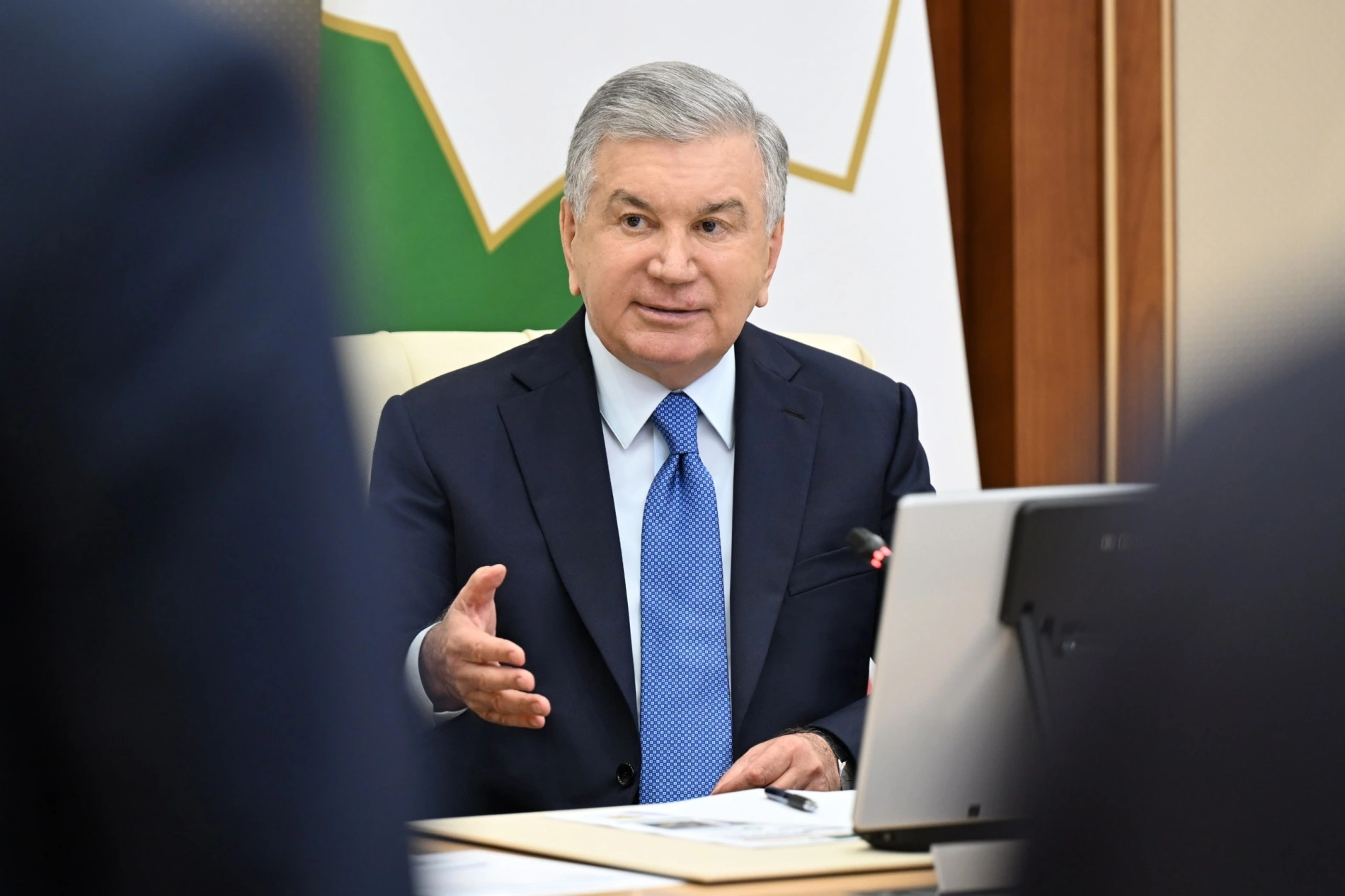
BAKU, Azerbaijan, July 6. President Shavkat
Mirziyoyev has reviewed a set of proposals aimed at combating
desertification, advancing a desert economy, and introducing “green
city” principles across the country .
This was reflected in the statement published by the press
service of the Uzbek president.
The presentation highlighted that climate change, water
scarcity, land degradation and desertification are becoming
increasingly urgent environmental challenges for the region,
directly affecting agricultural sustainability, food security,
public health and overall economic development. Around 80% of the
country’s territory consists of desert and semi-desert zones, where
salinization, and movement, dust storms and dry winds pose
significant risks, particularly in Karakalpakstan, Bukhara, Navoi,
Khorezm, as well as parts of Kashkadarya, Surkhandarya and Jizzakh
regions.
It was noted that the drying of the Aral Sea has further
intensified environmental pressures, leading to the formation of
the Aralkum desert. In response, large-scale afforestation efforts
continue in the Aral Sea region, including the planting of saksaul
and other desert-adapted species. Over the past years, more than 2
million hectares of forest plantations have been established on the
dried seabed.
Under the nationwide “Yashil Makon” program, more than 1 billion
trees and shrubs have been planted, increasing the country’s green
coverage from 8% in 2020 to 14.3% in 2025. Expansion of green belts
and protective plantations is also ongoing in arid and border
regions.
Looking ahead to 2026–2030, the proposals include restoring and
establishing forests across 1.27 million hectares and creating
16,000 hectares of protective green belts in desert, mountain and
foothill areas. Plans also include a 10,000-hectare green cover in
Surkhandarya, an 84-kilometer “green wall” in Syrdarya’s border
areas, and pilot applications of modern agro-technologies on
degraded lands.
The President emphasized that desert areas should not be viewed
solely as an environmental challenge, but also as a source of new
economic opportunities. The concept of a “desert economy” was
highlighted, focusing on income generation from unused and saline
lands through desert plant seed production, nursery development,
cultivation of halophytes, pasture improvement, livestock
expansion, eco-tourism, and scientific research.
Additional initiatives include establishing desert plant
nurseries in Karakalpakstan, conducting scientific expeditions to
the dried Aral seabed, expanding pistachio plantations in the
Babatag area, and developing halophyte gardens. A regional seed and
drought-resistant plant bank is also planned, alongside efforts to
attract international funding and private investment.
Regional cooperation was also emphasized, with presentation
underlining that desertification and land degradation require a
coordinated Central Asian response. Proposals include expanding the
Central Asian Regional Research Center for Desertification Control
and Desert Economy Development, strengthening joint projects under
the “Green Shield” program, and developing a long-term strategy
through 2040.
A major focus of the presentation was the transformation of
Samarkand into a model “green city” under the “Green Samarkand”
initiative. By 2030, the plan targets significant environmental
improvements, including preventing 51,200 tons of air pollutants,
cutting PM2.5 and PM10 particles by 50%, reducing construction dust
by 80%, halving transport-related emissions, and increasing urban
green zones to 30%.
A dedicated project office, “Yashil Samarkand,” will coordinate
implementation across urban development, transport, industry,
tourism, and utilities. The city will introduce strict green
building standards, expand electric public transport with 50
electric buses, modernize traffic infrastructure, and gradually
transition taxis and public transport to electric vehicles by
2030.
Other measures include the creation of artificial lakes and
fountains, restoration of irrigation canals, and the development of
a 102.7-kilometer green belt around the city. A 300-hectare “Green
City Samarkand” zone is also planned, along with the relocation of
environmentally harmful industrial facilities outside urban
areas.
Waste management reforms under a “Zero Waste Samarkand” model, a
carbon neutrality roadmap, and digital environmental monitoring
platforms are also part of the strategy. Tourism and biodiversity
initiatives will promote green hotels, urban biodiversity indices,
and eco-tourism branding.
"The President of our country approved the proposals and issued
relevant instructions to the responsible officials regarding
combating desertification, the rational use of land and water
resources, strengthening environmental requirements in urban
planning, and creating a healthy environment for the population."
the press service said in the statement.
In conclusion, President Mirziyoyev approved the proposals and
issued directives to strengthen efforts in combating
desertification, improving land and water management, tightening
environmental standards in urban development, and ensuring a
healthier living environment for the population.