BAKU, Azerbaijan, July 4. Azerbaijan maintains
the leadership in the South Caucasus for the development of
unmanned air vehicle (UAV) systems.
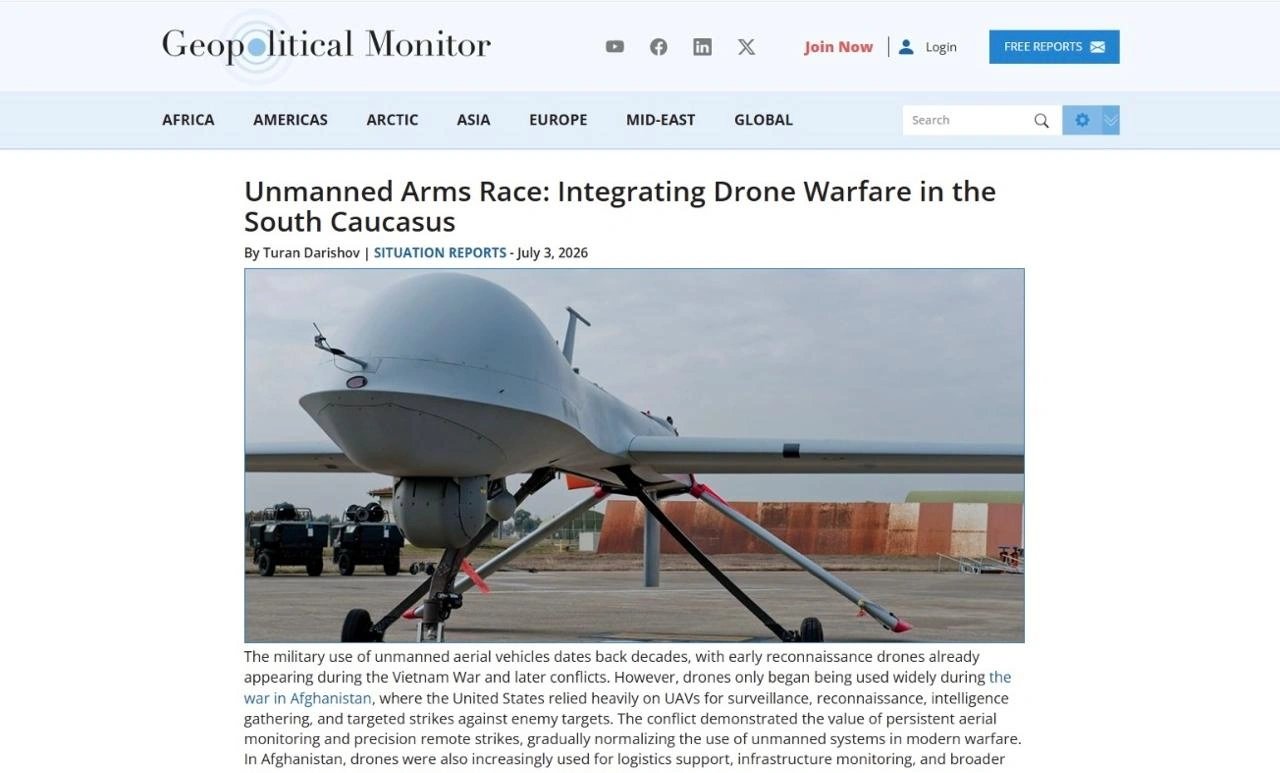
This was announced in an article titled "Unmanned Arms Race: Integrating
Drone Warfare in the South Caucasus" published on Geopolitical
Monitor portal.
"The use of drones leaped even further during the 2020 Karabakh
War between Azerbaijan and Armenia, which became the first major
interstate conflict where unmanned systems played a central
battlefield role. Azerbaijan’s extensive use of Turkish Bayraktar
TB-2 drones, Israeli loitering munitions, and reconnaissance UAVs
demonstrated how deadly drones can be against armored vehicles,
artillery systems, and air defenses. This conflict sealed UAVs as a
vital part of the modern battlefield," the publication said.
According to the article author, Azerbaijan remains the most
advanced and institutionally developed drone operator in the South
Caucasus.
"The country continues actively expanding its unmanned warfare
capabilities through both procurement and domestic development
efforts. In recent years, Azerbaijan adopted several new drone
systems into service, including domestically produced UAVs such as
the “İti Qovan.” Azerbaijan’s leading defense producer “Azersilah”
is also actively involved in UAV design and production efforts.
Alongside local production initiatives, Azerbaijan continues
operating a diverse fleet of Turkish and Israeli unmanned systems,
including Bayraktar TB-2 and Akıncı drones, while also showing
interest in acquiring additional advanced UAV platforms in the
future. The country also established dedicated training and
maintenance facilities for Akıncı drones," the publication
noted.
The article emphasized that the military cooperation framework
established with Türkiye under the 2021 Shusha Declaration further
strengthened cooperation in defense technologies, training, and
military-industrial development.
The author also highlighted Azerbaijan's seeking to deepen
cooperation with Turkish defense companies beyond simple
procurement by exploring possibilities for joint drone production
and broader defense-industrial collaboration with Baykar
company.
"In recent years, sides signed cooperation agreements and
memorandums regarding technology exchange, industrial cooperation,
and potential localized production of Baykar systems in Azerbaijan.
One of the most important developments, which received little
international attention, was the formal establishment of dedicated
Unmanned Systems Troops within the Azerbaijani Armed Forces.
Azerbaijan’s expanding drone capabilities are also supported by
steadily increasing military expenditure. The country’s defense
budget grew from approximately $2.24 billion in 2020 to a planned
$5.1 billion in 2026, reflecting Baku’s continued emphasis on
military modernization and technological development," the article
noted.
The publication stressed that the South Caucasus remains one of
the regions where the importance of unmanned systems is most
visible.
"The experience of the Karabakh wars, followed by the lessons
emerging from Ukraine, demonstrated to regional actors that drones
are a crucial weapon in 21st century warfare. Azerbaijan currently
stands out as the clear regional leader in drone warfare
integration due to its domestic production, diversified
procurement, and creation of dedicated unmanned systems structures.
Armenia, largely motivated by the lessons of defeat in 2020, is
rapidly attempting to modernize and diversify its military
capabilities with increased emphasis on drones. Georgia, despite
possessing some domestic production initiatives, lags significantly
in practical adaptation," the publication pointed out.
Overall, the author made a conclusion that drone adaptation will
remain one of the most important military modernization trends in
the South Caucasus in the coming years.