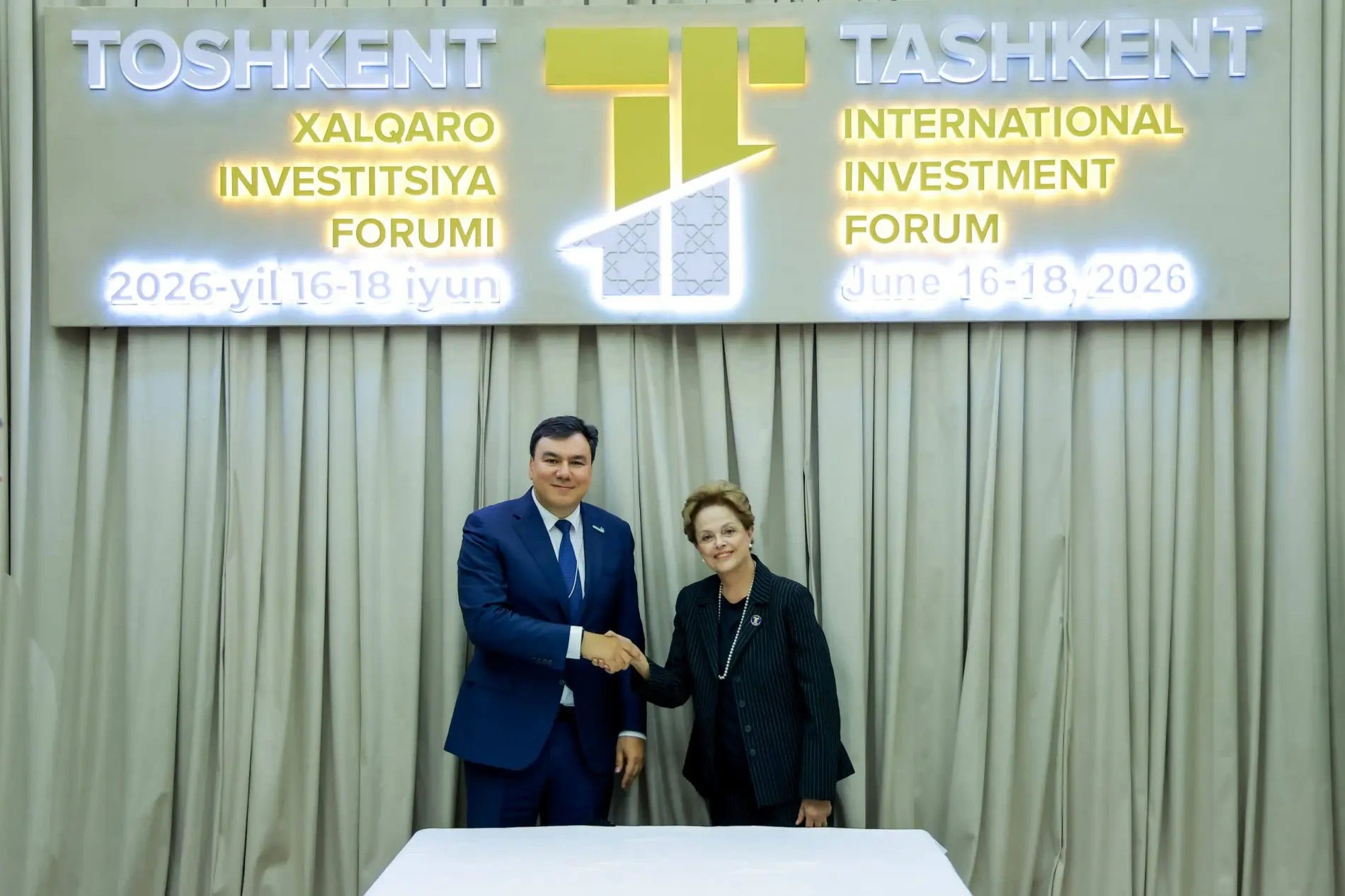
BAKU, Azerbaijan, June 22. Uzbekistan is
seeking to expand cooperation with BRICS, international financial
institutions and regional organizations on climate resilience,
environmental protection and sustainable development.
This was reflected in the statement by the National Committee on
Ecology and Climate Change of Uzbekistan, following a series of
meetings held on the sidelines of the Tashkent International
Investment Forum.
Aziz Abdukhakimov, presidential adviser on environmental issues
and chairman of Uzbekistan's National Committee on Ecology and
Climate Change, held talks with leaders of international
organizations and financial institutions focused on green
investment, desertification mitigation and climate adaptation.
One of the key meetings took place with Dilma Rousseff,
president of the BRICS New Development Bank (NDB). The parties
discussed opportunities to expand cooperation in financing green
economy projects, sustainable infrastructure and climate adaptation
initiatives.
Abdukhakimov highlighted the country's ongoing reforms aimed at
building a green economy and strengthening climate resilience.
"Uzbekistan attaches great importance to the New Development
Bank as a leading multilateral financial institution supporting
sustainable development and environmental transformation. Under the
leadership of President Shavkat Mirziyoyev, we are implementing
large-scale reforms aimed at building a green economy,
strengthening climate resilience and achieving the Sustainable
Development Goals," Abdukhakimov said.
The discussions covered potential cooperation in renewable
energy, sustainable water management, environmental protection and
climate adaptation. Particular attention was given to investment
projects that could support Uzbekistan's environmental agenda and
enhance climate resilience across Central Asia.
During the meeting, Uzbek side presented the country's
environmental goals through 2030, including plans to plant one
billion trees and shrubs, expand protected natural areas to 21% of
national territory, establish dendrological parks in every region,
increase waste recycling rates to 40%, reduce pollutant emissions
and improve environmental education among young people.
The Uzbek side also showcased its environmental education and
research ecosystem centered around Green University, the Central
Asian University for Environmental and Climate Studies, which
coordinates research institutes, scientific centers and specialized
green technical schools.
The parties additionally discussed projects aimed at restoring
degraded land, combating desertification and improving
climate-resilient water management. Among the initiatives presented
was a project focused on rainwater harvesting systems and
water-saving technologies designed to improve water-use efficiency
amid climate change.
Separately, Abdukhakimov met with Balazs Hendrich, executive
director of the Organization of Turkic States (OTS) Representation
Office, and Laszlo Orloci, chairman of the supervisory board of the
OTS Drought Prevention Institute.
The talks focused on implementing environmental initiatives
proposed by President Shavkat Mirziyoyev during the informal OTS
summit in Shusha, Azerbaijan, including the establishment of a
Turkic Environmental Council headquartered in Nukus, a region
heavily affected by the Aral Sea environmental crisis.
The parties discussed cooperation on climate adaptation, drought
prevention, land degradation and dust storm mitigation. Uzbekistan
presented plans to establish national and regional early-warning
systems for sand and dust storms, as well as a National Climate and
Hydrometeorology Center that would integrate climate data,
meteorological information and scientific research to support
climate risk management.
Discussions also covered drought monitoring, risk assessment,
forecasting models and the use of remote sensing technologies and
climate analytics. Particular interest was expressed in launching
pilot projects in desertification-prone areas, especially the Aral
Sea region, and expanding knowledge-sharing and specialist training
programs.
Abdukhakimov also invited representatives of the Organization of
Turkic States to participate in Eco Expo Central Asia 2027, which
will be held in Tashkent alongside the Tashkent International
Investment Forum.
As part of the exhibition, Uzbekistan proposed creating a
"Desert Economy Startup Corner" to showcase innovative startups and
technological solutions focused on combating desertification,
restoring degraded land, improving water efficiency and promoting
sustainable economic development in arid regions.