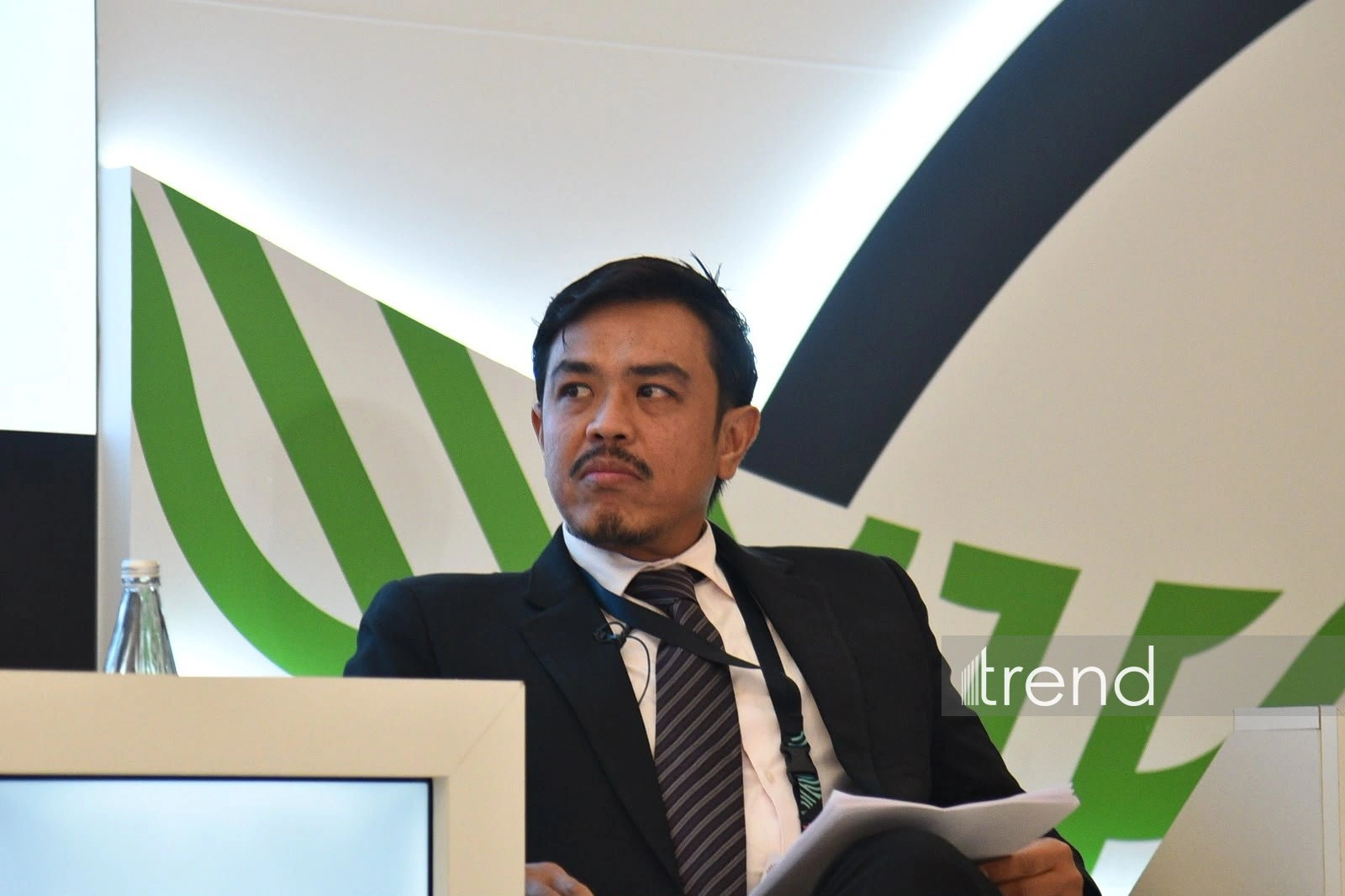
BAKU, Azerbaijan, June 16. The halal industry
develops through the unification of government, business, and
partners, Special Officer at the CEO's Office of the Halal
Development Corporation (HDC) of Malaysia, Mohamad Hadi Bin Hamzah,
said during the 14th Islamic Development Bank (IsDB) Group Private
Sector Forum held in Baku, Trend's correspondent reports from the event.
"The key to developing the halal industry is consolidating the
efforts of government agencies, businesses, and regional partners,
which allows consumer trust to be transformed into a significant
economic resource," he clarified.
According to him, the development of the halal industry in
Malaysia began primarily with the need to ensure consumer
confidence in products and ingredients that meet Islamic
requirements.
"Initially, halal certification was purely about trust. The
first official documents were issued to confirm that products and
services met halal standards. However, over time, we saw that halal
has become not only a matter of religious compliance but also an
important commercial factor," he noted.
Hamzah emphasized that in recent decades, international
companies have begun actively implementing halal standards, viewing
them as a competitive advantage in the global market.
"We have seen major international brands and multinational
corporations increasingly integrating halal requirements into their
operations. This has signaled that halal has become a fully-fledged
economic value for products and services," said the HDC
representative.
He noted that the Halal Development Corporation was established
in 2006 with the goal of developing national capacity in this area
and supporting local producers.
"We had significant resources, a developed supply chain, and a
raw material base, but we were not fully exploiting our potential.
The creation of the HDC allowed us to consolidate these
capabilities, stimulate new product development, and introduce
Malaysian halal products to international markets," Hamza
emphasized.
According to him, today the halal economy accounts for
approximately 10% of Malaysia's gross domestic product.
Approximately 12,000 companies operate in the industry.
He also noted that the halal industry ecosystem in Malaysia is
being formed with the participation of approximately 300 government
agencies, industry associations, non-governmental organizations,
export agencies, and business associations.
"The key lesson we've learned is the need for convergence. By
this, we mean the ability of government agencies to work together
within a unified industry strategy, as well as strengthen
cooperation at the regional level. This is the model that will
ensure sustainable growth in the halal industry," Hamzah added.
According to him, Southeast Asian countries, including
Indonesia, Thailand, Vietnam, and the Philippines, are currently
forming one of the most dynamic centers of the halal economy,
accounting for a significant share of global consumption and halal
production.