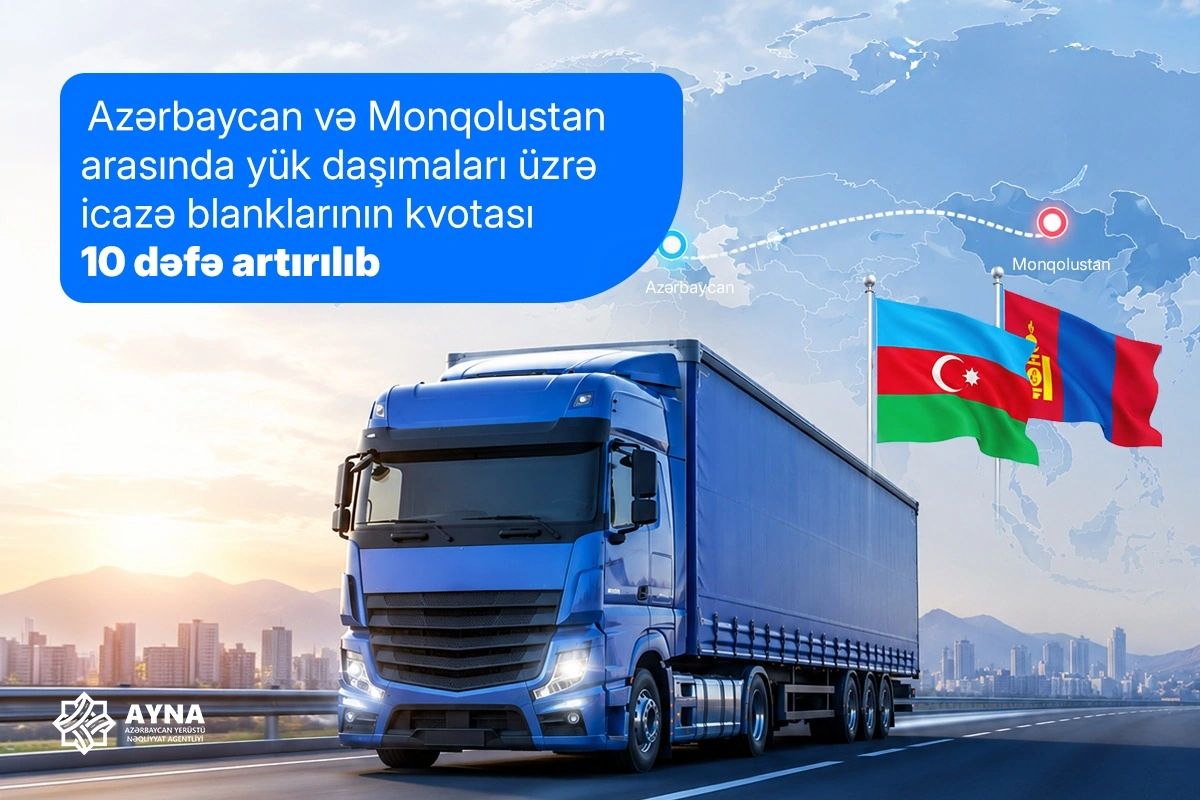
BAKU, Azerbaijan, June 16. The quota for cargo
transportation between Azerbaijan and Mongolia has been increased
by 10 times.
This was announced in the report by the Azerbaijan Land
Transport Agency.
According to the report, for 2026, an additional 2,000 permit
forms for bilateral transportation, 250 for transit transportation,
and 400 for transportation to/from a third country will be
exchanged between the two countries.
The report noted that the first-ever bilateral meeting in the
field of international road transport was held in Baku between the
Azerbaijan Land Transport Agency and the Department for
Coordination of Road Transport Policy of the Ministry of Road and
Transport of Mongolia.
The meeting was attended by representatives of the State Customs
Committee, the Azerbaijan International Road Carriers Association
(ABADA), and national carriers.
During the discussions, views were exchanged on the current
state of international road freight transport between Azerbaijan
and Mongolia, transit potential, expansion of cooperation, and
issues faced by carriers.
As a result of the meeting, important agreements were reached
that will give impetus to the development of international freight
transport. According to the decision, an additional 2,000 permit
forms for bilateral transport, 250 for transit transport, and 400
for transport to/from a third country will be exchanged for
2026.
In addition, the initial permit quota for 2027 was set at 2,000
for bilateral transportation, 250 for transit transportation, and
450 for transportation to/from a third country. Thus, the number of
permit forms exchanged between the two countries for international
cargo transportation has increased 10 times compared to the
previous period.
The parties also stated that the demand for permit forms by
carriers will be fully met in the current and subsequent years.
An important agreement was also reached during the meeting on
the electronic exchange and use of permit forms. For this purpose,
it is planned to establish a joint technical working group and
start work on the project from July 1.
The introduction of the electronic system will simplify the
process of obtaining and using permits, reduce operational costs
and time losses, and enable more transparent and prompt
transportation.
The parties also agreed on the implementation of a direct and
flexible coordination mechanism between the relevant institutions
for the prompt resolution of issues arising during international
cargo transportation.