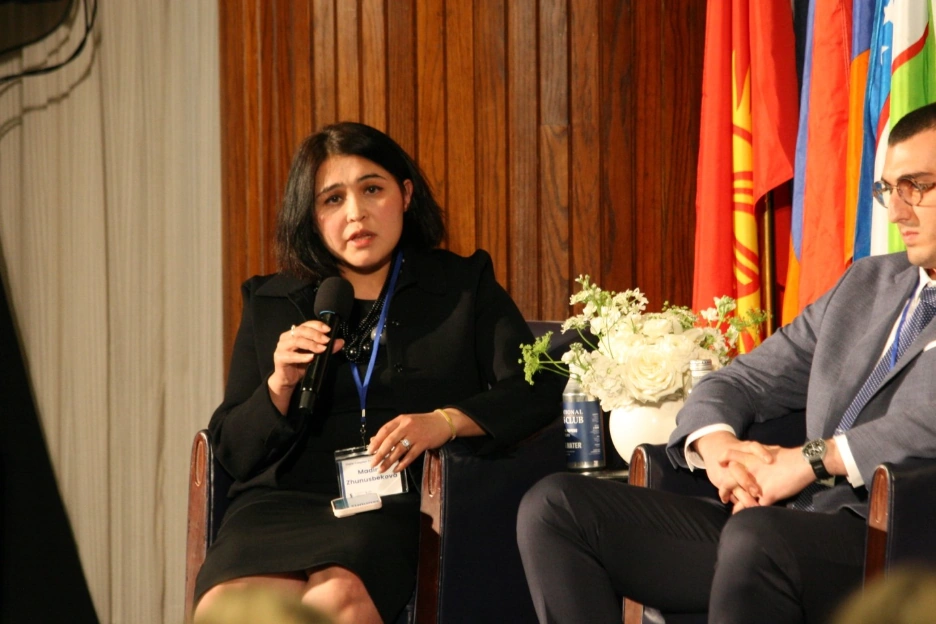
BAKU, Azerbaijan, June 12. The Middle Corridor
is an important matter for investors, Madina Zhunusbekova, Senior
Advisor to the Executive Director at the International Monetary
Fund (IMF) said.
“We can expand the Middle corridor. In my personal opinion,
right now the challenge is not the vision of the Middle Corridor,
but the coordination and adapting to new challenges. At
international finance institutions, we often say downside and
upside risk. The region has been very resilient, stable, and
growing. With all the geopolitical uncertainty going around, in
some regards, the Middle Corridor could be seen as an upside risk,”
she said, speaking at the 10th anniversary Trans-Caspian Forum,
held by the Caspian Policy Center in Washington, DC on June 10.
Zhunusbekova believes that right now is a good moment to enter
the region because the governments are very interested in
attracting new investors and in providing even more guarantees to
them.
She pointed out that Central Asian economies and Middle Corridor
countries have shown remarkable resilience, and resilience is right
now a currency, which is very good for investors to see.
The Middle Corridor is a transport and trade route that passes
through a number of countries in the region and connects Asia with
Europe. It serves as an alternative to the traditional Northern and
Southern Corridors.
The route begins in China and runs through the countries of
Central Asia. It then crosses the Caspian Sea, Azerbaijan, Georgia,
and Türkiye, before reaching Europe. The Middle Corridor is a land
route that bypasses longer sea routes, connecting the eastern
regions of Asia, including China, with Europe.
The IMF earlier said that the conflict in the Middle East could
lead to an increase in transit traffic along the Middle
Corridor.
"An escalation of the conflict in the Middle East could lead to
a further decline in tourist flows from Israel and the Gulf
countries, intensify inflationary pressures, and tighten financial
conditions. “A more protracted conflict could lead to a redirection
of financial and tourist flows toward Georgia, as well as an
increase in transit through the Middle Corridor,” the fund’s report
states.
In May 2025, Thanos Arvanitis, Deputy Director of the IMF’s
Middle East and Central Asia Department, said during the media
roundtable at the Central Bank of Uzbekistan that the development
of the Middle Corridor could bring substantial economic gains to
the region, but realizing its full potential will require strong
cooperation and sustained investment.
"Clearly, the Middle Corridor and investing in it could create
positive spillovers for all the countries connected to it," he
said. "It would facilitate trade, support economic diversification,
and therefore, it is very important for this regional cooperation
to continue to ensure that the investment is carried through".
He emphasized that effective implementation of the corridor
would depend on joint efforts by all participating states and the
mobilization of external funding. "Strong cooperation would be
critical to realizing this corridor and would, of course, require
coordinated efforts among all the countries, as well as
international financing to be raised for it," Arvanitis noted.