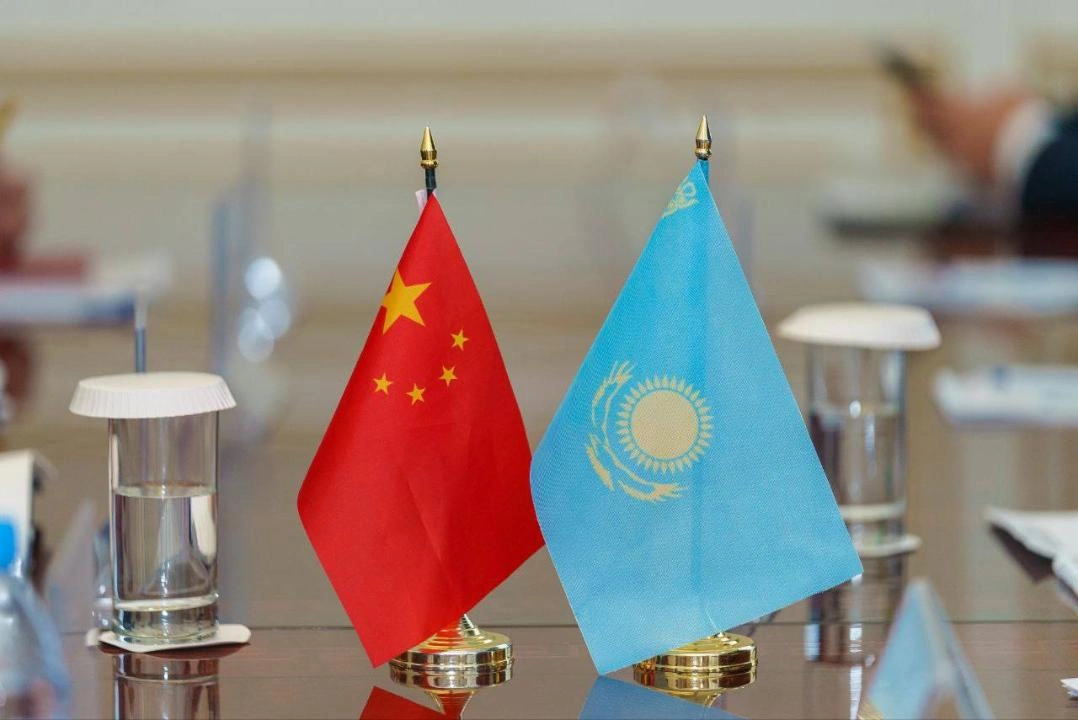
BAKU, Azerbaijan, June 8. Economic cooperation
between Kazakhstan and China continues to develop dynamically. In
early June, the Chief Executive of the Hong Kong Special
Administrative Region of the People's Republic of China made a
historic first-ever visit to Kazakhstan. John Lee arrived with a
massive delegation comprising 75 officials and entrepreneurs
representing a wide spectrum of industries, including logistics,
green energy, mining, innovation, technology, and education.
Today, particular emphasis in bilateral relations is placed on
industrial cooperation, investments, and joint infrastructure
projects. Over the past 20 years, Kazakhstan has attracted more
than $445 billion in foreign direct investment, including about $30
billion from China. Meanwhile, the volume of investment from Hong
Kong into the republic's economy reached nearly $740 million. A
representative office of the Hong Kong Trade Development Council
(HKTDC) is already operating in Almaty, actively contributing to
the strengthening of business ties between the business communities
of the two countries.
By the end of last year, trade turnover between the countries
reached a record $48.7 billion. China also became Kazakhstan's
largest trading partner in the first quarter of 2026: the volume of
mutual trade amounted to $7.8 billion, which corresponds to 23.8%
of the republic's total foreign trade turnover. Compared to the
same period last year, the figure grew by 30%.
Astana seeks to utilize cooperation with Beijing not only to
expand foreign trade but also to develop industry, modernize
transport infrastructure, and attract investment. The localization
of manufacturing facilities within Kazakhstan is gaining increasing
importance.
Among the latest major projects is the construction of a
metallurgical complex in the western part of the country. In April
2026, plans were announced for Fujian Hengwang Investment to invest
$1.2 billion in creating a modern metallurgical enterprise in
Kazakhstan's Zhambyl. The project's implementation will take place
in two stages—by 2027 and 2029. Upon reaching full capacity, the
plant will be able to produce up to 3 million tons of steel
annually.
In the energy sector, JSC NC KazMunayGas and CITIC Construction
reached an agreement on cooperation for the construction of the
Karachaganak gas processing plant.
Another significant project was the launch of the construction
of a urea production plant. Kazakhstan's national oil and gas
company, KazMunayGas (KMG), and China National Petroleum
Corporation (CNPC) have begun implementing this urea (carbamide)
production project in the Aktobe Region. The enterprise is planned
to be located near the Zhanazhol gas processing plant, which will
provide the project's raw material base—up to 600 million cubic
meters of commercial gas per year. The future plant's design
capacity will reach up to 800,000 tons of urea annually, and the
total investment volume is estimated at $1.25 billion.
An additional impetus to cooperation was provided by the recent
visit of the Hong Kong delegation to Astana, following which the
parties signed 42 agreements in various areas of interaction.
In parallel, the export of Kazakh products to China is
developing. In January–March 2026, its volume reached $3.5 billion,
which is 45.8% more than a year earlier, when the figure stood at
$2.4 billion. The agro-industrial complex is playing an
increasingly vital role in the structure of supplies. In
particular, Kazakhstan has strengthened its position as one of the
leading suppliers of sunflower oil to the Chinese market, securing
local producers access to a massive consumer base and contributing
to the growth of non-commodity exports. Following the results of
2025, the republic ranked sixth in the world for sunflower oil
exports and second among suppliers of this product to China.
Additional opportunities for cooperation are also opening up in
the financial sphere. One of the most promising instruments is the
issuance of so-called "panda bonds," allowing Kazakh issuers to
raise financing on the Chinese debt market and diversify capital
sources.
On June 1, a grand ceremony marking the listing of the debut
issuance of the Republic of Kazakhstan's sovereign panda bonds took
place on the AIX Exchange platform. By placing securities worth 3.4
billion yuan with a yield of 1.9%, Kazakhstan set a record,
achieving the lowest placement rate among BBB-rated countries and
matching performance levels comparable to states with an AA
rating.
Connecting to this financial infrastructure opens new avenues
for attracting Chinese capital, expands the access of Kazakh
investors to one of the world's largest debt markets, and fosters
further integration of the financial systems of Kazakhstan and
China.
At the same time, sustainable economic development requires
maintaining a balance in foreign economic policy. China's high
share in Kazakhstan's foreign trade objectively strengthens the
interdependence of the two countries, which is why diversification
issues remain highly relevant. Any changes in the economic
environment of the PRC can reverberate across adjacent markets and
trade flows in the region.
This is precisely why Kazakhstan is simultaneously expanding
cooperation with the European Union, Central Asian states, Türkiye,
and Middle Eastern countries. This approach allows for the
mitigation of risks associated with excessive concentration in a
single direction and helps form a more resilient system of
international economic ties.
Special attention is paid to supporting domestic business in the
face of competition with large foreign manufacturers. Concurrently,
the development of the Trans-Caspian International Transport Route
continues. This route plays a crucial role in delivering goods
between China and Europe while maintaining its multilateral
character and attracting investments not only from China but also
from Europe, Türkiye, and other countries.
Overall, the development of relations between Kazakhstan and
China demonstrates a transition toward a deeper and more
comprehensive format of interaction. Utilizing the advantages of
its geographical position and the investment potential of the
neighboring country, Kazakhstan aims to strengthen its industrial
base, develop logistics infrastructure, and simultaneously preserve
the multi-vector character of its economic policy.