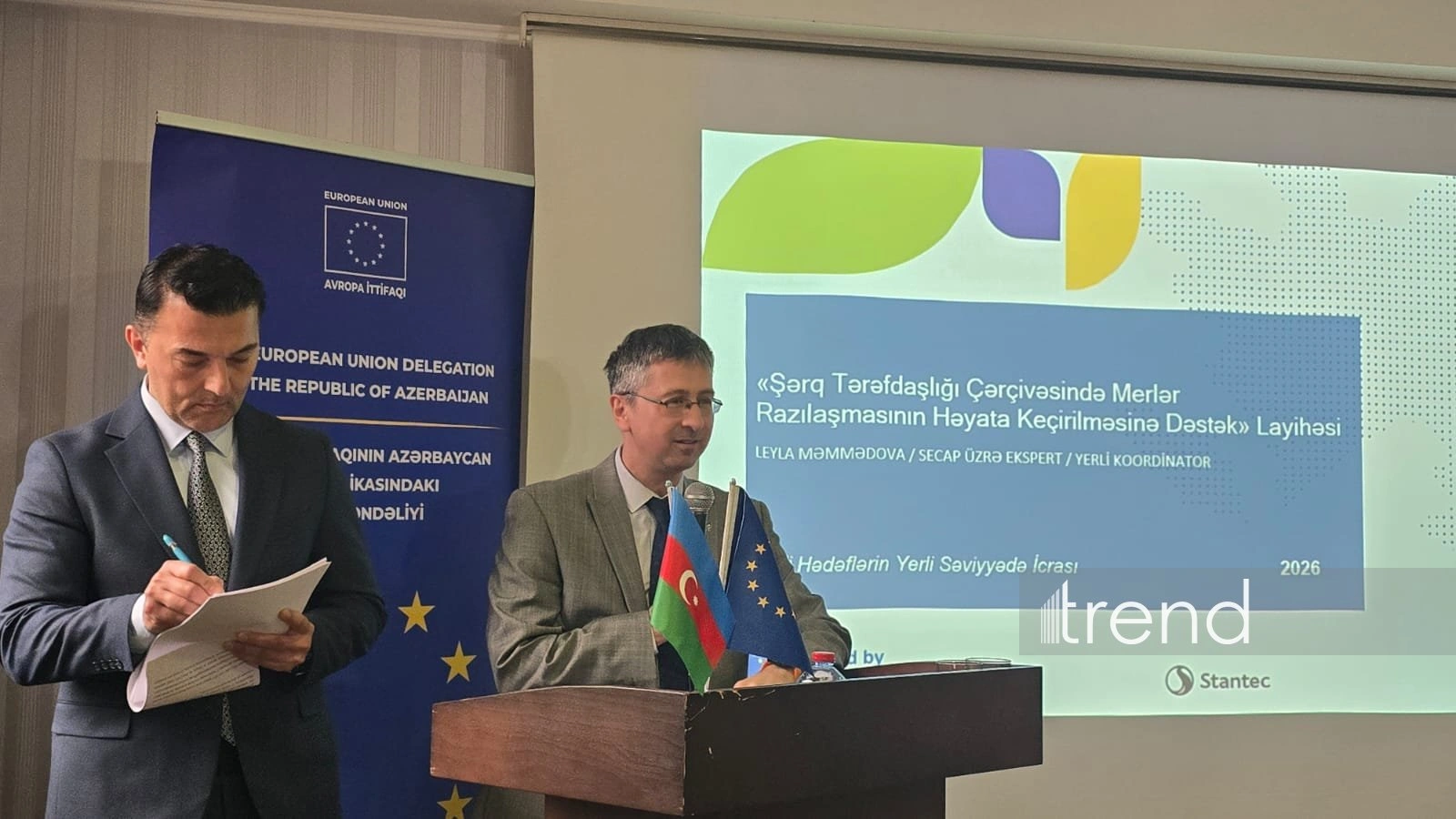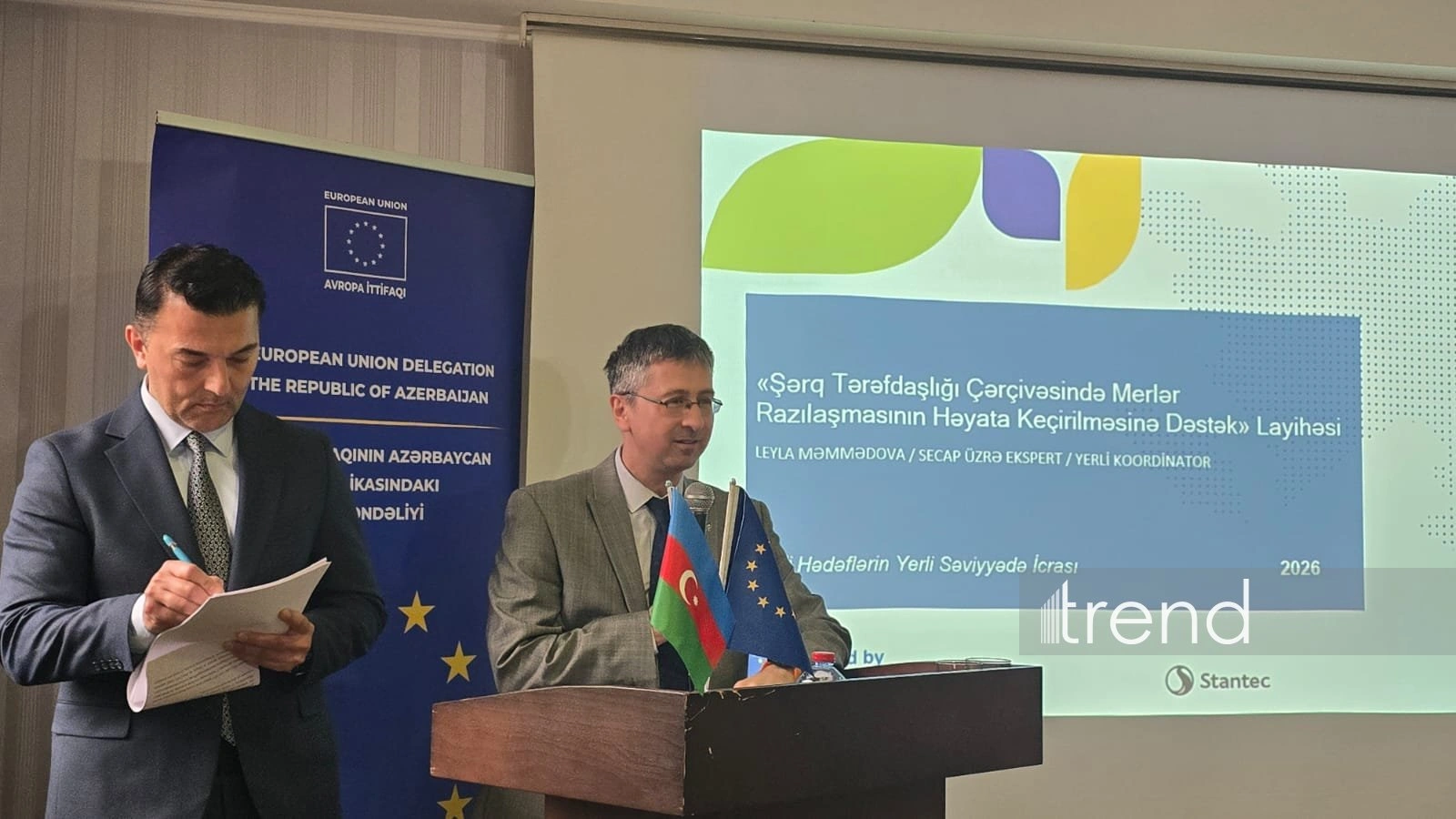
GANJA, Azerbaijan, June 5. The European Union
(EU) and Azerbaijan partnership ushers in a new stage, Head of
Cooperation Section at the EU Delegation, Victor Bojkov, said at a
media briefing on the 30th anniversary of the EU-Azerbaijan
partnership and projects implemented in Ganja, Trend reports.
According to him, the bilateral agreement signed between the EU
and Azerbaijan in 1996 remains in force today.
"However, as the world has changed politically, economically,
and geopolitically, the parties are working to move relations to a
new phase. Therefore, the existing cooperation framework is being
updated and adapted to modern challenges," he noted.
Bojkov pointed out that the phrase "30 years of partnership"
refers not only to the past, but also to the continuity of future
cooperation.
"This is not just a completed 30 years, but an ongoing
partnership," he emphasized.
The official recalled that intensive negotiations were held
between the EU and Azerbaijan in Baku on June 2-3.
The EU was represented at the meetings by the Deputy Director of
the External Action Service, and Azerbaijan by the Deputy Foreign
Minister. The main goal of the negotiations was to raise
partnership relations to a higher level and prepare a new bilateral
agreement.
Bojkov noted that negotiations on the new agreement are ongoing,
and time is still needed to sign the document.
At the same time, priority areas of cooperation have already
been identified. These areas include the environment, coordination
and connectivity projects, healthcare, academic research,
people-to-people relations, and "green cities" initiatives.
He highlighted that the projects implemented in Ganja are also
part of this cooperation framework.
"The goals and ambitions that the European Union and Azerbaijan
have jointly set are also reflected in Ganja. The projects
implemented in the city are the practical results of this
partnership," he added.
According to Bojkov, the financing of projects is carried out in
two main directions.
The first direction is the grant projects allocated to
Azerbaijan by the EU through international organizations.
The second direction is investment projects. Within the
framework of these projects, financial resources are provided in
the form of loans to government agencies or, specifically, to the
Ganja City Executive Power and municipal structures.
According to him, investment projects include larger financial
packages.
The EU’s flagship initiative, “European Village 2026,” is
scheduled to take place in Ganja on June 6.
Dedicated to the theme “EU-Azerbaijan: 30 Years of Partnership,”
the event is organized by the EU Delegation to Azerbaijan in
cooperation with the embassies of EU member states and with the
support of the Ganja City Executive Authority.
The official opening ceremony will be held on June 6 with the
participation of the ambassadors of the EU and its member states
accredited to Azerbaijan. Prior to the opening, a tree-planting
ceremony will take place in Heydar Aliyev Park.
The program will feature face painting, puppet performances,
board games, quizzes, mini-competitions, and music and dance
activities for children.
In addition to the EU Delegation, representatives of Belgium,
Bulgaria, Croatia, the Czech Republic, France, Germany, Greece,
Hungary, Latvia, Lithuania, the Netherlands, Poland, Romania,
Slovakia, Spain, and Sweden will participate in the event.