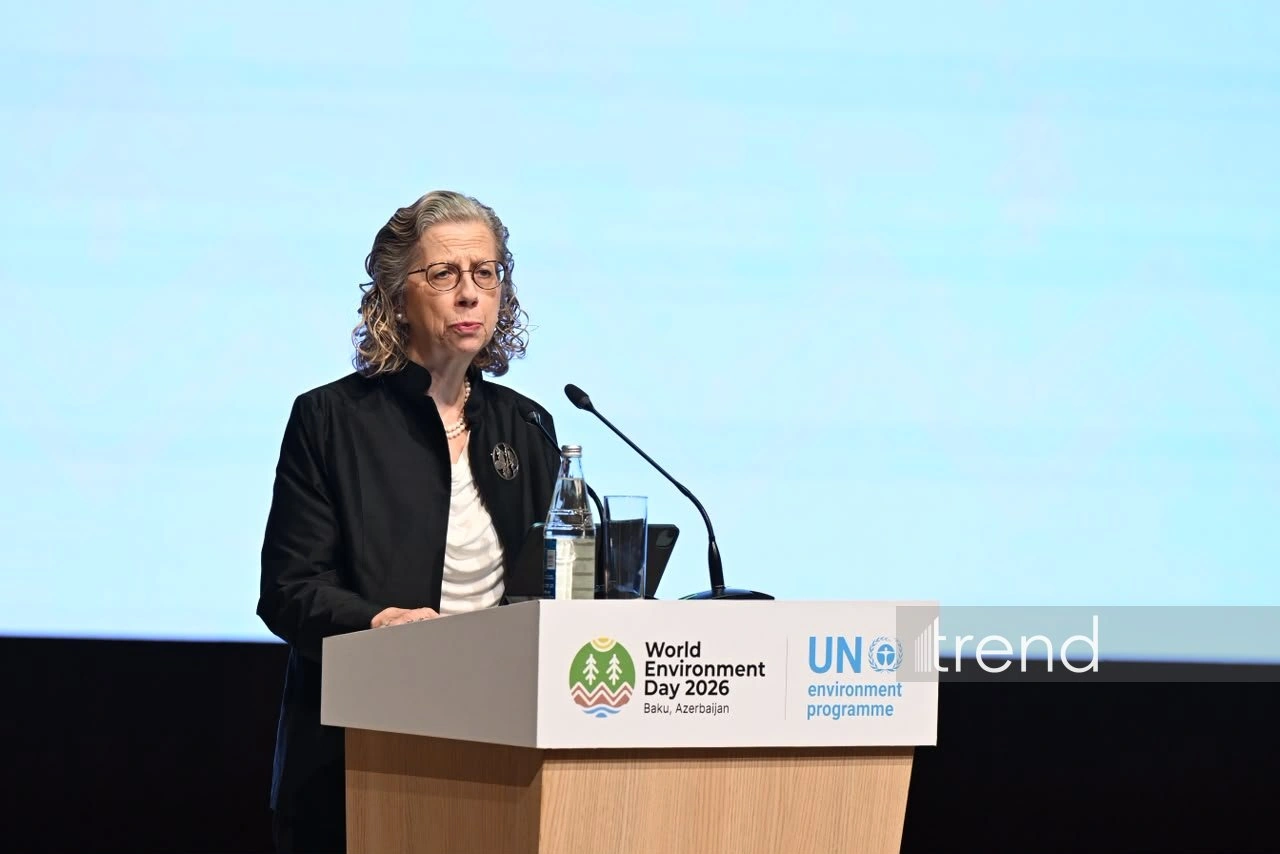
BAKU, Azerbaijan, June 5. Like other countries,
Azerbaijan faces serious climate challenges, Inger Andersen,
Executive Director of the United Nations Environment Programme
(UNEP), said at an international conference marking World
Environment Day in Baku today, Trend reports.
She added that Azerbaijan continues to play an important role in
combating climate change at the global, regional, and national
levels.
According to her, hosting COP29 contributed to achieving the
goals of the “Baku commitment” and the “Baku outcomes”:
“The climate negotiations held in Baku in 2024 led to an
agreement to mobilize $300 billion in climate finance by 2035.
Recently, Baku also hosted the World Urban Forum, which focused on
climate resilience and the connection between cities and nature.
Today, we have gathered here to strengthen our resolve and take
practical steps in the fight against climate change. Climate change
is a global problem that must be at the forefront of each of our
minds. Global temperatures are rising, and the consequences of
climate change are becoming increasingly severe. The Earth is
sending us signals — heat waves, droughts, floods, desertification,
and sand and dust storms are manifestations of these signals.
These consequences affect everyone, but the poor and vulnerable
segments of the population suffer the most. Azerbaijan, like other
countries, faces serious climate challenges. The degradation of
mountain ecosystems and the drop in the water level of the Caspian
Sea are having a significant impact on ports, economic activity,
fisheries, infrastructure, and coastal communities.
“However, this should not lead to despair. This is not the story
we are writing to be desperate – the story has not yet been
written, and the pen is in our hands. We can shape this future,”
she noted.
The UN representative stated that the rise in global
temperatures is likely to exceed the 1.5-degree Celsius limit set
in the Paris Agreement in the near future.
“Therefore, we must work even harder to return to that level by
the end of the century, while simultaneously protecting communities
and countries, especially small island developing states, from the
more severe and frequent impacts of climate change.
This means a just, orderly, and equitable transition away from
fossil fuels in our energy systems. This requires urgent and
large-scale investment and the implementation of all available
solutions. It also means, as promised in Baku, robust financing,
effective adaptation measures, early warning systems, and
strengthened disaster preparedness. Multilateral cooperation on
climate change can make this happen. “When the Paris Agreement was
adopted in 2015, global temperature rise was projected to reach 3.5
degrees. Azerbaijan is also sending important signals on climate
change,” she added.